

When patients need a dentist, they reach for their phone. Over 77% of patients use search engines like Google when looking for healthcare providers, including dentists. If your dental practice isn’t appearing prominently in local search results, you’re invisible to the majority of potential patients actively seeking dental care in your area.
The stakes are high: 78% of local mobile searches result in offline visits within 24 hours. That means when someone searches “dentist near me” or “emergency dental Sydney,” they’re not just browsing—they’re ready to book. This comprehensive guide covers everything Australian dental practices need to dominate local search and attract more patients.
Why SEO Matters for Dental Practices
Dental services are inherently local. Patients choose dentists based on proximity, convenience, and trust—all factors that local SEO directly influences. When your practice ranks at the top of Google’s local pack and organic results, you’re positioned as the obvious choice for nearby patients.
The numbers speak for themselves:
- 77% of patients start their search for a dentist on Google
- 78% of local mobile searches lead to an in-person visit within 24 hours
- Patients are 37.7% more likely to click on top organic search results
- Google Business Profile listings with complete information receive 7x more clicks
Unlike traditional advertising that interrupts people, SEO captures patients at the moment they’re actively looking for dental services. This intent-driven traffic converts at significantly higher rates than any other marketing channel.
Google Business Profile: Your Most Important Asset
For dental practices, Google Business Profile (formerly Google My Business) is the cornerstone of local SEO success. Your GBP listing determines whether you appear in the local map pack—those three prominent business listings that appear for local searches with a map.
Optimising Your Google Business Profile
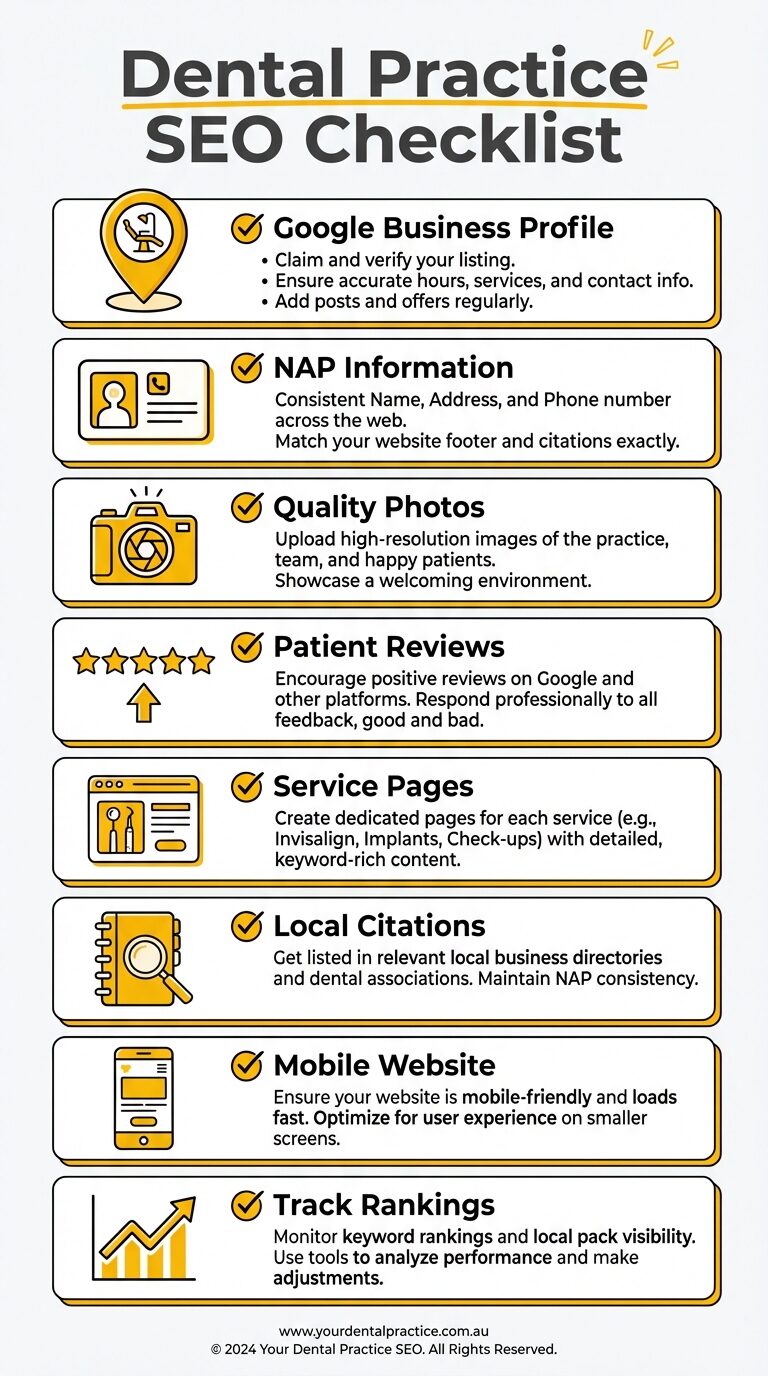
A fully optimised Google Business Profile should include:
- Accurate NAP information: Your practice name, address, and phone number must be identical across all online listings
- Complete business categories: Primary category “Dentist” plus relevant secondary categories (Cosmetic Dentist, Pediatric Dentist, Emergency Dental Service)
- Business hours: Including lunch breaks, weekend hours, and holiday schedules
- Services and attributes: List all services you offer with accurate descriptions
- High-quality photos: Interior, exterior, team photos, and before/after treatment images (where appropriate)
- Regular posts: Share updates, promotions, and educational content
Managing Reviews Effectively
Reviews are the lifeblood of dental practice SEO. Practices with higher ratings and more reviews consistently rank better in local search results and convert more searchers into patients.
Effective review management includes:
- Asking satisfied patients for reviews at the right moment (post-appointment follow-up)
- Responding professionally to all reviews—positive and negative
- Addressing concerns in negative reviews while maintaining AHPRA compliance
- Never offering incentives for reviews (violates Google’s guidelines)
Dental-Specific Keyword Strategy
Effective keyword research for dental practices focuses on three main categories: service-based keywords, location-based keywords, and problem-based keywords.
Service-Based Keywords
These target patients searching for specific dental procedures:
- Teeth whitening [suburb]
- Dental implants [city]
- Root canal treatment [area]
- Invisalign [suburb]
- Emergency dentist [suburb]
- Wisdom teeth removal [city]
Location-Based Keywords
Combine your services with geographic modifiers:
- Dentist in [suburb]
- Dental clinic near [landmark]
- [Suburb] family dentist
- Best dentist [city]
Problem-Based Keywords
Target patients searching for solutions to dental problems:
- Tooth pain relief [suburb]
- Broken tooth repair [city]
- Sensitive teeth treatment
- How to fix crooked teeth
Creating Service Area Pages
For dental practices serving multiple suburbs, creating dedicated service area pages dramatically improves local visibility. Each page should target a specific location while providing unique, valuable content.
What to Include on Service Area Pages
- Unique content about serving that specific community
- Directions from key landmarks in the area
- Local testimonials from patients in that suburb
- Information about parking, public transport access
- Embedded Google Map showing your location relative to the suburb
Avoid creating thin pages that simply swap suburb names. Each service area page should offer genuine value to patients in that location, supporting your broader local SEO strategy.
AHPRA Compliance in Dental Marketing
Australian dental practices must navigate AHPRA (Australian Health Practitioner Regulation Agency) advertising guidelines when marketing online. Non-compliance can result in serious professional consequences.
Key AHPRA Compliance Points
- No testimonials: AHPRA prohibits using patient testimonials in advertising (though Google reviews are generally considered user-generated content)
- Before/after images: Must be used cautiously and cannot create unrealistic expectations
- Claims must be verifiable: Avoid superlatives like “best dentist” unless you can substantiate them
- Qualifications: Only advertise qualifications that are AHPRA-approved
- No guarantees: Cannot guarantee treatment outcomes
Work with an SEO provider who understands healthcare marketing regulations to ensure your online presence remains compliant while still being effective.
Technical SEO for Dental Websites
A technically sound website forms the foundation for all other SEO efforts. Dental practice websites should prioritise:
Mobile Optimisation
With most dental searches happening on mobile devices, your website must provide an excellent mobile experience. This means fast loading times, easy-to-tap buttons, and click-to-call functionality.
Site Speed
Patients won’t wait for slow websites. Aim for page load times under three seconds. Compress images, minimise code, and use reliable hosting to ensure fast performance.
Schema Markup
Implement LocalBusiness and Dentist schema markup to help search engines understand your practice information. This structured data can enable rich results showing your hours, reviews, and services directly in search results.
Follow our complete local SEO checklist to ensure your technical foundation is solid.

Content Strategy for Dental Practices
Quality content establishes your practice as an authority and captures patients at every stage of their decision journey.
Educational Blog Content
Answer common patient questions through blog posts:
- What to expect during a root canal
- How often should you visit the dentist?
- Signs you might need wisdom teeth removal
- Caring for dental implants
- Choosing between Invisalign and braces
Service Pages
Create comprehensive pages for each service you offer. These pages should explain the procedure, benefits, what to expect, and why patients should choose your practice.
FAQ Content
Compile and answer frequently asked questions. This content serves patients while targeting valuable long-tail keywords and potentially earning featured snippets in search results.
Building Local Citations
Citations are mentions of your practice’s NAP information on other websites. Consistent citations across authoritative directories improve your local search visibility.
Essential Directories for Australian Dental Practices
- Australian Dental Association directory
- Healthdirect.gov.au
- Yelp Australia
- Yellow Pages Australia
- True Local
- Hotfrog
- Local suburb directories
Ensure your NAP information is identical across all citations. Inconsistencies confuse search engines and can harm your local rankings.
Link Building for Dental Practices
Quality backlinks from relevant, authoritative websites signal trust to search engines. Dental practices can build links through:
- Local sponsorships: Supporting community events, sports teams, or schools
- Professional associations: Active membership in dental organisations
- Guest content: Contributing expert articles to health and lifestyle publications
- Local partnerships: Collaborating with complementary healthcare providers
Similar strategies work well for other professional services—see our guide on local SEO for law firms for comparable approaches.
Measuring Dental SEO Success
Track these key metrics to measure your SEO performance:
- Local pack rankings: Position in Google’s map results for target keywords
- Organic traffic: Website visitors from search engines
- Phone calls: Track calls from Google Business Profile and website
- Form submissions: Appointment requests and contact form completions
- Review volume and rating: Growth in reviews and maintaining high ratings
Set up proper tracking through Google Analytics, Google Search Console, and call tracking software to attribute new patients to your SEO efforts.
Get Professional Dental SEO Support
Dental practices face unique SEO challenges: high local competition, strict advertising regulations, and the need to build trust before patients book appointments. Working with experienced SEO specialists who understand the dental industry accelerates results while ensuring compliance.
Whether you’re a single-location family practice or a multi-site dental group, a tailored SEO strategy positions your practice to capture more of the patients actively searching for dental care in your area. The practices dominating local search today are the ones investing in SEO—will yours be among them?
Common Dental SEO Mistakes to Avoid
Many dental practices undermine their SEO efforts through easily avoidable mistakes. Understanding these pitfalls helps you achieve better results faster.
Ignoring Mobile Users
With the majority of dental searches happening on smartphones, a website that performs poorly on mobile devices loses patients before they even see your services. Test your site on multiple devices and prioritise mobile performance.
Neglecting Google Business Profile
Some practices set up their GBP listing and never touch it again. Regular updates, fresh photos, posts, and active review management signal to Google that your practice is engaged and current.
Inconsistent NAP Information
Having different versions of your practice name, address, or phone number across the web confuses search engines. Audit all your citations and ensure perfect consistency.
Targeting Too Broad
Trying to rank for generic terms like “dentist Australia” wastes resources. Focus on location-specific keywords where you can realistically compete and convert searchers into patients.
Thin Service Pages
Single-paragraph service pages don’t demonstrate expertise. Each service deserves comprehensive content explaining the procedure, benefits, candidacy, and what makes your practice the right choice.
The Competitive Landscape for Dental SEO
Dental is one of the most competitive local SEO industries in Australia. Major metro areas may have dozens of practices competing for the same keywords. This competition demands a strategic, sustained approach to SEO.
Practices that succeed invest consistently over time rather than expecting overnight results. They understand that SEO compounds—the efforts you make today build upon previous work to create increasingly strong search visibility.
Standing Out in a Crowded Market
Differentiation matters more than ever. Your SEO strategy should highlight what makes your practice unique:
- Specialised services not offered by every practice
- Advanced technology and techniques
- Convenient hours or location
- Particular expertise (sedation dentistry, paediatric care, complex restorations)
- Practice philosophy and patient experience focus
Integrating SEO with Your Broader Marketing Strategy
SEO works best as part of an integrated marketing approach. Your SEO efforts should align with and reinforce your other marketing channels.
Social Media Integration
While social signals aren’t a direct ranking factor, an active social media presence builds brand awareness and can drive traffic to your website. Share your blog content, patient education, and practice updates across Facebook, Instagram, and LinkedIn.
Email Marketing
Capture website visitors with email signup incentives. Regular email communication keeps your practice top-of-mind and can encourage reviews, referrals, and repeat appointments.
Paid Advertising
Google Ads can complement SEO by capturing additional visibility for competitive keywords while your organic rankings develop. Use paid and organic together for maximum search result coverage.
Future-Proofing Your Dental Practice SEO
Search continues evolving with AI-powered features, voice search, and changing user behaviours. Dental practices should prepare for these shifts by focusing on fundamentals that endure:
- Quality over quantity: Comprehensive, helpful content that genuinely serves patients
- User experience: Websites that load fast, work perfectly on mobile, and make booking easy
- Reputation: Consistently earning positive reviews through excellent patient care
- Local presence: Deep integration with your local community and citations
Practices that build on these foundations will adapt successfully as search technology evolves.
Getting Started with Dental Practice SEO
If you’re new to SEO or haven’t prioritised it previously, the path forward is clear. Start with the highest-impact activities first:
Immediate Actions (Week 1)
- Claim and verify your Google Business Profile if you haven’t already
- Ensure your NAP information is accurate and complete
- Add high-quality photos of your practice, team, and equipment
- Request reviews from your most satisfied recent patients
Short-Term Priorities (Month 1)
- Audit your website for mobile-friendliness and speed issues
- Create or improve service pages for your most profitable treatments
- Begin building consistent citations on major directories
- Implement basic schema markup on your website
Ongoing Activities
- Publish helpful blog content targeting patient questions
- Continue building reviews through systematic requests
- Monitor and respond to all reviews promptly
- Track rankings and traffic to measure progress
- Build local links through community involvement
SEO is a marathon, not a sprint. Practices that commit to consistent effort over twelve months or more see transformational results in their new patient flow. The investment in SEO pays dividends for years through sustainable, cost-effective patient acquisition that compounds over time.
Ready to transform your dental practice’s online visibility? Contact our team to discuss a customised SEO strategy that addresses your specific market, competition, and growth goals.