
Here’s a reality check that might sting: nearly 60% of Google searches now end without a single click. That means more than half of your potential visitors are getting their answers directly from search results—and never setting foot on your website.
Welcome to the era of zero-click searches.
If you’ve noticed your organic traffic plateauing despite solid rankings, you’re not imagining things. The search landscape has fundamentally shifted, and businesses that fail to adapt risk becoming invisible—even when they’re technically “ranking well.”
But here’s the good news: zero-click searches aren’t the death of SEO. They’re an evolution. And with the right strategies, you can turn this challenge into a competitive advantage.
What Are Zero-Click Searches?
A zero-click search occurs when a user gets the information they need directly from the search engine results page (SERP) without clicking through to any website. Google provides the answer upfront, satisfying the user’s query then and there.
Think about the last time you Googled “weather Sydney” or “how many cups in a litre.” Did you click on a website? Probably not. Google gave you the answer immediately.
According to SparkToro’s 2024 zero-click search study, 58.5% of US searches and 59.7% of EU searches result in zero clicks. That’s a staggering shift from just five years ago when the figure sat closer to 25%.
What’s Causing the Zero-Click Surge?
Google has become increasingly sophisticated at answering queries directly. Several SERP features contribute to this trend:
Featured Snippets
Featured snippets—those answer boxes that appear at the top of search results—provide direct answers to user queries. They pull content from web pages and display it prominently, often eliminating the need to click through.
When someone searches “what is a meta description,” Google extracts a concise definition and displays it above all other results. The user gets their answer; your website gets… visibility without the visit.
AI Overviews
The biggest game-changer has been Google’s AI Overviews, rolled out broadly in 2024. These AI-generated summaries synthesise information from multiple sources to answer complex queries directly.
Data from Similarweb research reveals that when AI Overviews appear, zero-click rates jump to approximately 83%—compared to 60% when they’re absent. That’s a massive difference.
As of early 2025, AI Overviews appear on roughly 13% of desktop queries in the US, and that number continues to climb.
Knowledge Panels
Knowledge panels display comprehensive information about entities—businesses, people, places, organisations—in a structured sidebar. When someone searches for your business name, Google might show your address, phone number, operating hours, reviews, and social profiles all in one place.
Useful for users? Absolutely. But it means they may never visit your website to find that information.
People Also Ask (PAA)
The “People Also Ask” boxes expand to show related questions and answers. Users can explore multiple queries without leaving the SERP, diving deeper into a topic while Google serves up pre-extracted answers from various websites.
Local Packs
For location-based searches, Google’s Local Pack displays a map with three business listings, complete with ratings, addresses, and contact information. Users can call directly, get directions, or read reviews—all without visiting a business website.
This is particularly impactful for Australian businesses relying on local search visibility. Your Google Business Profile optimisation has never been more critical.
The Numbers Don’t Lie: Zero-Click Statistics You Need to Know
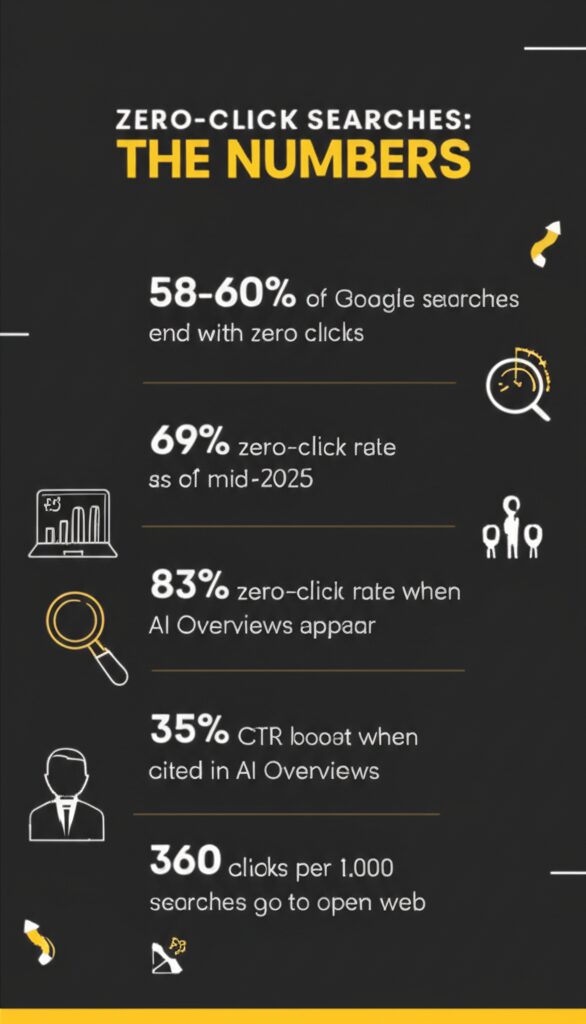
Let’s put some concrete figures behind this trend:
- 58-60% of all Google searches end without a click to an external website
- 69% zero-click rate observed as of mid-2025, up from 56% in May 2024
- 83% zero-click rate when AI Overviews are present
- 61% decline in organic click-through rates on queries with AI Overviews
- 35% increase in CTR for brands that get cited within AI Overviews
- 68.7% of clicks that do occur go to the top three organic results
According to Search Engine Land, for every 1,000 Google searches in the US, only 360 clicks go to the open web. The rest either end without clicks or direct users to Google-owned properties like YouTube and Google Maps.
Why Zero-Click Searches Aren’t All Bad News
Before you despair, let’s reframe the situation. Zero-click searches aren’t necessarily a loss—they’re a different kind of opportunity.
Brand Visibility Still Matters
Even when users don’t click, they see your brand. If your content appears in a featured snippet, your business name is front and centre. That visibility builds recognition and trust over time.
Think of it like a billboard on a busy highway. Not everyone who sees it will pull over, but they’ll remember your brand when they need your services.
Not Every Query Was Ever Going to Click
Many zero-click searches are informational queries that wouldn’t have converted anyway. Someone searching “what time is it in Melbourne” was never going to become your customer from that search.
The key is understanding which queries represent genuine opportunities and optimising accordingly.
Featured Positions Drive Credibility
Appearing in a featured snippet or having your content cited in an AI Overview positions you as an authority. Users may not click today, but when they need deeper information or services, they’ll remember who provided that initial answer.
Strategies to Win in the Zero-Click Era
Adapting to zero-click searches requires a shift in how you approach SEO services. Here’s how to maintain visibility and drive meaningful traffic:
1. Optimise for Featured Snippets
Featured snippets are prime real estate. To capture them:
- Answer questions directly in your content. Use the question as a heading, then provide a concise answer in the first paragraph.
- Use structured formatting—numbered lists, bullet points, tables—that Google can easily extract.
- Target question-based keywords through thorough SEO keyword research.
- Keep initial answers brief (40-60 words), then expand with detail below.
Even if users don’t click, your brand appears at the top of results. And research shows that featured snippet holders often see increased traffic for related, more complex queries.
2. Create Content That Demands a Click
Some content can’t be summarised in a snippet. Focus on:
- Original research and data: Statistics, surveys, and unique insights can’t be fully conveyed in a paragraph.
- In-depth guides: Comprehensive resources that go beyond surface-level answers.
- Interactive tools: Calculators, quizzes, and assessments require engagement.
- Visual content: Infographics, videos, and complex diagrams encourage users to visit for the full experience.
Your content marketing strategy should prioritise creating these high-value assets that AI simply can’t replicate in a summary.
3. Dominate the Local Pack
For Australian businesses serving local markets, the Local Pack is your battleground. To optimise:
- Complete your Google Business Profile with accurate, detailed information.
- Encourage customer reviews and respond to them thoughtfully.
- Post regularly to your Google Business Profile with updates, offers, and news.
- Ensure NAP consistency (Name, Address, Phone) across all online directories.
- Add photos and videos that showcase your business.
When users can’t find what they need in the Local Pack, they click through for more. Make sure your listing is compelling enough to earn that click—or comprehensive enough to convert directly.
4. Own the People Also Ask Section
PAA boxes represent additional opportunities to capture visibility. To appear in PAA:
- Research related questions around your target topics.
- Create FAQ sections on your pages that address these questions.
- Use conversational language that matches how people actually ask questions.
- Provide authoritative answers that Google deems worthy of featuring.
Strong on-page SEO helps ensure your content is properly structured to capture these opportunities.
5. Build Brand Search Demand
When users search for your brand specifically, you control the narrative. Build brand awareness through:
- Consistent messaging across all channels
- Thought leadership content that positions you as an industry authority
- Social media presence that keeps your brand visible
- Digital PR that earns mentions and links from reputable sources
Branded searches bypass the zero-click problem entirely. If someone searches “YourBusiness SEO services,” they’re coming to your site regardless of what features Google displays.
6. Diversify Your Traffic Sources
Don’t put all your eggs in the Google basket. Expand your reach through:
- Email marketing: Build a subscriber base you own.
- Social media: Engage audiences directly on platforms they use.
- YouTube: Video content often appears in universal search results.
- Industry partnerships: Collaborate with complementary businesses.
- Direct traffic: Make your brand memorable so users type your URL directly.
7. Track the Right Metrics
In the zero-click era, obsessing over click-through rates alone is misleading. Also measure:
- Impressions: How often does your content appear in search results?
- Brand search volume: Are more people searching for your brand over time?
- Featured snippet ownership: How many snippets do you hold for target keywords?
- Engagement on-site: When users do click, are they converting?
- Revenue per visit: Focus on quality over quantity.
Adapting Your SEO Strategy for 2026 and Beyond
The trajectory is clear: zero-click searches will continue to increase as Google and AI-powered search tools become more sophisticated at delivering instant answers.
But this doesn’t spell doom for SEO. It demands evolution.
The businesses that thrive will be those that:
- Embrace visibility as a metric, not just clicks
- Create genuinely valuable content that goes beyond what AI can summarise
- Build strong brand recognition that drives direct and branded search traffic
- Optimise strategically for SERP features that provide visibility
- Diversify traffic sources rather than depending solely on organic search
The search landscape has changed. User behaviour has changed. Your strategy needs to change too.
The Bottom Line
Zero-click searches aren’t a problem to solve—they’re a reality to navigate. Google will continue serving more answers directly because that’s what users want: fast, convenient information without extra steps.
Your job isn’t to fight this trend. It’s to position your brand so prominently within search results that users remember you, trust you, and turn to you when they need more than a quick answer.
The era of zero-click search rewards brands that prioritise visibility, authority, and genuine value. It punishes those clinging to outdated tactics that chase clicks over connections.
Which side will your business be on?
Ready to adapt your SEO strategy for the zero-click era? Our team specialises in helping Australian businesses maintain visibility and drive meaningful results in this evolving landscape. Get in touch today to discuss how we can help your business thrive.