
Tom Critchlow, a search marketing consultant, stated July 8 that brand, product, and PR teams—not SEO departments—drive outcomes in AI-powered search engines, describing the shift as a career risk for SEO professionals who fail to adapt, according to Search Engine Journal.
TL;DR: AI Search (GEO) outcomes depend on brand visibility, product positioning, and editorial reputation—activities that most organizations assign to teams outside SEO, exposing a control gap as generative search replaces traditional rankings.
Critchlow made the remarks during an interview with Ross Hudgens, framing the observation as “contrarian” but grounded in how search algorithms respond to brand signals. “The people that drive SEO outcomes are not SEO professionals, by and large,” Critchlow said, adding that the pattern held true in traditional search and now applies more strongly to generative engine optimization.
The consultant pointed to a scenario familiar to Australian businesses evaluating SEO marketing strategies: a CEO asks an AI search engine to recommend between two brands, and the system names a competitor. The question then becomes which internal team owns the fix—and in most organizations, the answer is not the SEO department.
Brand Signals Underpin AI Search Recommendations
AI search engines prioritize brand familiarity when generating recommendations, a tendency rooted in what behavioral researchers call Familiarity Bias—people’s documented preference for products and services they already recognize. Google’s algorithms have long incorporated user behavior signals; the company’s founders described PageRank as “a model of user behavior” in the original 1998 paper, showing that user response to content influenced rankings from the start.
Navboost, Google’s ranking system that processes branded search queries, reinforces this pattern by weighting how users interact with known entities. “What people respond to most online are brands,” the interview noted, explaining why brand marketing aligns with algorithmic priorities in both traditional and AI search environments.
Organizations building local SEO services for Australian clients face the same dynamic at regional scale: AI search engines cite businesses that prospects already recognize, making brand awareness campaigns a prerequisite for generative search visibility.
SEO Becomes Foundation Rather Than Driver
Critchlow described SEO fundamentals—technical setup, crawling, indexing—as equally important before and after the shift to AI search, but repositioned the discipline as foundational work rather than the primary driver of outcomes. “GEO, AI Search, is much more like brand marketing than it is SEO,” he said, explaining that the technical underpinning remains necessary but insufficient.
The observation echoes patterns documented in earlier research: AI search engines depend on traditional SEO infrastructure to function, but citation decisions rely on trust signals that fall outside SEO’s typical scope. Google’s John Mueller has made similar statements, confirming that “the fundamentals of SEO remain the same” even as the search interface changes.
What differs in Critchlow’s framing is the explicit acknowledgment that most SEO teams do not control the activities that generate those trust signals. “SEO has done a great job of being like, we’ve got to produce great content. We’ve got to have a good brand. We’ve got to have strong branded search,” he said. “But does an SEO team do any of those things? In most organizations, the answer is no.”
Outcome Ownership Sits Outside SEO Departments
Australian businesses allocating resources between internal teams and external agencies confront a structural question: if AI search recommendations depend on brand reputation, product positioning, and editorial credibility, which department owns the work?
Critchlow posed the question explicitly: “If I’m a CEO and I’m sat looking at my organization and I’m like, who’s going to do this GEO thing for me? Is it the SEO team? Or is it the brand team? Or is it the product team?” The answer varies by industry and business model, but the pattern points to a gap between who understands the AI search problem and who controls the levers that solve it.
The consultant described the gap as “a real risk for the SEO industry,” noting that it existed in traditional search but becomes more pronounced as generative engines surface brand-level recommendations rather than page-level rankings. SEO teams that advise on content quality, brand building, and reputation management without owning execution face the risk that organizations reassign outcome responsibility to teams that do.
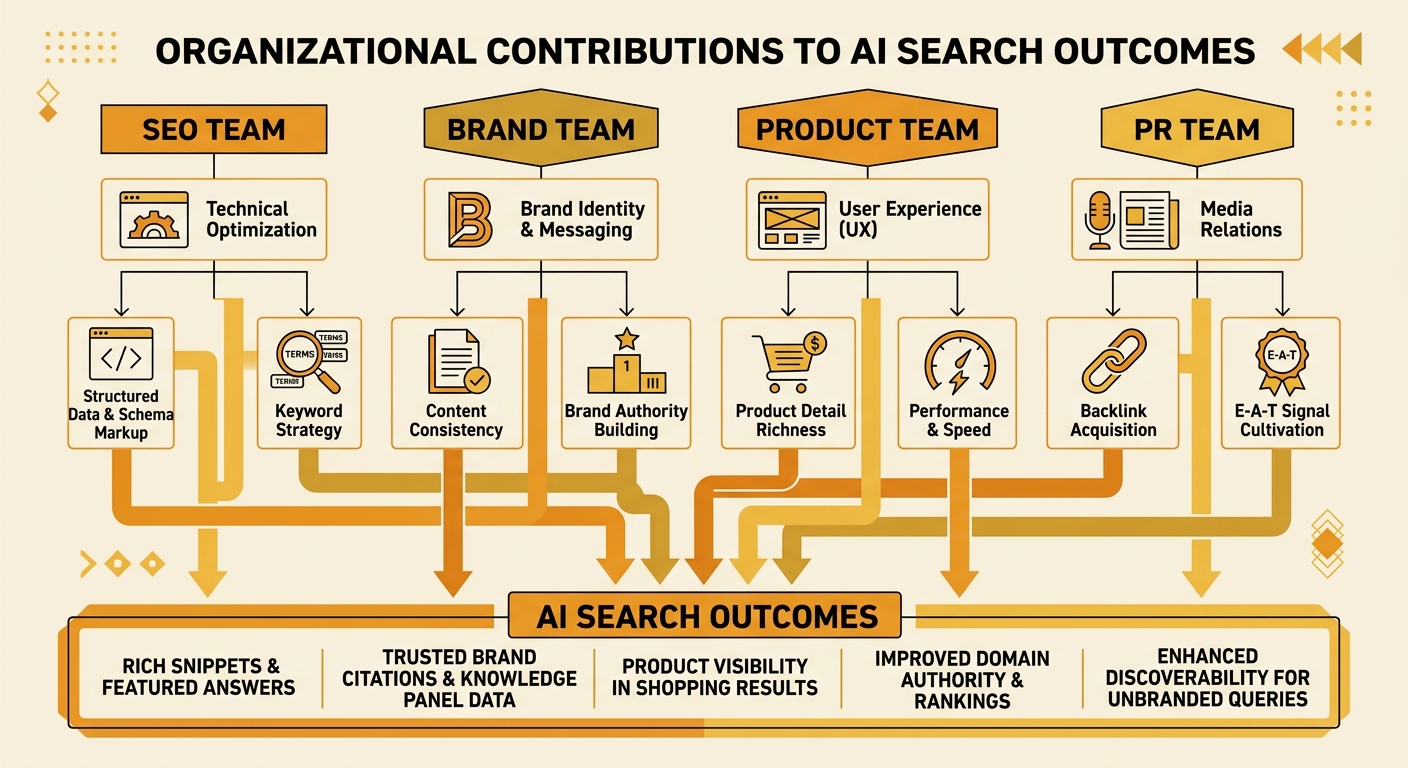
The distinction matters for Australian SMEs evaluating whether to build internal SEO capacity or retain external specialists: technical SEO remains essential, but the activities that differentiate one business from another in AI search results often live elsewhere in the org chart.
What Happens Next
Australian businesses planning 2026 search strategies need to audit which teams own the activities that drive AI search citations—content production, brand visibility campaigns, product positioning, review generation, and editorial partnerships. Organizations where SEO teams advise but do not execute risk disconnecting diagnosis from action.
SEO professionals face a choice: expand services to include brand and product marketing activities, or clarify that technical optimization is a necessary input to a larger cross-functional effort. The former requires new skills and potentially different commercial structures; the latter requires transparently repositioning SEO as foundational infrastructure rather than outcome driver.
Businesses that already coordinate SEO, brand, and product teams around shared visibility metrics hold a structural advantage as generative search becomes the primary discovery interface. Those where SEO operates in isolation may need to reconsider team structure, reporting lines, or agency relationships before AI search exposure gaps widen into measurable traffic losses.