

A South African digital marketing consultancy published a pillar-page and topic-cluster implementation framework on July 12, outlining how businesses can structure content to signal topical authority to search engines, according to the guide published by Ever. The framework describes a hub-and-spoke model where a central pillar page links to multiple cluster articles on related subtopics, with internal linking connecting the network.
TL;DR: Ever.co.za released a guide July 12 explaining how pillar pages and cluster articles form an interconnected content architecture that Google evaluates when assessing site-level expertise on a topic.
The guide positions the approach as the dominant content architecture for businesses building topical authority, stating that Google now assesses expertise by evaluating the breadth and depth of coverage across a topic rather than isolated individual pages. A business with one article on a subject holds one relevant page; a business with a comprehensive pillar page plus multiple interlinked cluster articles covering subtopics receives treatment as an authoritative source, according to the publication.
The Pillar-and-Cluster Architecture
The framework defines a pillar page as a comprehensive, long-form content piece covering a broad topic at a high level while linking to detailed cluster articles for each subtopic. The guide specifies pillar pages typically run 2,500 to 4,000 words, structured with clear headings and designed to rank for primary broad keywords while capturing variations.
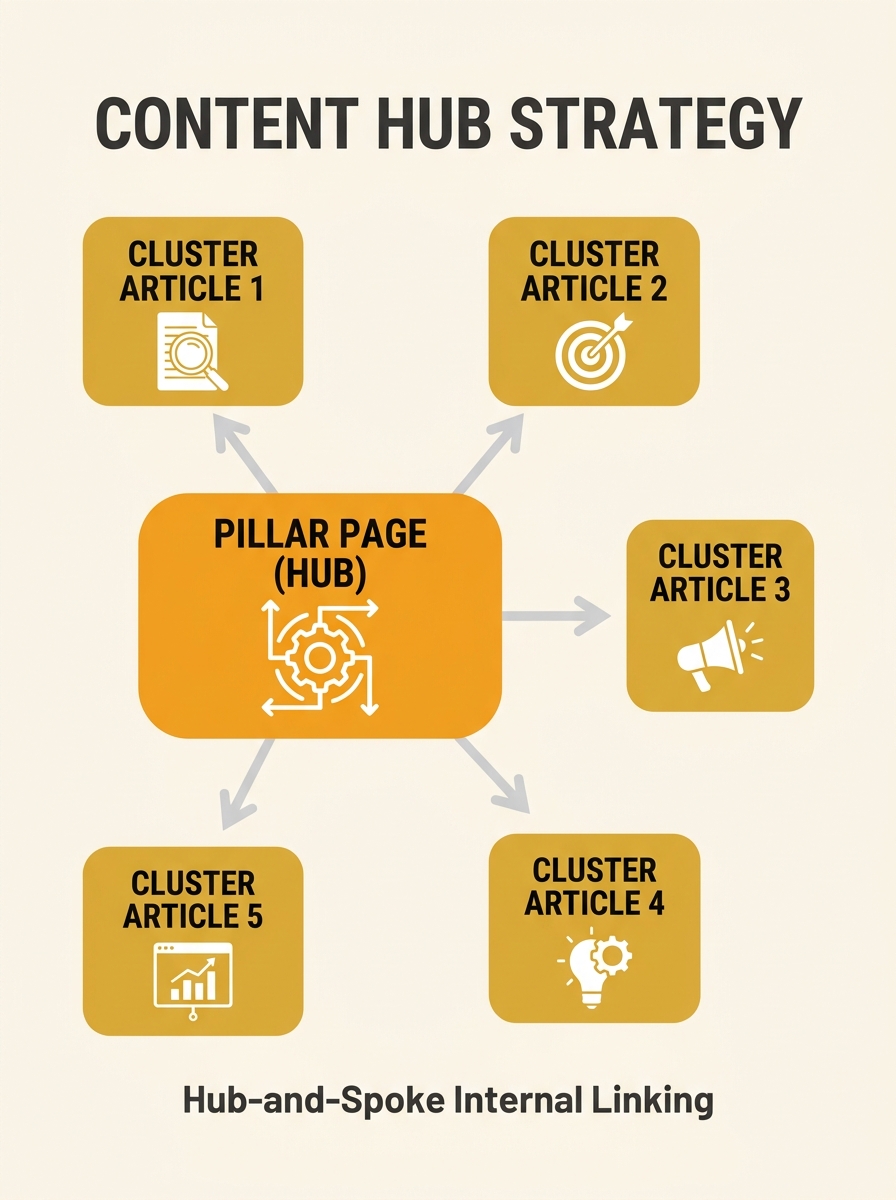
Cluster articles serve as deeper, more specific content supporting each pillar. The guide states these articles target more specific keywords within the broader topic, provide substantially more detail than the pillar’s overview scope allows, and link back to the pillar page. For a local SEO cluster example, the framework describes cluster articles covering Google Business Profile optimization, local citation building for South African businesses, Google review management, and location-specific landing page creation.
The internal linking structure makes the model function as an SEO architecture rather than merely a content organization strategy, according to the publication. The pillar page links to each cluster article, each cluster article links back to the pillar, and cluster articles can link to each other where relationships are genuine. This creates a tightly connected page group around a shared topic, signaling comprehensive interlinked coverage to search engines—a key indicator of topical authority. The guide explains that authority accumulated by the pillar page through external backlinks flows through internal links to cluster articles, improving their ranking ability for specific keywords, while cluster articles reinforce the pillar’s authority through inbound links they provide.
Australian businesses implementing similar site hierarchy and topical clustering strategies have reported faster indexing by AI search systems when content demonstrates clear topical relationships through internal link structures.
Implementation Approach
The framework recommends mapping service areas to topic clusters as a starting point. Each major service or product category becomes a potential cluster, requiring a pillar page and at least three to five supporting cluster articles to build genuine topical depth, according to the guide.
For keyword-based topic mapping, the publication advises taking full keyword research output and grouping related keywords together. Keywords sharing the same user intent and covering the same topic area belong in the same cluster; keywords going deeper on specific aspects belong in cluster articles within that group. The framework provides an example where a marketing agency creates clusters for SEO, paid search, content marketing, social media, email marketing, and web design—each becoming a pillar supported by cluster articles, with the entire architecture internally linked into a coherent topical authority map.
The approach aligns with internal linking templates for topic cluster implementation that digital platforms have released in recent months to help businesses structure content relationships.
Timeline Expectations
The guide states topic clusters compound over time, with the first cluster article in a new cluster starting with no authority and typically requiring several months to rank meaningfully. As the cluster grows, the interconnected structure accelerates ranking for every new piece added, according to the publication. The fifth article in a well-developed cluster typically ranks faster than the first article did because it connects into an already-authoritative structure.
Businesses committing to building two or three complete topic clusters over twelve months—rather than publishing random articles across dozens of unrelated topics—consistently see stronger and faster ranking improvements than those who scatter content effort, the framework states. This timeline matches observations that topical authority now matters more than individual keywords when search engines evaluate site-level expertise.
The guide includes a call to action for South African businesses to book a topic cluster workshop to map content architecture and identify clusters with the highest commercial value.
Context and Outlook
The framework publication arrives as Australian small and medium businesses face mounting pressure to demonstrate topical depth in both traditional search and generative AI platforms. The hub-and-spoke model described in the Ever guide directly addresses Google’s shift toward evaluating site-wide topic coverage rather than individual page optimization—a transition that has accelerated since the March 2026 core update that heavily weighted Information Gain signals.
For Australian businesses with limited content resources, the framework’s recommendation to focus on two to three complete clusters over twelve months offers a practical alternative to scattered publishing across many topics. The internal linking structure becomes particularly valuable as AI search engines increasingly rely on clear topical relationships to determine which sites merit citation for complex queries. Businesses that have structured content as isolated articles face disadvantage compared to those demonstrating comprehensive coverage through interconnected cluster architectures.
The guide’s South African context requires adaptation for Australian regulatory and market conditions, but the underlying architecture principles apply across markets where Google and AI search platforms evaluate topical authority as a primary ranking factor.