

Google’s search quality evaluators use E-E-A-T—Experience, Expertise, Authoritativeness, and Trustworthiness—as a framework for assessing content quality. While not a direct ranking factor, E-E-A-T influences how Google’s algorithms evaluate whether your content deserves top positions in search results. Understanding and demonstrating these qualities has become essential for sustainable SEO success.
This comprehensive guide explains each E-E-A-T component, shows you how Google evaluates these signals, and provides actionable strategies to strengthen your website’s perceived quality.
What is E-E-A-T?
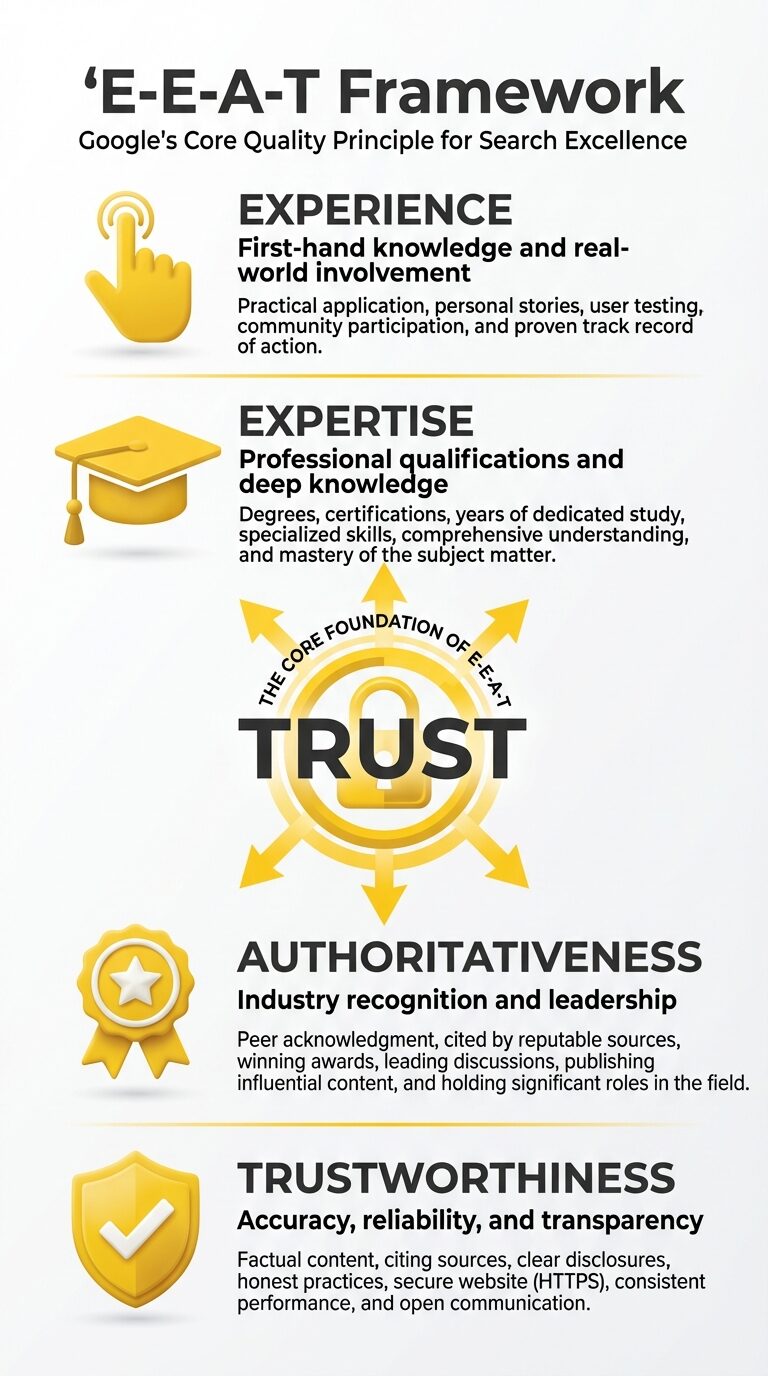
E-E-A-T stands for Experience, Expertise, Authoritativeness, and Trustworthiness. Google added “Experience” to the original E-A-T framework in December 2022, recognising that first-hand experience with a topic adds unique value that pure expertise cannot replicate.
According to Google’s Search Quality Rater Guidelines, E-E-A-T assessment considers:
- Experience: Does the content creator have first-hand, real-world experience with the topic?
- Expertise: Does the creator possess the knowledge or skill required for the topic?
- Authoritativeness: Is the creator or website recognised as a go-to source?
- Trustworthiness: Is the content and website accurate, honest, safe, and reliable?
Trust sits at the centre of the E-E-A-T model—it’s the most critical factor. Experience, expertise, and authority all contribute to establishing whether users can trust your content.
Experience: The Newest E-E-A-T Factor
Experience evaluates whether content creators have actually used a product, visited a place, or lived through what they’re writing about. This addition acknowledges that someone who has personally experienced something often provides insights that purely academic expertise cannot match.
Demonstrating Experience
To show first-hand experience in your content:
- Share personal stories: Include specific details that only someone with real experience would know
- Use original photos: Images you’ve taken yourself (not stock photos) demonstrate you were actually there
- Provide unique insights: Offer perspectives that aren’t simply regurgitated from other sources
- Include case studies: Document real results from your work or experiences
- Be specific: General advice suggests research; specific details suggest experience
For example, a product review from someone who actually purchased and used the product for six months carries more weight than a review compiled from reading the manufacturer’s specifications.
Expertise: Knowledge and Skill
Expertise refers to having the knowledge, qualifications, or skills relevant to the topic. The level of expertise required varies by subject—medical advice demands professional credentials, while everyday topics may only need practical knowledge.
Types of Expertise
Formal expertise comes from education, professional training, and credentials. This matters most for:
- Medical and health information
- Legal advice
- Financial guidance
- Scientific topics
Everyday expertise comes from practical experience and accumulated knowledge. A home cook who has perfected a recipe through years of practice has relevant expertise, even without culinary school credentials.
Demonstrating Expertise
- Author bios: Include detailed information about content creators’ backgrounds and qualifications
- Credentials: Display relevant certifications, degrees, or professional memberships
- Expert contributors: Have qualified professionals review or contribute to content
- Depth of content: Comprehensive coverage demonstrates thorough knowledge
- Accuracy: Factually correct information signals expertise
Authoritativeness: Recognised Leadership
Authoritativeness measures whether you or your website is recognised as a leading source on your topics. This significantly impacts where your website ranks because search engines trust authoritative sources to provide reliable information.
Building Authority
Authority develops over time through:
- Quality backlinks: Links from other authoritative websites signal that experts trust your content
- Brand mentions: Being cited or mentioned by industry publications and experts
- Industry recognition: Awards, speaking engagements, and professional acknowledgment
- Consistent publishing: A track record of quality content on your topics
- Social proof: Engagement, shares, and discussion of your content
Authority is topic-specific. A dental practice website may be highly authoritative for dental topics but have no authority for unrelated subjects. Focus your authority-building efforts on your core areas.
Trustworthiness: The Foundation of E-E-A-T
Trust is the most important E-E-A-T factor because even experienced, expert, authoritative content fails if users can’t trust it. Trustworthiness encompasses the accuracy, honesty, safety, and reliability of both content and website.
Elements of Trustworthiness
Content trust signals:
- Accurate, well-sourced information
- Clear distinction between fact and opinion
- Transparent about sponsored content or affiliate relationships
- Regular updates to keep information current
- Corrections when errors are identified
Website trust signals:
- Secure HTTPS connection
- Clear contact information and physical address
- Privacy policy and terms of service
- Transparent business information
- Professional design and functionality
Building trust requires consistency over time. A single trustworthy article doesn’t establish overall trust—it’s the accumulation of reliable, honest content that builds reputation.
YMYL: When E-E-A-T Matters Most
YMYL stands for “Your Money or Your Life”—topics that could significantly impact users’ health, financial stability, safety, or wellbeing. Google applies stricter E-E-A-T evaluation to YMYL content because misinformation in these areas causes real harm.
YMYL Categories
- Health and medical: Symptoms, treatments, medications, mental health
- Financial: Investment advice, taxes, retirement planning, loans
- Legal: Legal rights, immigration, wills, custody
- Safety: Product safety, emergency procedures, dangerous activities
- News and current events: Information affecting civic understanding
- Groups of people: Information about race, religion, nationality, disability
If your website covers YMYL topics, prioritising E-E-A-T isn’t optional—it’s essential for ranking and for responsibly serving your audience.

E-E-A-T Implementation Strategy
Improving E-E-A-T requires systematic attention to your website, content, and online presence. Here’s how to strengthen each component:
Author and About Pages
Create comprehensive author pages for every content creator that include:
- Professional photo
- Detailed biography emphasising relevant experience and qualifications
- Links to credentials, certifications, or professional profiles
- Links to their published content on your site
- Social media profiles and professional websites
Your About page should clearly explain your organisation’s mission, team, history, and qualifications to cover your topics.
Content Quality Standards
Implement editorial standards that ensure quality:
- Fact-check all claims against authoritative sources
- Include citations and references for statistics and studies
- Have experts review technical content
- Update content regularly to maintain accuracy
- Clearly label opinions, sponsored content, and advertising
Support your content marketing efforts with robust quality controls.
Building Authority Through Links
Earn backlinks from authoritative sources through:
- Original research and data that others cite
- Expert commentary for journalists and publications
- Guest contributions to respected industry sites
- Active participation in professional communities
Quality link building strategies directly support your authority signals.
E-E-A-T and AI Content
As AI-generated content proliferates, E-E-A-T becomes even more important for differentiation. AI can aggregate information but cannot provide genuine experience or true expertise.
To stand out in an AI-saturated content landscape:
- Emphasise unique human experiences AI cannot replicate
- Include original insights from real practitioners
- Feature expert perspectives and commentary
- Share case studies and real-world results
- Provide nuanced analysis that requires genuine understanding
AI can assist content creation, but E-E-A-T signals require human expertise, experience, and accountability.
Measuring E-E-A-T Progress
While E-E-A-T itself isn’t directly measurable, you can track related metrics:
- Referring domains: Growth in quality backlinks indicates increasing authority
- Brand searches: More people searching for your brand suggests growing recognition
- Rankings for competitive terms: Improving positions for difficult keywords indicates trust
- Time on page: Engaged readers suggest content meets their needs
- Return visitors: People coming back indicates trust in your content
Combine these metrics with regular content audits to assess whether your E-E-A-T improvements translate to better performance.
E-E-A-T Is a Long-Term Investment
Building genuine E-E-A-T takes time. You cannot fake experience, manufacture expertise, or shortcut authority. These qualities develop through consistent delivery of valuable, accurate content created by qualified people.
The businesses that commit to building real E-E-A-T create sustainable competitive advantages. As Google’s algorithms become better at identifying authentic expertise and trustworthiness, superficial optimisation tactics become less effective while genuine quality becomes more valuable.
Invest in E-E-A-T not just for rankings, but because it makes your content genuinely better for users—which is ultimately what sustainable SEO success requires.
Ready to strengthen your website’s E-E-A-T signals? Explore how our SEO services can help you build the expertise, authority, and trust that both users and search engines reward. From content strategy to link building, we help Australian businesses demonstrate their true value to search engines and customers alike.
Common E-E-A-T Mistakes to Avoid
Many websites undermine their E-E-A-T signals through easily correctable mistakes:
Anonymous or Vague Authorship
Content attributed to “Admin” or “Staff Writer” fails to demonstrate expertise. Every piece of content should have a named author with verifiable credentials relevant to the topic.
Missing or Thin About Pages
Your About page is often one of the most visited pages on your site. A sparse About page missing team information, company history, and mission suggests you have something to hide.
Outdated Information
Content that hasn’t been updated in years, especially for rapidly changing topics, signals neglect. Regular reviews and updates demonstrate ongoing commitment to accuracy.
No Contact Information
Websites without clear contact details—physical address, phone number, email—appear untrustworthy. Make it easy for users to reach you.
Copying Competitor Content
Duplicating or lightly rewriting competitor content demonstrates neither expertise nor experience. Original perspectives based on genuine knowledge always outperform derivative content.
Ignoring Negative Reviews
Failing to respond to criticism or negative feedback suggests you’re not accountable. Professional, constructive responses to negative reviews actually build trust.
E-E-A-T for Different Industries
E-E-A-T requirements vary by industry. Here’s how to approach it for different sectors:
Healthcare and Medical
The highest E-E-A-T bar. Content must be created or reviewed by qualified medical professionals. Include credentials, cite peer-reviewed research, and clearly distinguish evidence-based information from general wellness advice.
Financial Services
Require qualified financial professionals to create or review content. Display relevant licenses and certifications. Provide disclaimers where appropriate and avoid making guarantees about returns or outcomes.
Legal Services
Content should come from licensed attorneys or be reviewed by legal professionals. Make jurisdiction clear and include appropriate disclaimers about general information versus legal advice.
E-Commerce and Product Reviews
Show actual product experience through original photos, detailed usage information, and honest assessments including drawbacks. Avoid generic reviews that could be written without product access.
Local Services
Demonstrate local expertise through community involvement, local case studies, and understanding of regional factors. Reviews and testimonials from local customers strengthen E-E-A-T signals.
Technical Implementation for E-E-A-T
While E-E-A-T is primarily about content quality, technical elements support these signals:
Schema Markup for Authors
Implement Person schema for authors linking them to their profiles across the web. This helps Google understand and verify author credentials.
Secure Website Infrastructure
HTTPS is essential for trust. Ensure your entire site uses secure connections and displays proper security certificates.
Clear Site Structure
Logical navigation helps users and search engines understand your expertise areas. Group related content together and make it easy to explore topics in depth.
Fast, Accessible Performance
A slow, buggy website undermines trust regardless of content quality. Ensure excellent Core Web Vitals and accessibility compliance.
Explore our guide to SEO marketing fundamentals for more on how technical and content elements work together.
Building an E-E-A-T-First Content Strategy
Rather than retrofitting E-E-A-T to existing content, build it into your content strategy from the start:
Content Planning
Before creating any content, ask: Who is the best person to write this? Do they have genuine experience and expertise? Can we demonstrate that expertise credibly?
If you lack internal expertise on a topic, consider:
- Partnering with qualified external contributors
- Interviewing experts and including their insights
- Having subject matter experts review content before publication
- Focusing on topics where you genuinely have expertise
Content Creation
During content creation, weave E-E-A-T signals throughout:
- Include specific examples from personal experience
- Cite authoritative sources for claims and statistics
- Share unique insights that demonstrate genuine expertise
- Use original images and examples where possible
- Write with appropriate depth for the topic complexity
Content Promotion
Promote content in ways that build authority:
- Share on professional networks where experts engage
- Pitch to industry publications for coverage
- Engage with comments and questions demonstrating expertise
- Build relationships with other authoritative voices in your space
E-E-A-T isn’t a checkbox exercise—it’s a fundamental approach to creating content that genuinely serves users while demonstrating your qualifications to do so.
The websites that thrive in modern search understand that E-E-A-T isn’t optional—it’s the foundation of sustainable visibility. Start implementing these strategies today to build the experience, expertise, authority, and trust that both users and search engines increasingly demand.