
Featured snippets sit at the very top of Google’s search results—the coveted “position zero.” When your content earns a featured snippet, it commands attention above all organic results, often capturing a significant share of clicks even as search behaviour evolves. Research shows featured snippets capture 38.9% to 42.9% of clicks when present, making them one of the most valuable SERP features to target.
This guide explains what featured snippets are, the different types available, and proven strategies to optimise your content for snippet selection.
What Are Featured Snippets?
Featured snippets are selected search results that Google displays in a special box above the regular organic listings. They aim to quickly answer user queries without requiring a click—though they often drive significant traffic to the source website.
Google pulls featured snippet content directly from web pages, highlighting the most relevant portion that answers the searcher’s question. The source page receives attribution and a link, providing valuable visibility.
Featured Snippets vs AI Overviews
With Google’s AI Overviews expanding, understanding the distinction matters. Featured snippets extract specific content from a single source. AI Overviews synthesise information from multiple sources into AI-generated summaries. Both occupy premium SERP real estate, but featured snippets give a single source prominent attribution.
Types of Featured Snippets
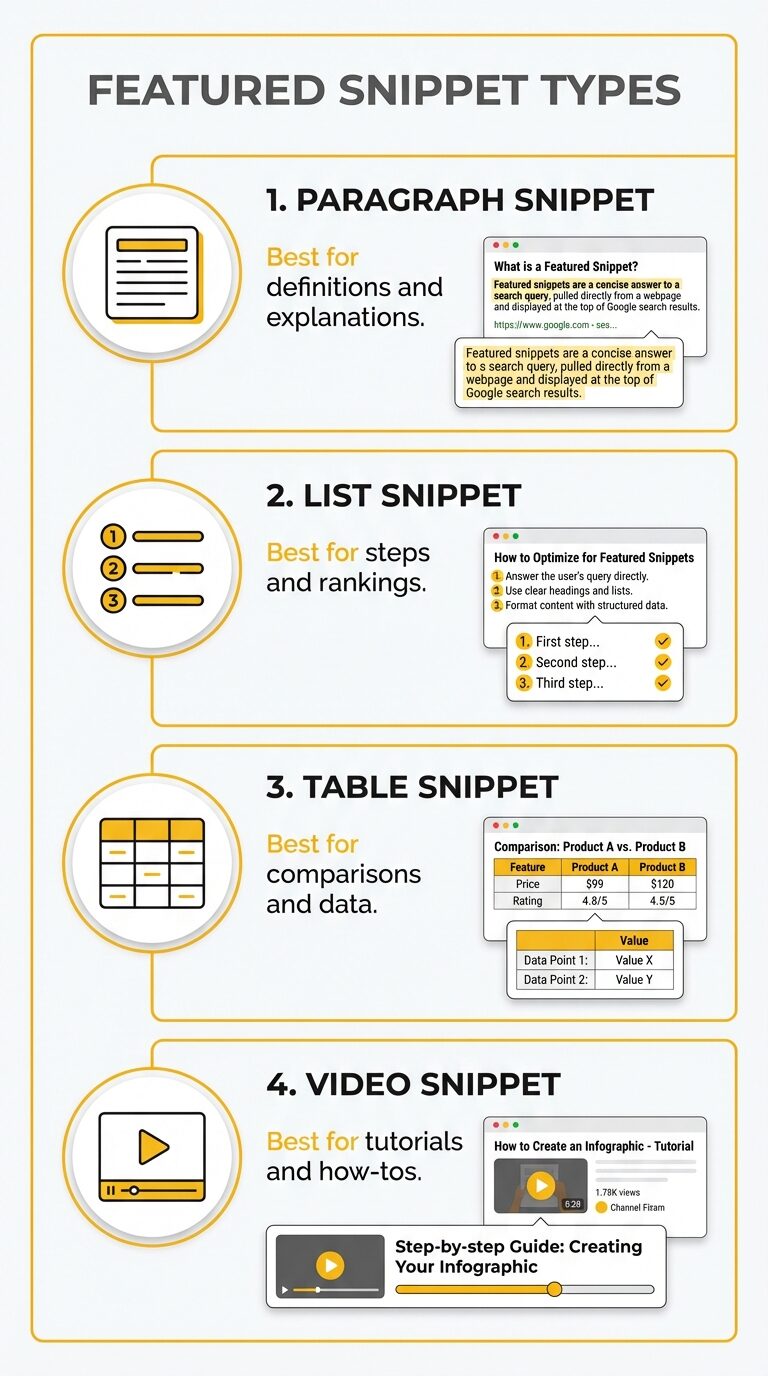
Google displays several featured snippet formats depending on the query type and available content:
Paragraph Snippets
The most common type, paragraph snippets display a block of text answering the query directly. These typically appear for “what is,” “why,” and “how” questions seeking explanations.
Optimal format: 40-60 words providing a direct, comprehensive answer immediately following the question as a header.
List Snippets
List snippets appear for queries seeking steps, rankings, or collections of items. They can display as numbered (ordered) lists for processes or bulleted (unordered) lists for non-sequential items.
Optimal format: Clear H2/H3 header followed by 5-8 list items. If your list has more items, Google often shows “More items…” encouraging clicks.
Table Snippets
Table snippets display structured data comparisons, statistics, or specifications. Google may extract tables directly from your page or construct them from your content structure.
Optimal format: Properly marked-up HTML tables with clear headers and consistent data formatting.
Video Snippets
For how-to and tutorial queries, Google sometimes features video content with a specific timestamp highlighted. YouTube videos dominate this format, though other video hosts can appear.
How to Win Featured Snippets
Earning featured snippets requires strategic content optimisation. Here’s the systematic approach:
1. Target Snippet-Friendly Keywords
Not all keywords trigger featured snippets. Focus your efforts on:
- Question-based queries (what, how, why, when)
- Definition queries (“what is X”)
- Comparison queries (“X vs Y”)
- Process/how-to queries
- List queries (“top X,” “best X”)
Use tools like SEMrush, Ahrefs, or Google Search Console to identify keywords where snippets exist and you rank within the top 10—these are your best opportunities.
2. Structure Content for Extraction
Google needs clearly structured content to pull for snippets:
- Question headers: Use the exact question users search as your H2 or H3
- Immediate answers: Provide direct answers in the first 1-2 sentences after the header
- Proper formatting: Use appropriate lists, tables, or paragraphs for the content type
- Consistent structure: Maintain predictable formatting throughout
3. Optimise for Specific Snippet Types
For paragraph snippets:
- Place answer immediately below question header
- Keep initial answer under 60 words
- Use clear, factual language
- Avoid first-person perspective
For list snippets:
- Use proper HTML list formatting
- Lead each item with the key point
- Keep items concise and parallel
- Include more items than typically shown (encourages clicks)
For table snippets:
- Use semantic HTML table markup
- Include clear header rows
- Keep data consistent across rows
- Ensure mobile-responsive display
4. Improve Overall Page Quality
Google primarily selects featured snippets from pages already ranking in the top 10. Strengthen your overall on-page SEO to improve ranking potential, then optimise specifically for snippet extraction.
Pages with strong E-E-A-T signals are more likely to be selected for snippets, particularly for YMYL topics.
Featured Snippet Opportunities by Industry
Different industries see varying snippet opportunities:
Professional Services
Service businesses can target:
- Definition queries: “What is [service]?”
- Process queries: “How does [service] work?”
- Cost queries: “How much does [service] cost?”
- Comparison queries: “[Service A] vs [Service B]”
E-commerce
Online retailers can target:
- Product comparisons: “Best [product] for [use case]”
- How-to guides: “How to choose [product]”
- Specification tables: “[Product] specifications”
Local Businesses
Local businesses can target:
- Service explanations: “What does a [profession] do?”
- Local how-tos: “How to find [service] in [location]”
- FAQ content: Common customer questions

Tracking Featured Snippet Performance
Monitor your snippet success through:
Google Search Console
Search Console shows which queries trigger your featured snippets and their click-through rates. Filter by “Search appearance” to see featured snippet performance specifically.
Rank Tracking Tools
Tools like SEMrush, Ahrefs, and Moz track featured snippet ownership, showing when you gain or lose snippet positions and which competitors hold them.
Key Metrics to Monitor
- Snippet ownership: Keywords where you hold the featured snippet
- CTR changes: How snippet ownership affects click-through rates
- Volatility: How often you gain or lose snippets
- Opportunities: Keywords where you rank highly but don’t have the snippet
Featured Snippets and Zero-Click Searches
A common concern: do featured snippets cannibalise clicks? With over 58% of Google searches now resulting in zero clicks, this is a valid consideration.
The reality is nuanced. Featured snippets can:
- Increase brand visibility even without clicks
- Capture more clicks than regular positions would
- Build authority as a trusted information source
- Drive clicks for complex queries where the snippet teases more detail
For most websites, winning the featured snippet beats losing it to a competitor, even accounting for potential zero-click behaviour.
Common Featured Snippet Mistakes
Avoid these pitfalls when optimising for snippets:
Targeting Wrong Keywords
Not every keyword triggers snippets. Research which queries in your niche actually display featured snippets before investing optimisation effort.
Weak Existing Rankings
Snippets are pulled from top-ranking pages. If you’re not in the top 10, focus on improving overall rankings before snippet-specific optimisation.
Poor Content Formatting
Content buried in paragraphs won’t be extracted. Use clear headers, lists, and formatting that makes extraction easy for Google.
Incomplete Answers
Snippets that partially answer questions get replaced. Provide comprehensive, authoritative answers that fully satisfy query intent.
Start Winning Featured Snippets
Featured snippets represent a significant opportunity for Australian businesses to capture premium search visibility. The combination of strategic keyword research, structured content formatting, and strong page authority creates the foundation for snippet success.
Review your current content for snippet opportunities, identify high-value targets where you already rank well, and begin systematically optimising for extraction. With consistent effort, featured snippets can become a reliable source of traffic and visibility for your website.
Ready to capture more featured snippets? Our content marketing and SEO services help Australian businesses develop snippet-winning content strategies that drive visibility and traffic.
Advanced Featured Snippet Strategies
Once you’ve mastered the basics, these advanced tactics can help you capture more snippets:
Snippet Stacking
Target multiple snippet opportunities within a single piece of content. A comprehensive guide can potentially win snippets for various sub-queries by thoroughly covering related questions throughout the content.
Competitor Snippet Analysis
Study the snippets your competitors hold. Analyse their content structure, formatting, and answer quality. Then create content that provides better, more complete answers with superior formatting.
Featured Snippet FAQs
Create dedicated FAQ sections targeting common questions in your niche. Each question-answer pair is a potential snippet opportunity. Structure these with proper FAQ schema markup to maximise visibility.
Snippet-Optimised Content Updates
Review existing high-ranking content for snippet potential. Often, minor formatting changes—adding proper headers, restructuring answers, improving lists—can win snippets without major content rewrites.
Featured Snippets and Voice Search
Featured snippets power many voice search responses. When Google Assistant, Siri, or Alexa answer questions, they frequently read featured snippet content. This makes snippets valuable for:
- Brand mentions in voice responses
- Capturing voice search traffic
- Building authority in voice-first contexts
Voice optimisation aligns with snippet optimisation: clear, direct answers to natural-language questions.
Featured Snippets in Your SEO Strategy
Featured snippets should be part of a comprehensive SEO approach, not an isolated tactic. They work best when integrated with:
- Content strategy: Planning content around snippet opportunities
- Keyword research: Identifying snippet-friendly query patterns
- Technical SEO: Ensuring proper page structure and schema markup
- Link building: Building authority that supports snippet selection
The pages most likely to win snippets combine strong overall SEO fundamentals with specific snippet optimisation tactics.
Measuring Featured Snippet ROI
To justify snippet optimisation investment, track business impact:
- Traffic changes: Measure traffic before and after winning snippets
- Conversion tracking: Do snippet visitors convert at different rates?
- Brand searches: Do snippets increase brand awareness and direct searches?
- Competitive displacement: What happens when you take snippets from competitors?
While some snippets satisfy queries without clicks, the brand visibility and authority benefits often justify the effort even with lower click-through rates for certain queries.
Featured snippets represent one of the most valuable SERP features available to Australian businesses. With strategic targeting, proper formatting, and quality content, your website can consistently capture these prominent positions and the visibility they deliver.
The Future of Featured Snippets
Featured snippets continue evolving alongside search technology. Several trends are shaping their future:
Integration with AI Overviews
As Google’s AI Overviews expand, the relationship between traditional featured snippets and AI-generated content is shifting. Sources cited in AI Overviews gain similar visibility benefits to snippet ownership, making E-E-A-T and content quality increasingly important.
More Visual Snippets
Google increasingly incorporates images, videos, and interactive elements into snippets. Optimising visual content alongside text improves your chances of capturing these richer snippet formats.
Mobile-First Snippet Display
With mobile searches dominating, snippet display optimises for smaller screens. Concise, scannable answers perform better on mobile, influencing snippet selection criteria.
Personalisation and Context
Google personalises results based on user context. Different users may see different snippets for the same query. Building comprehensive, authoritative content helps capture snippets across diverse user contexts.
Taking Action on Featured Snippets
Start your featured snippet strategy today with these steps:
- Audit existing content: Identify pages ranking in positions 2-10 for snippet-eligible queries
- Research opportunities: Find keywords in your niche that trigger snippets
- Prioritise high-value targets: Focus on snippets with meaningful traffic potential
- Optimise strategically: Apply formatting and structural changes to priority pages
- Monitor results: Track snippet wins and their impact on traffic and visibility
- Iterate and expand: Apply learnings to capture additional snippets
Consistent effort over time builds a portfolio of featured snippet wins that compound into significant competitive advantage in search visibility.
The businesses that invest in featured snippet optimisation today position themselves to capture valuable SERP real estate as search continues evolving. Whether you’re targeting local customers or national audiences, featured snippets offer a proven path to enhanced visibility and traffic that outperforms standard organic rankings.