
Local pack ranking in Australia hinges on three measurable signals, and Google Business Profile signals alone account for up to 32% of the weighting, according to RevGenX’s analysis of Australian map pack ranking factors. Fully optimised profiles appear 80% more often in results and generate 4x more website visits than incomplete ones.
TL;DR: GBP signals drive 32% of local pack rankings. The profiles that win combine a specific primary category, consistent NAP data across Australian directories, steady review velocity (50+ reviews = 3x more clicks), and weekly visual uploads. Businesses running local ads without this foundation are overpaying for visibility they could earn organically.
The Three Ranking Factors and Their Relative Weight
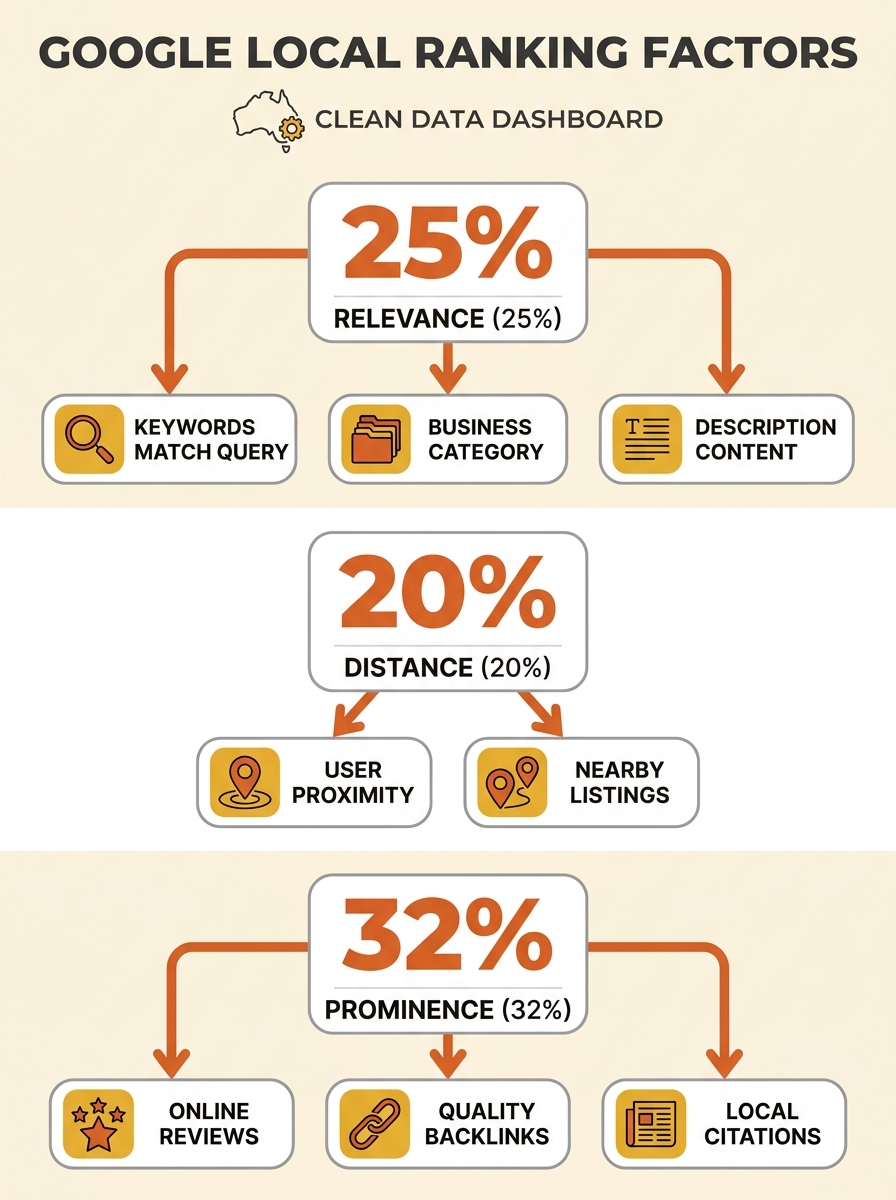
Google’s local algorithm evaluates every listing against three criteria: relevance, distance, and prominence. Relevance measures how well your profile matches the searcher’s query. Distance calculates proximity to the user or the location specified in the search. Prominence reflects online reputation and authority, drawn from reviews, backlinks, and web presence.
Distance is the one factor you can’t control. Prominence is where competition actually plays out. Review signals alone account for over 15% of local pack ranking factors, per RevGenX’s breakdown of Australian data. Businesses that actively manage their profile features see 67% more profile views and 43% more website clicks compared to those that don’t.
The practical implication for paid search budgets: an incomplete GBP forces you to rely on ad spend to capture traffic that a well-maintained profile would generate organically. When local SEO services include GBP optimisation alongside paid campaigns, the two channels reinforce each other instead of competing for the same clicks.
Choosing the Right GBP Categories for Australian Businesses
Your primary category is the single strongest relevance signal in the local pack. Birdeye’s listing optimisation guide recommends entering “your business name and choose a primary category that best describes your business,” using specific terms like “Café” or “Electrician” rather than broad labels.
Google maintains over 4,000 GBP categories. Grownomics published a complete category list filtered for Victorian businesses, with industry-specific filters and one-click copy functionality for profile updates. The taxonomy is more granular than most business owners realise: a legal practice can choose “Personal Injury Solicitor” instead of “Law Firm,” and a physiotherapy clinic can select “Sports Physiotherapist” instead of “Physiotherapist.”
When selecting GBP categories Australia businesses often make the mistake of adding every vaguely related option. Retain Media’s analysis warns that “although you don’t want to omit services from your selections, you also don’t want to add irrelevant categories in the hope of boosting your reach. Doing so could lead to being penalised by Google, and potentially even having your GBP suspended.”
Secondary categories expand your reach when they’re accurate. A bakery adding “Cake Shop” and “Caterer” makes sense. A bakery adding “Event Venue” when it doesn’t host events creates a real suspension risk under Google’s tightened 2026 enforcement standards.
Warning: Google’s 2026 enforcement is stricter on business name keyword stuffing. Listing yourself as “Sydney Best Plumber – 24/7 Emergency Plumbing” when your registered name is “Smith Plumbing Pty Ltd” triggers review and potential suspension.
NAP Consistency Across Australian Directories
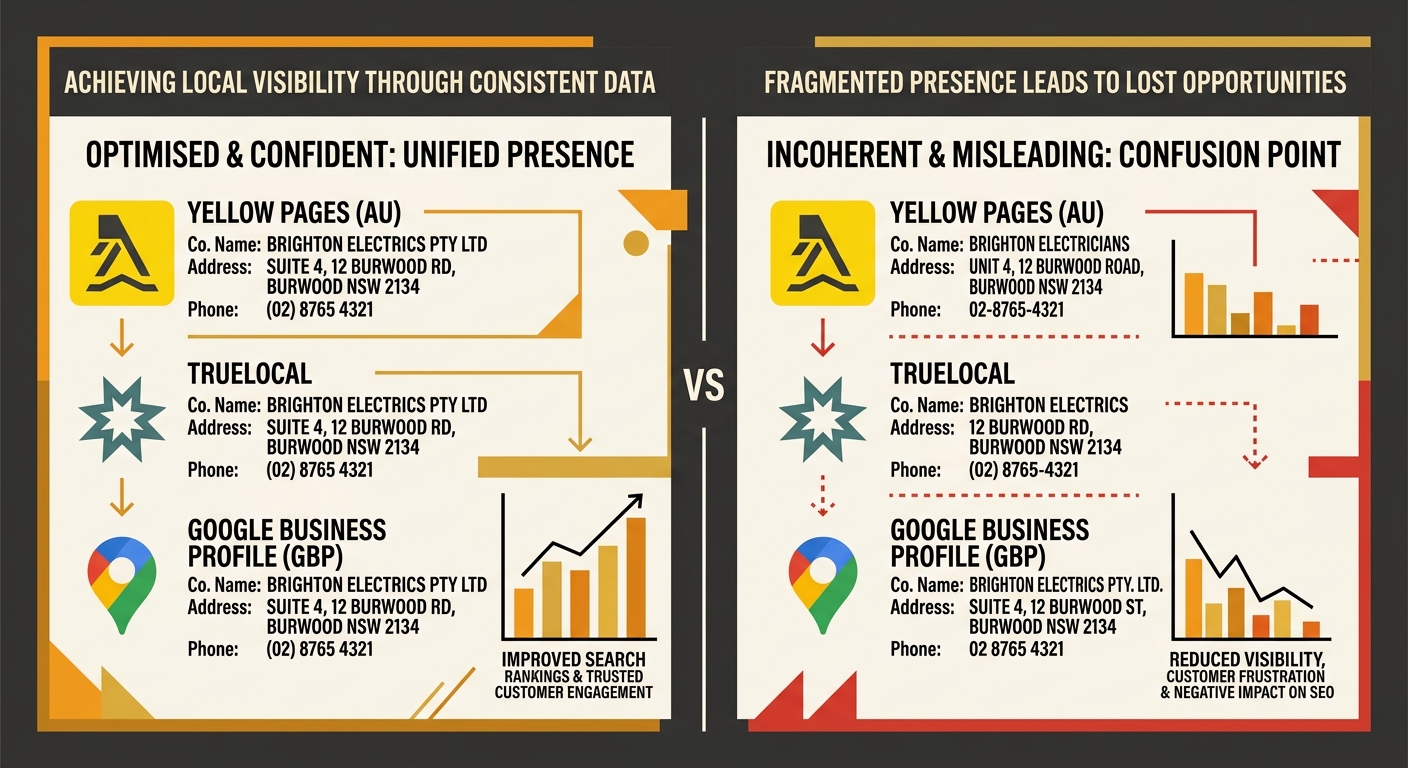
Why does NAP accuracy have such an outsized effect on rankings? Google cross-references your GBP data against every directory that lists your business, and inconsistencies erode the trust signals your profile depends on. Wise Local’s guide illustrates the problem well: “If your Google profile says ‘123 Main St’ but Yellow Pages says ‘123 Main Street,’ that’s a mismatch. Go through every listing and make sure your business name, address, and phone number are identical, down to abbreviations and punctuation.”
The local SEO setup process for NAP involves auditing these core Australian directories: Yellow Pages Australia, TrueLocal, Hotfrog, StartLocal, and any industry-specific platforms relevant to your sector. If you’ve experienced duplicate listing problems that fragment your local profiles, you’ll know how quickly inconsistent data erodes the authority you’ve built.
For service-area businesses without a shopfront (mobile mechanics, cleaning services, in-home care providers), hide the physical address in your GBP and define specific service areas by suburb or region. This tells Google where to show your listing without broadcasting a residential address. Set boundaries that match the areas you genuinely serve, covering perhaps 8-15 suburbs rather than an entire metro area.
Review Velocity and Its Measured Impact on Rankings
Profiles with 50 or more reviews receive 3x more clicks than those with fewer than 10, according to aggregated data cited in Creative Warrior’s 2026 Google Maps ranking guide. The guide notes that “the map pack in 2026 still rewards the basics, but the winners add consistent review velocity, credible web signals, and useful on-profile activity.”
A business that collects 4 reviews per week over 3 months builds more ranking momentum than one that accumulates 50 reviews in a single week and then goes quiet for 6 months. Google’s systems flag unnatural review patterns, and the August 2025 spam update specifically targeted fake engagement across local listings.
A business that collects 4 reviews per week over 3 months builds more ranking momentum than one that gets 50 in a single week and then goes silent.
Detailed reviews carry more weight than generic praise. A review saying “fixed our hot water system in Cronulla, arrived within 2 hours” gives Google’s algorithm stronger relevance signals for location-specific queries than “great service, highly recommend.” Encourage customers to mention the specific service they received and their suburb.
Your response strategy feeds the algorithm too. Reply to every review with specific details rather than canned text. When you respond, naturally include service and location references (“glad we could help with your plumbing emergency in Bondi”) without forcing keywords. This is exactly the type of keyword deployment in reviews and business profiles that creates compounding visibility in AI-powered search.
Visual Content as a Measurable Ranking Signal
Businesses with complete profiles and regular visual updates receive 7x more clicks than incomplete profiles, per industry benchmarks. Photos need to be authentic: team shots, completed projects, and behind-the-scenes work all outperform stock imagery. Google’s AI analyses photo quality in 2026, and blurry or generic images receive lower visibility weighting in map results.
Upload new photos weekly. Geotagging each image helps associate it with your service area. Short video clips of your team at work or walking through a completed project increase both engagement time and trust signals. We’ve covered the evidence for why photos and videos now function as direct ranking factors previously, and the data supporting that position has only grown stronger.
Google Posts deserve the same weekly attention. Treat your GBP as a content channel, publishing at least one post per week featuring service updates, seasonal offers, or educational content. Posts that address actual search intent (“how to prepare your Sydney home for winter plumbing issues”) outperform purely promotional ones.
Where Paid Local Ads and GBP Intersect
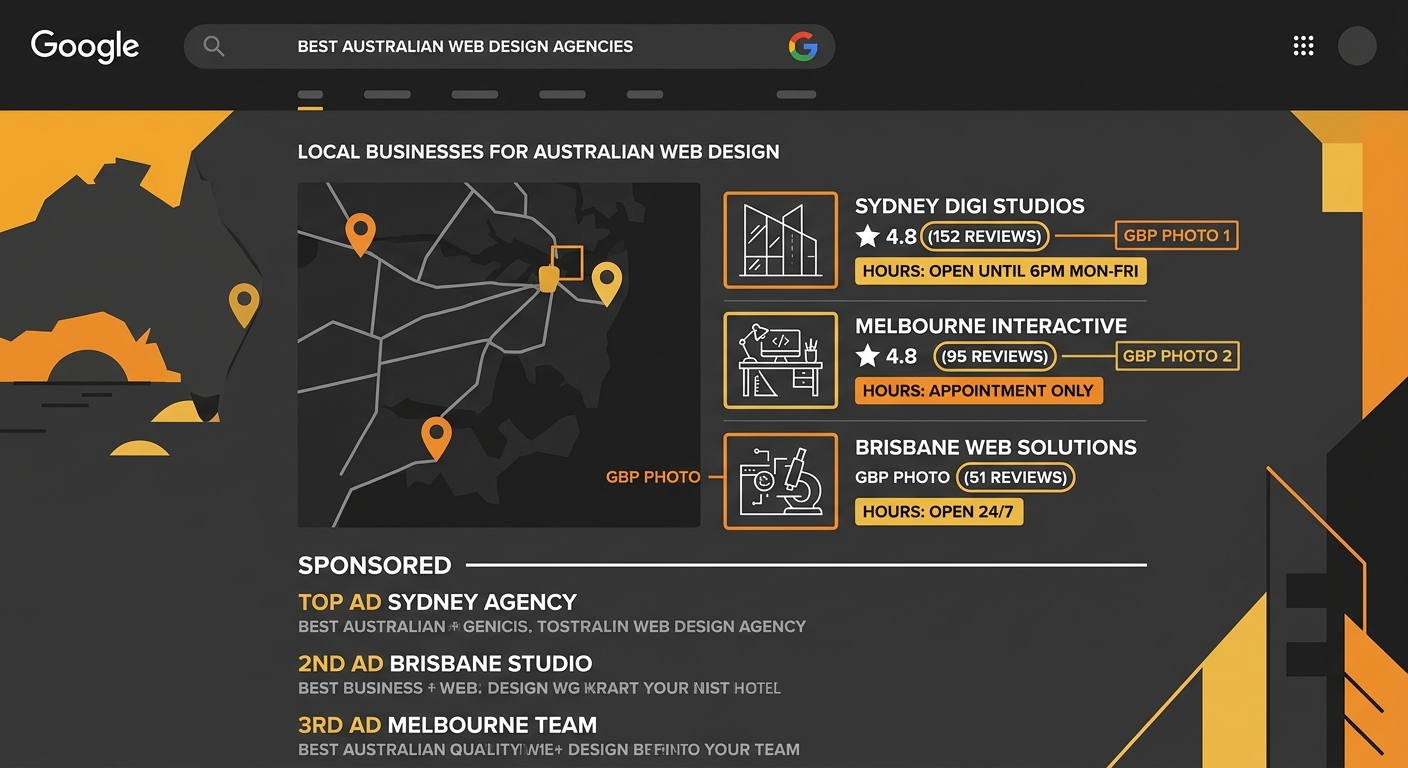
Google Business Profile optimisation has direct consequences for paid campaign performance. Location extensions in Google Ads pull data from your GBP, so an incomplete or inaccurate profile weakens every local ad you run. If your GBP hours are wrong, your ad drives clicks to a business that appears closed.
Local Services Ads (LSAs) depend on your profile even more heavily. LSAs display your GBP reviews, photos, and verification status directly in the ad unit. A profile with 12 reviews and no photos will underperform against a competitor carrying 80 reviews and weekly visual updates, regardless of how aggressive your bid strategy is. The 3x click differential between profiles with 50+ reviews and those under 10 applies to paid placements, not only organic ones.
The cost calculation matters for every Australian business running local Google Ads. Businesses rebuilding their SEO strategy after Google’s AI changes often discover that a well-ranked GBP reduces the volume of local keywords they need to bid on entirely. If your profile appears in the Australian map pack organically for “electrician Parramatta,” you no longer need to pay $8-15 per click for that same query through a text ad.
Backlinks and Website Signals That Feed the Map Pack
Your website directly affects your Google Maps position. Google treats your site as a trust and relevance signal when evaluating your GBP listing. Ewebmarketing’s Australian local SEO checklist recommends focusing on “earning backlinks from well-regarded Australian websites, especially those with domains like .com.au or .edu.au,” including chambers of commerce, industry groups, universities, and regional news platforms.
Digilari Media’s local SEO guide reinforces the technical side: “A local SEO strategy begins with a technically sound website. Audit your site to ensure optimal crawlability, mobile usability, and on-page optimisation.” Local schema markup (LocalBusiness and FAQ schema) on your website reinforces data consistency between your site and your GBP, giving Google two sources that validate each other.
For multi-location businesses, each location page should target specific suburbs with unique content. Thin, duplicated location pages dilute authority rather than building it, and Google’s crawlers spot templated content quickly.
Questions the Numbers Still Can’t Answer
The 32% GBP signal weighting, the 3x click differential for reviews, the 7x engagement lift for visual content, and the 15% review signal contribution all point in the same direction: complete, active profiles outperform incomplete ones. But several gaps in the available data persist.
Nobody outside Google knows the exact weighting between review recency, review volume, and review quality. A business with 200 ageing reviews and nothing new in 6 months might underperform against a competitor with 40 reviews, all from the past quarter. The data suggests recency matters significantly, but we don’t have precise thresholds to quantify it.
Distance weighting is equally opaque. How far from the searcher does a business need to be before proximity overtakes prominence? In dense metro areas like Sydney CBD or Melbourne’s inner suburbs, the radius appears tighter. In regional centres like Townsville or Ballarat, Google seems to expand it considerably. “Seems” is the honest word here, because Google hasn’t published specific radius data for Australian markets.
And the interaction between paid and organic local signals remains unmeasured in any publicly available study. Does running Local Services Ads produce any ranking benefit in the organic map pack? Google says no. Anecdotal reports from Australian agencies suggest otherwise, particularly in competitive verticals like legal services and trades. Until controlled studies surface, the safest working assumption is that paid and organic operate independently, and your Google Business Profile optimisation needs to stand on its own data-backed foundation.