

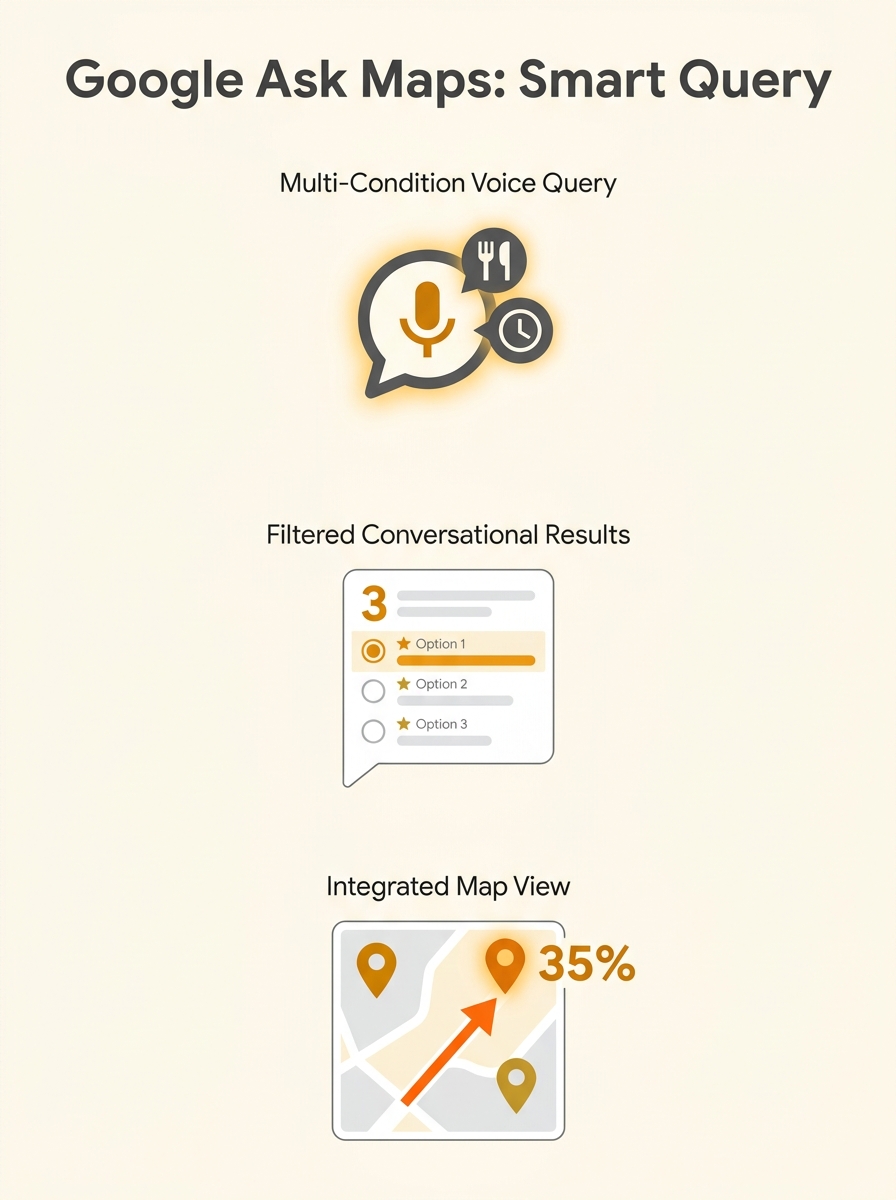
Google’s Ask Maps feature, announced June 8, processes conversational queries with multiple conditions—such as “lit tennis court available tonight”—by pulling from business profile data, operating hours, amenity fields, and third-party sources, according to Search Engine Journal. The feature draws on 300 million places and reviews from 500 million contributors, with Google describing responses as personalized based on user search history and saved locations. The company has not disclosed how it ranks businesses within Ask Maps answers.
TL;DR: Google’s Ask Maps feature processes multi-condition local queries using business profile data, hours, amenities, and reviews, though ranking methodology remains undisclosed.
Multi-Condition Queries Increase Data Dependency
Ask Maps answers questions that bundle several requirements into a single conversational request. The tennis court example Google provided requires the feature to verify the court exists in location data, confirm it’s publicly accessible, check for lighting infrastructure, and cross-reference current operating hours against the search time.
Each condition pulls from a different data layer. Entity and location information come directly from the Google Business Profile listing. Amenity details—whether a court has lights, a restaurant offers outdoor seating, or a locksmith provides 24-hour service—may be sourced from structured place attributes, user reviews, uploaded photos, or external data. Time-specific availability depends on accurate operating hours.
A business ranking well for simple one-variable searches may lack the detailed profile information required to surface in Ask Maps results for queries with multiple conditions. Google’s announcement did not explain how the feature weights individual data fields or resolves conflicts between sources.
Profile Completeness Signals Rise in Ranking Factor Surveys
Whitespark’s 2026 Local Search Ranking Factors survey, gathering insights from approximately 50 local SEO practitioners, found review signals increased in weight from 16% in 2023 to 20% in 2026. The survey, conducted since 2008 by a company providing local SEO software, represents expert consensus rather than Google-confirmed data.
BrightLocal’s breakdown of the survey results highlighted that “being open at the time of search” ranks as a key local pack signal. Experts responding to the survey indicated most Business Profile fields don’t significantly impact rankings—keywords in the business description and Google Q&A volume scored low—while signals demonstrating a business is genuine, active, and accurately represented carried the most weight.
Google’s own local ranking guidance states that businesses keeping information up to date are more likely matched with relevant local searches. The company has not released Ask Maps-specific ranking criteria. Australian businesses managing Google Business Profile listings for map pack visibility now face higher accuracy requirements as conversational queries pull from multiple profile sections simultaneously.
Local Search Experts Tie Feature to Data Volume Demands
Mike Blumenthal, co-founder of Near Media, told the Whitespark Local Update Podcast in June that “Google always loves more data, and clearly Q&A had become unwieldy.” He added that Google is leaning on businesses to supply structured data, though that reliance lasts only while the data remains useful.
Greg Sterling, also a Near Media co-founder, wrote in his Local Dialog newsletter that information for Google’s in-profile conversational features is “drawn from GBP, user reviews, the business website, and third-party sources.” That sourcing pattern aligns with factors the Whitespark survey rated highly for AI search visibility.
Darren Shaw, Whitespark founder, wrote in a post about Google’s AI Mode that conversational discovery extends beyond business-controlled sources, pulling from “what the entire internet says about you.” None of these observations are officially confirmed by Google but match patterns in survey data tracking review volume and photo libraries as visibility factors.
Google shut down the My Business Q&A API in November 2025, according to its developer changelog. The company has not explained what the new Q&A experience will look like or whether businesses will regain programmatic Q&A management tools.
Unknown Ranking Methodology and Monetization Path
Google has not disclosed how Ask Maps selects which businesses to include in conversational answers or how it weighs Business Profile data against reviews, websites, and third-party sources when those sources conflict. Any claims about Ask Maps ranking factors beyond Google’s published guidance represent educated speculation rather than confirmed methodology.
The monetization model for Ask Maps is also undisclosed. At launch, Google did not announce sponsored placements or paid priority within Ask Maps results. Whether the feature will eventually incorporate advertising similar to traditional local pack ads remains unconfirmed.
Australian businesses using incomplete or outdated profiles face increasing disadvantage as Google’s local features shift toward multi-variable query processing. Operating hours, amenity attributes, service areas, and response rates to reviews now function as potential filters in conversational search paths, not merely as supplementary listing details.
The Takeaway
Ask Maps shifts Google Business Profile management from verification-and-forget maintenance to active data curation. Multi-condition queries demand accuracy across operating hours, amenity fields, service attributes, and real-time availability—information many Australian SMEs leave incomplete or outdated. The feature’s reliance on third-party sources and user-generated content means profile gaps can’t be offset by website optimization alone; conversational search pulls what the internet collectively says about a business, not just what the business says about itself. Until Google releases Ask Maps ranking criteria, Australian businesses should prioritize profile completeness signals the 2026 Whitespark survey identified as high-weight: current operating hours, active review management, and accurate service/amenity attributes over low-value fields like keyword-stuffed descriptions.