

Topical authority has become one of the most powerful SEO strategies for 2025 and beyond. Rather than chasing individual keywords, websites that demonstrate comprehensive expertise in specific subject areas consistently outrank competitors—even those with more backlinks.
This guide explains what topical authority means, why it matters more than ever, and how to build it systematically for your website.
What Is Topical Authority?
Topical authority refers to your website’s perceived expertise and trustworthiness in a specific subject area. Rather than publishing random content or keyword-stuffed blogs, websites that demonstrate in-depth knowledge across a topic earn Google’s trust as authoritative sources.
Think of it as becoming the go-to resource for a particular subject. When your website thoroughly covers a topic from every angle, search engines recognise this depth and reward it with higher rankings across related queries.
Topical Authority vs Traditional SEO
Traditional SEO focused on optimising individual pages for specific keywords. Topical authority takes a broader view—building interconnected content that establishes expertise across an entire subject area.
The difference matters because:
- Google’s algorithms increasingly evaluate site-wide expertise, not just page-level signals
- Users expect comprehensive resources, not isolated answers
- Topical depth creates natural internal linking opportunities
- Authority in one area supports rankings for related queries
How Google Evaluates Topical Authority
Google assesses topical authority through several signals:
Content Depth and Breadth
Does your website cover a topic thoroughly? Websites with comprehensive content across all aspects of a subject demonstrate expertise. If you cover SEO, do you address technical SEO, content strategy, link building, local SEO, and related subtopics?
Content Quality and E-E-A-T
Quality matters more than quantity. Each piece of content should demonstrate experience, expertise, authoritativeness, and trustworthiness. Learn more about these signals in our E-E-A-T guide.
Internal Linking Structure
How content connects reveals topical relationships. Strategic internal linking between related pieces creates semantic clusters that search engines understand.
External Validation
Backlinks from authoritative sources on related topics reinforce your authority. When respected sites in your space link to your content, it validates your expertise.
The Content Cluster Model
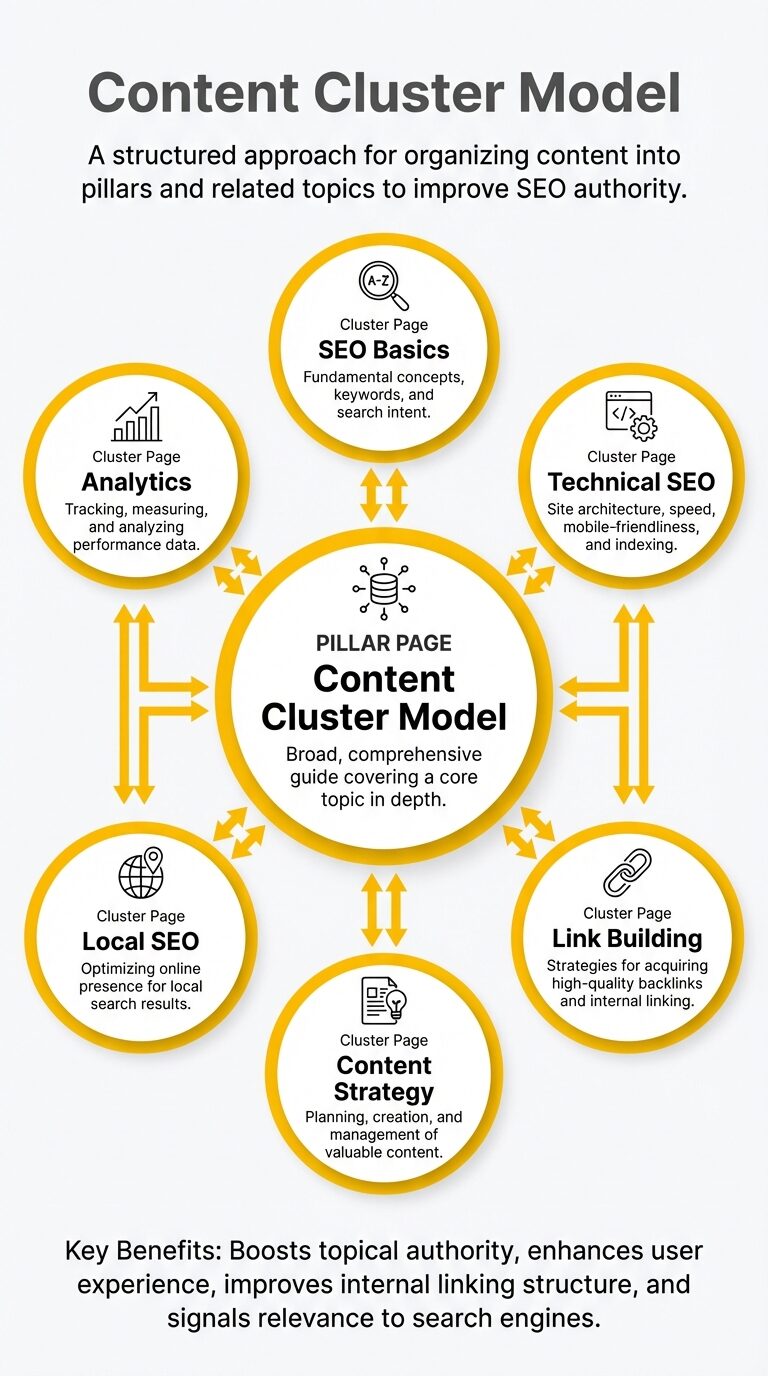
Content clusters are the practical framework for building topical authority. This approach organises content into interconnected groups that comprehensively cover subject areas.
Pillar Content
Pillar pages are comprehensive resources covering broad topics. They provide high-level overviews while linking to more detailed cluster content. A pillar page on “SEO” might cover all major aspects while linking to dedicated pages on each subtopic.
Characteristics of effective pillar content:
- Covers the topic broadly (3,000+ words typically)
- Provides genuine value as a standalone resource
- Links naturally to related cluster content
- Targets high-volume, competitive keywords
- Updated regularly to maintain relevance
Cluster Content
Cluster pages dive deep into specific subtopics. They’re more focused, targeting long-tail keywords while linking back to the pillar page. For an SEO pillar, cluster content might include pages on technical audits, keyword research, link building strategies, and content optimisation.
Effective cluster content:
- Addresses specific questions or subtopics thoroughly
- Links back to the pillar page
- Links to related cluster content where relevant
- Targets lower-competition, longer-tail keywords
- Provides unique value not available in the pillar
Strategic Internal Linking
Internal links connect pillar and cluster content, creating a web of relationships that search engines follow. This linking structure signals topical relationships and distributes page authority throughout the cluster.
Best practices for cluster linking:
- Every cluster page links back to its pillar
- Pillar pages link to all related cluster content
- Cluster pages link to each other where contextually relevant
- Use descriptive anchor text that reflects the linked content
Building Topical Authority: Step by Step
1. Identify Your Core Topics
Choose subjects where you can genuinely demonstrate expertise. Consider your business focus, team knowledge, and competitive landscape. It’s better to dominate one or two topics than spread thin across many.
Evaluate potential topics for:
- Business relevance and revenue potential
- Existing expertise and content
- Competitive difficulty
- Search demand and growth trends
2. Map Your Topic Landscape
Research all subtopics within your chosen area. Use keyword research to identify what questions users ask, what terms they search, and what gaps exist in competitor coverage.
Create a topic map that includes:
- Main topic (pillar)
- Subtopics (cluster content opportunities)
- Related questions users ask
- Keyword targets for each piece
- Content gaps competitors haven’t filled
3. Audit Existing Content
Before creating new content, evaluate what you already have. Identify content that can become pillar pages, pieces that fit into clusters, and gaps requiring new content.
Your audit should categorise content as:
- Keep and optimise: Good content needing updates
- Consolidate: Multiple pieces to combine into stronger content
- Create: Gaps requiring new content
- Remove: Thin or outdated content to delete or redirect
4. Create Your Pillar Content
Develop comprehensive pillar pages for each core topic. These become the hubs of your topical clusters, providing broad coverage while linking to detailed supporting content.
5. Build Cluster Content Systematically
Create cluster content according to your topic map. Prioritise based on search demand, business value, and gap analysis. Ensure each piece links appropriately to pillar and related content.
6. Implement Internal Linking
Connect your content strategically. As new content publishes, update existing pieces with relevant internal links. This ongoing process strengthens your topical structure over time.
7. Maintain and Expand
Topical authority requires ongoing investment. Regularly update pillar content, add new cluster pieces as topics evolve, and refine internal linking as your content library grows.

Measuring Topical Authority Progress
Track these indicators to assess your topical authority development:
- Topic keyword rankings: Position improvements across related terms
- Organic traffic growth: Traffic increases within topic clusters
- Featured snippet capture: Earning answer boxes for topic queries
- Internal link metrics: Pageviews and engagement from internal traffic
- Topical backlinks: Links from authoritative sources in your topic area
Common Topical Authority Mistakes
Going Too Broad
Trying to establish authority in too many topics dilutes your efforts. Focus deeply on fewer topics before expanding.
Neglecting Content Quality
Quantity without quality hurts authority. Every piece should genuinely serve users and demonstrate expertise.
Weak Internal Linking
Content clusters only work when properly connected. Inconsistent or missing internal links break the topical relationship.
Ignoring Updates
Topics evolve. Pillar content that becomes outdated undermines your authority. Schedule regular reviews and updates.
Orphan Content
Content that doesn’t connect to any cluster wastes authority potential. Integrate all relevant content into your topical structure.
Topical Authority for Australian Businesses
Australian businesses can build topical authority by combining global best practices with local expertise. Demonstrate knowledge of Australian regulations, market conditions, and consumer preferences within your topic area.
This local expertise differentiates your content from international competitors and builds trust with Australian audiences searching for locally relevant information.
Start Building Your Topical Authority
Topical authority represents the future of SEO success. Websites that invest in comprehensive, interconnected content covering their core topics position themselves for sustained ranking advantages—advantages that become increasingly difficult for competitors to overcome.
Begin with a single topic cluster. Map the landscape, create quality pillar and cluster content, connect it strategically, and measure results. Then expand to additional topics as your authority grows.
Ready to build topical authority for your website? Our content marketing and SEO services help Australian businesses develop authoritative content strategies that drive sustainable organic growth. Combined with strategic link building, topical authority creates compounding advantages in search visibility.
Topical Authority and AI Search
As AI-powered search features like Google’s AI Overviews expand, topical authority becomes even more valuable. AI systems need comprehensive, trustworthy sources to cite and synthesise information from. Websites with deep topical coverage are more likely to be referenced in AI-generated summaries.
This makes topical authority a future-proof investment. While individual keyword strategies may become less effective as search evolves, demonstrating genuine expertise in subject areas remains consistently valuable—regardless of how users discover and consume information.
The Compound Effect of Topical Authority
One of the most powerful aspects of topical authority is its compounding nature. As you publish more quality content within a topic cluster:
- Each new piece strengthens the entire cluster
- Existing content becomes more valuable through new internal links
- Rankings across the topic area improve together
- Your website becomes increasingly difficult to displace
This creates a sustainable competitive advantage. Competitors who want to catch up don’t just need to match your content volume—they need to match your accumulated topical depth and the authority signals that come with time.
How Long Does Building Topical Authority Take?
Building meaningful topical authority typically requires six to twelve months of consistent effort. Initial results may appear within three to four months as content clusters form and internal linking strengthens.
Factors that influence timeline include:
- Starting point: Existing content and authority accelerate progress
- Topic competition: More competitive topics require more investment
- Content quality: High-quality content builds authority faster
- Publishing consistency: Regular content additions compound faster
- External links: Quality backlinks accelerate authority growth
Topical Authority vs Link Building: Which Matters More?
Topical authority and link building work together, not in opposition. Links from authoritative sources in your topic area carry more weight than random links. Similarly, topical content creates better link-worthy assets that naturally attract backlinks.
The most effective approach combines both:
- Build comprehensive topical content that deserves links
- Promote that content to earn relevant backlinks
- Use link building to amplify already-strong topical coverage
- Focus link efforts on pillar content that distributes authority throughout clusters
Case Study: Topical Authority in Action
Consider a digital marketing agency wanting to rank for SEO-related terms. Instead of creating random blog posts, they develop a comprehensive content structure:
Pillar page: “Complete Guide to SEO” covering all major aspects
Cluster content:
- Technical SEO checklist
- Keyword research guide
- On-page optimisation best practices
- Link building strategies
- Local SEO fundamentals
- SEO tools comparison
- Algorithm update analysis
- Content optimisation techniques
Each piece links to the pillar and relevant other cluster content. Over time, this interconnected structure demonstrates comprehensive expertise, earning higher rankings across all SEO-related queries—not just the specific keywords targeted.
Next Steps: Building Your First Content Cluster
Start small but strategic:
- Choose one core topic central to your business
- Research thoroughly using keyword tools and competitor analysis
- Create a pillar page providing comprehensive overview
- Develop 5-8 cluster pieces addressing specific subtopics
- Implement strategic internal linking connecting all content
- Measure and iterate based on performance data
Success with one cluster builds confidence and processes you can apply to additional topics. Each new cluster strengthens your overall site authority while expanding your keyword reach.
Tools for Building Topical Authority
Several tools can support your topical authority building efforts:
- Keyword research tools: SEMrush, Ahrefs, or Moz for topic mapping
- Content gap analysis: Identify subtopics competitors haven’t covered
- Internal link analysis: Screaming Frog or Sitebulb for link auditing
- Topic clustering tools: Clearscope or MarketMuse for semantic analysis
- Rank tracking: Monitor performance across topic keyword groups
These tools provide data to inform strategy, but success ultimately comes from creating genuinely valuable content that demonstrates real expertise.
When Topical Authority Isn’t the Right Strategy
Topical authority works best for established businesses committed to long-term content investment. It may not be suitable if:
- You need immediate results (paid advertising serves better)
- Resources are limited to occasional content production
- Your business focus changes frequently
- You lack genuine expertise in potential topic areas
Be honest about your capacity before committing. Half-hearted topical authority attempts waste resources without building meaningful advantage.
For businesses ready to invest in sustainable organic growth, topical authority represents one of the most powerful strategies available. Start with one topic, execute consistently, and watch your search visibility compound over time.
The businesses dominating search results in 2026 aren’t those with the most content or most links—they’re those that have systematically built comprehensive expertise that search engines and users alike recognise and trust.