
If you’ve ever wondered why some websites consistently rank at the top of Google while others struggle to gain visibility, the answer often comes down to one critical concept: topical authority. In simple terms, topical authority is your website’s reputation as the go-to expert on a particular subject in Google’s eyes.

Think of it like being the trusted specialist everyone turns to for advice. When Google recognises your site as an authority on a topic, it rewards you with higher rankings, more organic traffic, and increased visibility across related searches. This isn’t just about having one great article—it’s about demonstrating comprehensive expertise across an entire subject area.
According to HubSpot’s research on topic clusters, websites that implement a strategic content cluster model see significant improvements in their search rankings. One case study showed a single topic cluster ranking for over 1,100 different keywords—demonstrating the compounding power of building genuine topical authority.
Understanding Google’s E-E-A-T Framework
To understand how topical authority works, you need to grasp Google’s E-E-A-T framework: Experience, Expertise, Authoritativeness, and Trustworthiness. These four pillars guide how Google evaluates content quality and determines which sites deserve top rankings.
Experience refers to first-hand knowledge of the subject. Have you actually done what you’re writing about? Google increasingly values content from people who’ve lived the experience, not just researched it.
Expertise is about demonstrable knowledge and skill. This includes formal qualifications, but also the depth and accuracy of information you provide across multiple pieces of content.
Authoritativeness relates to your reputation within your industry. Are other reputable sites linking to you? Do experts cite your work? This is where topical authority and authoritativeness intersect directly.
Trustworthiness is considered the most important E-E-A-T factor, according to Google’s Search Quality Guidelines. Is your content accurate, honest, and safe? Do you cite sources and provide transparent information about who’s behind the content?
Google uses over 80 different signals to evaluate E-E-A-T factors, making it impossible to game the system with quick fixes. The only sustainable approach is building genuine authority through comprehensive, helpful content.
The Pillar-Cluster Content Model Explained
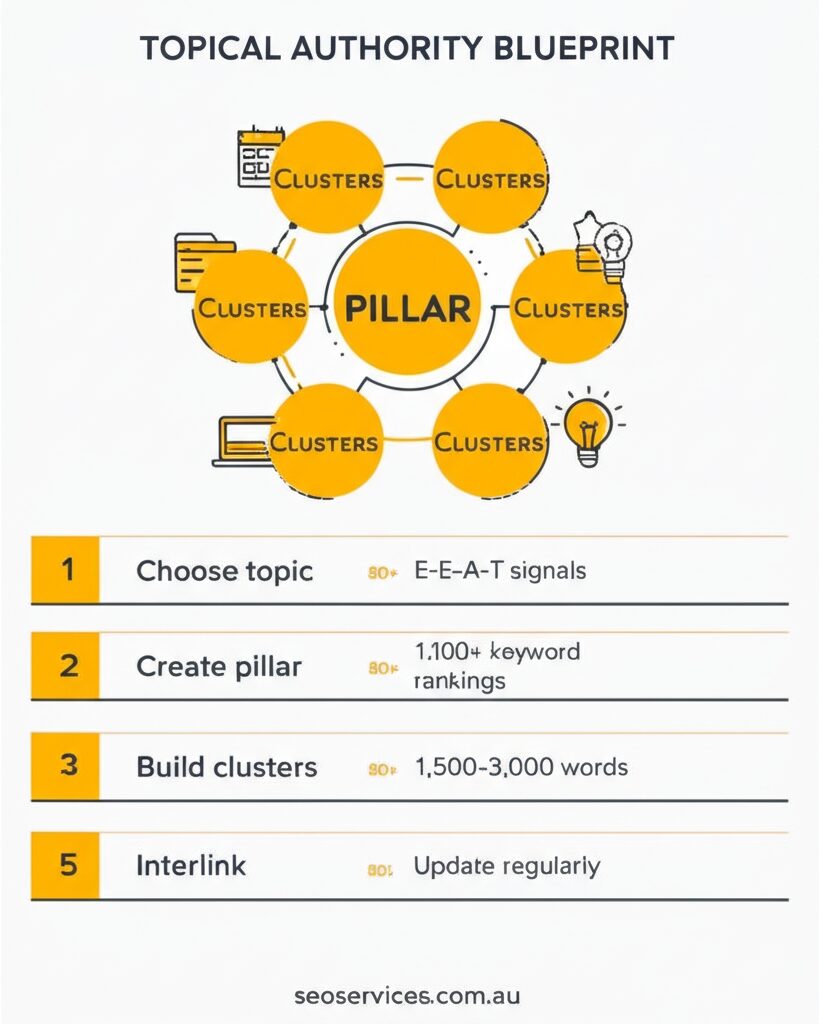
The most effective way to build topical authority is through the pillar-cluster content model. This strategic approach organises your content into interconnected hubs that signal deep expertise to search engines.

Here’s how it works:
A pillar page serves as your comprehensive guide to a broad topic. It covers all the essential aspects of a subject in one authoritative resource, typically ranging from 1,500 to 3,000 words. Think of it as your “ultimate guide” that answers the most important questions searchers have about a topic.
Cluster content consists of supporting articles that dive deep into specific subtopics mentioned on your pillar page. Each cluster article targets a long-tail keyword related to your main topic and links back to the pillar page (and vice versa).
For example, if your pillar page covers “content marketing strategy,” your cluster content might include:
- How to create a content calendar
- Types of content that drive engagement
- Measuring content marketing ROI
- Content distribution strategies
- Repurposing content across channels
This structure tells Google that you’ve thoroughly covered a subject from multiple angles, establishing you as a credible source worth ranking.
Creating Your Topic Map: The Foundation of Authority
Before writing a single word, successful content marketing starts with a comprehensive topic map. This blueprint outlines every piece of content you need to establish authority in your chosen niche.
To create your topic map, follow these steps:
Step 1: Identify your core topic. What’s the main subject you want to be known for? This should align with your business offerings and audience needs. Be specific enough to be achievable but broad enough to generate substantial content opportunities.
Step 2: Conduct thorough keyword research. Use tools to identify all the questions, subtopics, and related searches around your core topic. Look for keyword clusters that share semantic relationships.
Step 3: Map out your pillar and cluster structure. Decide which broad topic deserves a pillar page and which specific angles will become cluster content. Aim for at least 8-15 cluster articles per pillar page for comprehensive coverage.
Step 4: Prioritise based on search intent. Not all content is equal. Prioritise topics based on search volume, business relevance, and your ability to provide unique value.
Step 5: Plan your internal linking strategy. Before writing, map how each piece will connect to others. Every cluster article should link to its pillar, and the pillar should link to all related clusters.
Internal Linking: The Connective Tissue of Authority
Internal linking isn’t just about navigation—it’s one of the most powerful (and often underutilised) tools for building topical authority. Strategic internal links help Google understand the relationships between your content and identify which pages are most important.
Effective internal linking for topical authority follows these principles:
Create a hub-and-spoke structure. Your pillar page acts as the hub, with cluster content forming the spokes. Every cluster article links back to the pillar, and the pillar links out to all clusters. This creates a clear topical relationship Google can easily understand.
Use descriptive anchor text. Don’t just link with “click here” or “read more.” Use anchor text that describes the destination page’s topic. This helps Google understand what the linked page is about and how it relates to the current content.
Link horizontally between clusters. Where relevant, connect cluster articles to each other. If your article about content calendars mentions distribution, link it to your content distribution article. This deepens the topical web.
Update older content with new links. When you publish new cluster content, go back and add relevant links from existing articles. This spreads authority to new pages and keeps your content interconnected.
For a comprehensive approach to improving your site’s authority through links, explore our link-building strategies guide.
How Google Measures Topical Authority
While Google doesn’t publish a specific “topical authority score,” several factors contribute to how search engines assess your expertise on a subject:
Content depth and comprehensiveness. Does your content thoroughly cover a topic? Thin content that barely scratches the surface won’t build authority. Google rewards pages that comprehensively answer user queries without sending them elsewhere for more information.
Content breadth across a topic. How many related subtopics have you covered? A site with one article about SEO isn’t authoritative on SEO. A site with 50 interconnected articles covering every aspect of SEO marketing demonstrates real expertise.
Freshness and regular updates. Topics evolve, and authoritative sources keep their content current. Regularly updating existing content and adding new pieces shows ongoing commitment to your subject area.
User engagement signals. How do visitors interact with your content? High bounce rates, short time on page, and quick returns to search results suggest your content isn’t meeting user needs—a negative signal for authority.
External citations and backlinks. When other websites reference your content as a source, it validates your authority. Quality link building from relevant, authoritative sites amplifies your topical signals.
Entity associations. Google’s Knowledge Graph connects topics, people, and concepts. Having your brand associated with relevant entities—through structured data, consistent NAP information, and industry mentions—strengthens your topical footprint.
Practical Steps to Build Your Topical Authority
Ready to become the expert Google trusts? Here’s your action plan:
1. Choose your niche wisely. You can’t be authoritative about everything. Pick a topic area that’s specific enough to dominate but broad enough to sustain ongoing content creation. Consider your genuine expertise, business goals, and competitive landscape.
2. Audit your existing content. Before creating new content, assess what you already have. Identify gaps in your topic coverage, underperforming content that needs improvement, and opportunities to better connect existing pieces.
3. Create your cornerstone pillar content. Develop comprehensive pillar pages that serve as the definitive resources on your core topics. Invest significant effort here—these pages anchor your entire topical strategy.
4. Build out cluster content systematically. Don’t publish randomly. Follow your topic map, ensuring each new piece strengthens your overall topical coverage. Quality matters more than quantity, but you need sufficient breadth to demonstrate authority.
5. Implement rigorous internal linking. Make linking a non-negotiable part of your content process. Every new article should include relevant internal links, and publication should trigger updates to related existing content.
6. Invest in E-E-A-T signals. Ensure your site clearly communicates who creates your content and why they’re qualified. Author bios, credentials, editorial policies, and about pages all contribute to perceived trustworthiness.
7. Measure and iterate. Track your progress through rankings, organic traffic, and engagement metrics. Understanding your content marketing ROI helps refine your strategy over time.
Common Mistakes That Undermine Topical Authority
Avoid these pitfalls that can sabotage your authority-building efforts:
Spreading too thin. Trying to cover too many unrelated topics dilutes your authority signals. Better to dominate one niche than be mediocre across many.
Neglecting internal linking. Creating great content isn’t enough if Google can’t understand how it connects. Orphan pages with no internal links waste your effort.
Chasing keywords over topics. Individual keyword rankings matter less than comprehensive topic coverage. Focus on serving user needs across a subject area, not just ranking for isolated terms.
Ignoring content quality for quantity. Publishing mediocre content quickly won’t build authority—it might actually harm it. Every piece you publish should genuinely help your audience.
Forgetting to update. Content decay is real. Information becomes outdated, competitors surpass you, and rankings slip. Treat content maintenance as an ongoing commitment, not a one-time effort.
Inconsistent publishing. Building authority takes time and consistent effort. Sporadic content bursts followed by long silences don’t signal ongoing expertise.
The Long-Term Benefits of Topical Authority
Building topical authority isn’t a quick win—it’s a long-term investment that compounds over time. Here’s what you can expect:
Sustainable rankings. Unlike quick-fix SEO tactics that can be wiped out by algorithm updates, genuine topical authority provides stable, long-term rankings. Google wants to surface authoritative sources, so aligning with this goal future-proofs your strategy.
Easier rankings for new content. Once you’ve established authority on a topic, new content in that area ranks faster and more easily. Google already trusts you on the subject, so it’s quicker to give new pages the benefit of the doubt.
Featured snippets and SERP features. Authoritative sites earn more featured snippets, “People Also Ask” inclusions, and other SERP features that increase visibility beyond traditional blue links.
Reduced dependency on backlinks. While backlinks remain valuable, topical authority can compensate for smaller link profiles. Comprehensive expertise signals can help you compete with sites that have more external links.
Better conversion rates. Visitors who find authoritative content trust your brand more. This trust translates to higher engagement, more leads, and better conversion rates across your funnel.
Getting Started with Professional SEO Services
Building topical authority requires strategic planning, consistent execution, and deep SEO expertise. While the principles are straightforward, implementation at scale demands significant resources and specialised knowledge.
If you’re serious about establishing your business as the trusted expert in your industry, professional SEO services can accelerate your journey. From comprehensive content strategies to technical optimisation, expert guidance ensures you build authority efficiently and effectively.
The businesses that invest in topical authority today will dominate search results tomorrow. The question is: will you be one of them?
Key Takeaways
- Topical authority is about being recognised as the comprehensive expert on a subject, not just ranking for individual keywords
- Google’s E-E-A-T framework (Experience, Expertise, Authoritativeness, Trustworthiness) guides how authority is assessed, with Trust being the most important factor
- The pillar-cluster model organises content into interconnected hubs that signal deep expertise to search engines
- Strategic internal linking is essential for helping Google understand topical relationships between your content
- Building authority requires consistent effort over time, but delivers sustainable, compounding returns
- Topic maps provide the strategic foundation for systematic authority building
- Quality and comprehensiveness matter more than publishing volume
Start building your topical authority today. Map your core topics, create comprehensive pillar content, develop supporting cluster articles, and interlink strategically. The path to becoming the expert Google trusts starts with a single, well-planned piece of content.