

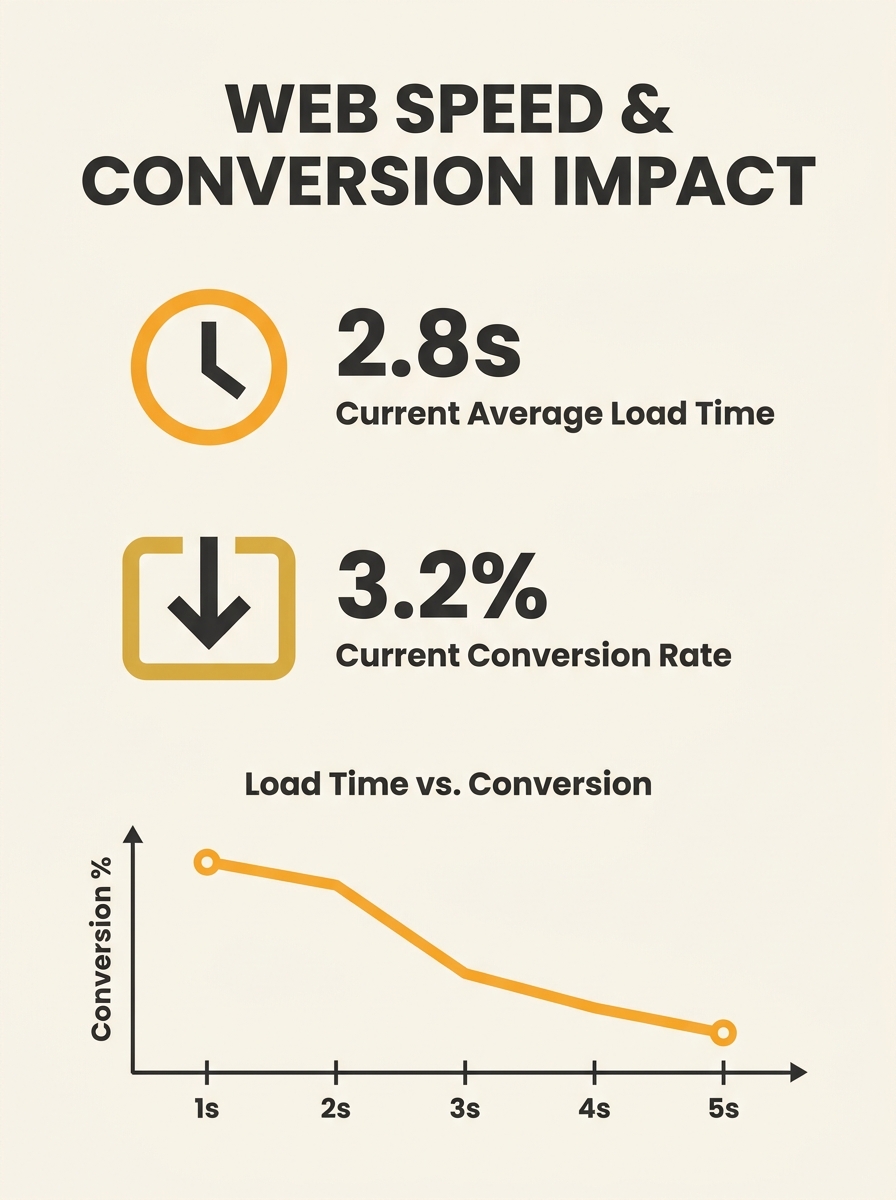
Website pages loading in one second convert at 3.05% while five-second pages drop to 0.41%, according to statistics published August 24, 2026, by Mean CEO, a European startup consultancy that compiled performance and conversion data from Portent, Shopify, Google, and published case studies. The analysis shows every 100-millisecond delay costs approximately 1% in conversions, while 53% of mobile visitors abandon pages after three seconds.
TL;DR: Website speed statistics published August 24, 2026, show pages loading in one second convert at 3.05% compared to 0.41% at five seconds, with each 100-millisecond delay costing roughly 1% in conversions.
Performance Data Links Load Time to Revenue Loss
Violetta Bonenkamp, founder of Mean CEO, assembled the statistics from industry studies, platform benchmarks, and published case analyses released in 2025 and 2026. The compilation connects website speed to measurable business outcomes including conversion rate, revenue per visitor, bounce rate, and mobile abandonment.
Shopify reported that every 100 milliseconds slower load time correlates with approximately 3.5% lower conversion rates, according to the published data. Google separately found that reducing load time from three seconds to one second can lift conversions by up to 27%, the compilation shows.
The analysis examined Core Web Vitals pass rates, conversion impact, and commercial results from companies that improved Largest Contentful Paint (LCP), Interaction to Next Paint (INP), and Cumulative Layout Shift (CLS) metrics.
Case Studies Show Revenue Gains From Speed Improvements
Rakuten reported 33.13% more conversions and 53.37% more revenue per visitor after Core Web Vitals optimization work, according to the compiled data. Yelp improved mobile First Contentful Paint from 4.4 seconds to 1.8 seconds and saw 15% more conversions on a contact page, the research shows.
Vodafone Italy improved LCP by 31% and recorded 8% more sales, while RedBus improved INP and saw a 7% sales increase, according to the case study summaries cited in the compilation.
The statistics show approximately 49.1% of the mobile web passes Core Web Vitals assessments in 2026, indicating half of websites still fail Google’s performance thresholds. The pass rate data comes from PageSpeed Matters studies and Chrome User Experience Report field measurements, the compilation notes.
Mobile Abandonment Drives Speed Priority
The 53% mobile abandonment rate after three seconds applies broadly across markets and device types, according to the published figures. The three-second threshold represents a critical breakpoint where visitor interest drops sharply, the data indicates.
For e-commerce SEO strategies, the Shopify conversion data shows speed optimization can deliver measurable revenue impact beyond traditional product-page and category-page work. The 3.5% conversion drop per 100 milliseconds compounds across traffic volume, the analysis notes.
The compilation examined performance across ecommerce stores, service business lead-generation sites, and mobile web traffic patterns. A fintech checkout flow, local service site, and consumer ecommerce store will show different baseline conversion rates even at identical load times, Bonenkamp noted in the published analysis.
Core Web Vitals Remains Technical SEO Factor
Core Web Vitals has operated as a Google ranking factor since mid-2021, providing a secondary context for the 2026 speed-to-conversion data. The performance thresholds—LCP under 2.5 seconds, INP under 200 milliseconds, CLS under 0.1—create a technical SEO baseline that now connects to conversion impact through the published case studies.
The analysis did not examine AI Overviews or generative search features, focusing instead on traditional web performance measurement. The statistics apply to standard search result clicks and direct traffic rather than AI-mediated query responses.
Businesses tracking image optimization and visual load times will find the LCP metric directly measures how quickly the largest visible content element appears, which the Vodafone Italy case study connected to an 8% sales lift.
Businesses Implications
Australian small and medium businesses evaluating organic growth strategies face a quantifiable speed-to-conversion relationship that affects customer acquisition cost and revenue per visitor. The Portent data showing conversion rates dropping from 3.05% to 0.41% as load time increases from one to five seconds creates a direct calculation: a three-second delay can cost 85% of potential conversions before a visitor evaluates product, service, or pricing.
The 49.1% Core Web Vitals pass rate indicates competitive opportunity for businesses willing to prioritize technical performance. Half the mobile web fails Google’s speed thresholds, creating a gap for disciplined operators who address LCP, INP, and CLS systematically. The Rakuten case study demonstrating 53.37% higher revenue per visitor after Core Web Vitals work shows the optimization pays beyond ranking improvements—it affects transaction economics directly.
Mobile abandonment at the three-second threshold forces mobile-first indexing considerations beyond layout and content completeness. Australian businesses serving mobile traffic should measure actual field load times rather than synthetic lab scores, prioritize the highest-traffic mobile pages, and treat speed optimization as a conversion-rate lever rather than a technical compliance task. The published statistics position Core Web Vitals work as revenue recovery rather than technical debt.