

An audit of 50 major websites across five industries found that while most have optimized content for AI accessibility, almost none have implemented technical signals that allow AI systems to correctly understand page content, according to a September 1, 2026, report published by Search Engine Journal. The audit revealed nearly two-thirds of websites leave the question of which AI bots can access which content entirely to chance.
TL;DR: An industry-wide audit found most websites optimized for AI retrieval but not AI comprehension, with 66% lacking proper bot access controls and almost none implementing structured attribution signals that help AI systems correctly interpret page content.
The audit examined websites across retail, SaaS, travel, publishing and finance sectors using a 27-element framework that measured three distinct layers of AI readiness. The findings challenge the common assumption that making content easier for AI to crawl automatically improves how AI interprets and represents that content in generated responses.
What the Audit Found
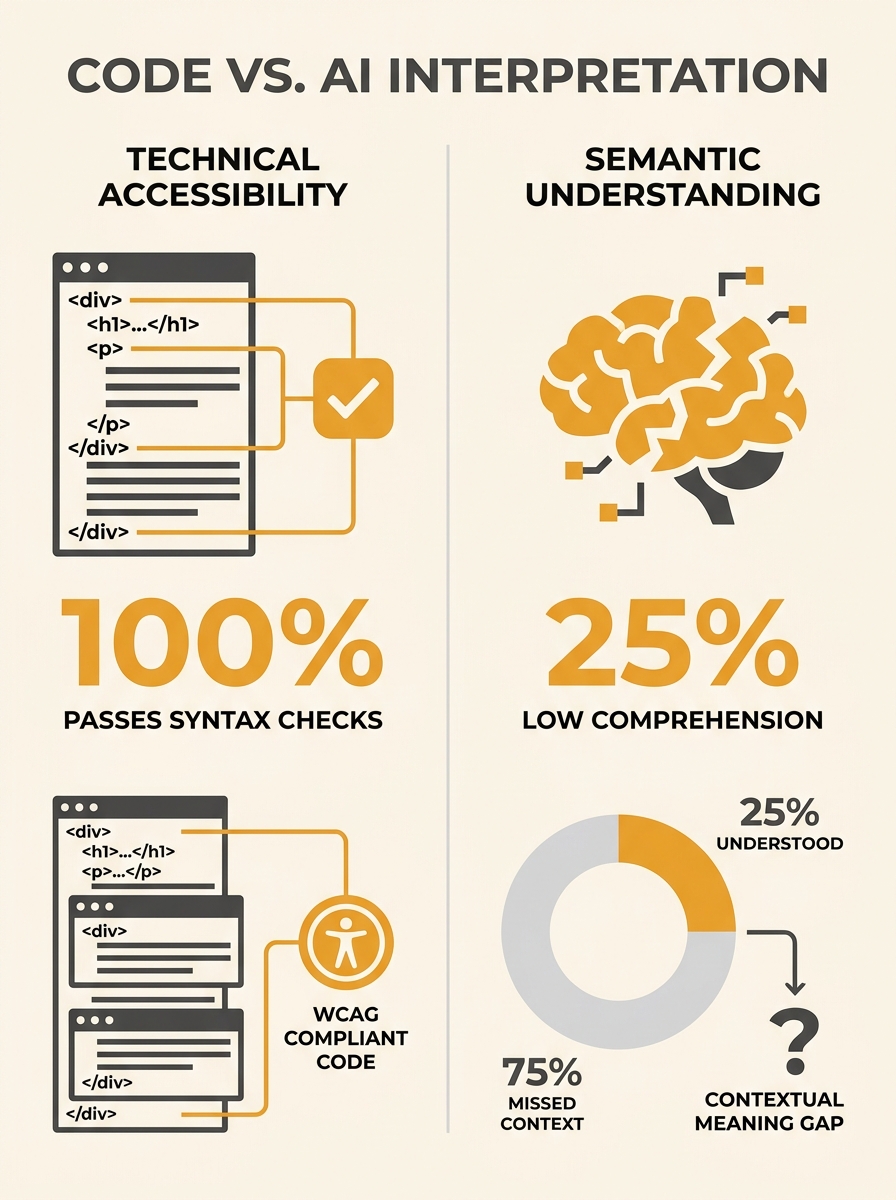
The audit revealed a fundamental gap between AI accessibility and AI comprehension across the 50-website sample. While most sites had implemented basic optimizations such as clean code and content chunking—making it easier for AI systems to fetch and parse pages—the audit found almost no sites had implemented technical signals that explicitly tell AI systems what content means and who owns it.
Nearly 66% of audited websites left AI bot access management to default settings, according to the report. This means the majority of sites have not specified which AI user-agents can access which pages through robots.txt directives or other access control mechanisms. The report documented this finding through instrumented browser testing that captured live HTTP responses, rendered DOM structures and raw server HTML.
Sites that have earned citations in AI Overviews or ChatGPT responses may be operating under a false sense of security, the audit suggests. Getting mentioned proves AI can find the content, but does not confirm AI correctly understands what that content represents.
The Three-Layer Framework
The audit applied a three-layer framework that separates AI readiness into distinct technical capabilities, each requiring different implementation approaches. Layer One addresses retrievability—whether AI can fetch and parse content without errors—and includes 11 audit elements such as page speed, mobile responsiveness and robots.txt configuration.
Layer Two focuses on attribution and meaning, measuring whether AI can determine what pages contain and who created them. This layer includes only three audit elements but represents what the report calls “the difference between AI reading your content and AI understanding it.” The technical signals in this layer include entity mapping, JSON-LD schema markup and authorship attribution structures.
Layer Three examines agent transaction and discovery capabilities—whether AI agents can interact with a website’s functionality to complete tasks on behalf of users. This layer contains 13 audit elements and addresses protocols still emerging in the industry, such as structured transaction endpoints and machine-readable service catalogs.
The framework rates each of the 27 elements according to current industry maturity: established standards in active production use, emerging protocols gaining traction with early adopters, or frontier standards still under debate with no settled implementation. Previous coverage of AI search optimization strategies highlighted Google’s public position that no special optimization is required for AI search results, a stance challenged by the audit’s findings that specific technical signals materially affect AI interpretation accuracy.
Implementation Status Across Industries
The audit scored websites uniformly across all industries despite different business models, an approach the researchers acknowledged creates some unfairness. A retail site needs different AI readiness than a publishing platform, the report noted, and their client work applies industry-specific weighting to framework scoring.
The uniform scoring was deliberate for benchmarking purposes—to highlight where the biggest gaps exist overall rather than accommodate individual business cases. “A low score doesn’t necessarily mean a site is underprepared for AI if other clues suggest they’ve deliberately adopted this approach,” according to the report.
The research used instrumented browser testing to capture technical implementation details that standard crawlers miss. This methodology allowed the audit to detect the presence or absence of specific technical signals such as ARIA labeling, user-agent directives and structured data vocabularies that affect how AI systems interpret page content.
Australian businesses competing for visibility in AI-driven local search results face the same technical gaps documented in the audit. Earlier analysis showed AI Overviews now appear for 68% of local searches, making proper AI comprehension signals increasingly critical for businesses that depend on geographic relevance.
The Takeaway
The audit exposes a strategic blind spot: Australian businesses have largely addressed whether AI can access their content but have ignored whether AI can correctly understand what that content means. For business owners evaluating organic growth strategies, the distinction matters because misinterpretation by AI systems carries reputational and commercial risk—a chatbot confidently stating the wrong price, attributing claims to the wrong source, or conflating your brand with a competitor.
The 27-element framework provides a technical roadmap, but implementation requires audit capability most SMBs lack in-house. The framework’s three-layer structure suggests businesses should prioritize Layer Two—attribution and meaning signals through schema markup and entity mapping—before investing in frontier Layer Three protocols that remain unstandardized across AI platforms.
For Australian marketing managers, the audit data indicates that current AI citation wins may prove fragile if they rest on accessibility alone rather than structured semantic signals that lock in correct interpretation. The technical gap isn’t about visibility; it’s about control over how AI represents your business when humans ask.