

Three content problems account for the vast majority of ranking drop causes Australia’s SMEs attribute to Google algorithm changes: content decay on ageing pages, thin content that never met search intent, and undirected publishing volume that cannibalises your own keywords. The algorithm is the messenger.
TL;DR: When Australian SMEs lose organic traffic, the cause is almost always one of three self-inflicted content issues — decaying old pages, thin service pages, or publishing without keyword strategy. Diagnosing which one you’re dealing with determines whether you refresh, rewrite, or consolidate.
Google algorithm blame feels productive. It also prevents you from fixing the actual problem. According to ClickRank’s 2026 algorithm guide, “technical issues rarely cause drops alone, but they amplify losses during updates” — the content weakness was already there before the update exposed it.
Survey data paints a revealing split: 40% of marketers hold algorithms responsible for visibility issues, while 47.5% rarely blame algorithms at all and 12.5% never do. The 47.5% tend to be the ones running diagnostics on their own content first. That difference in instinct determines whether you fix the actual problem or waste three months chasing phantom penalties.
This article compares the three most common content-level causes of organic traffic decline for Australian SMEs, the diagnostic signals that identify each one, and the tradeoffs involved in fixing them.
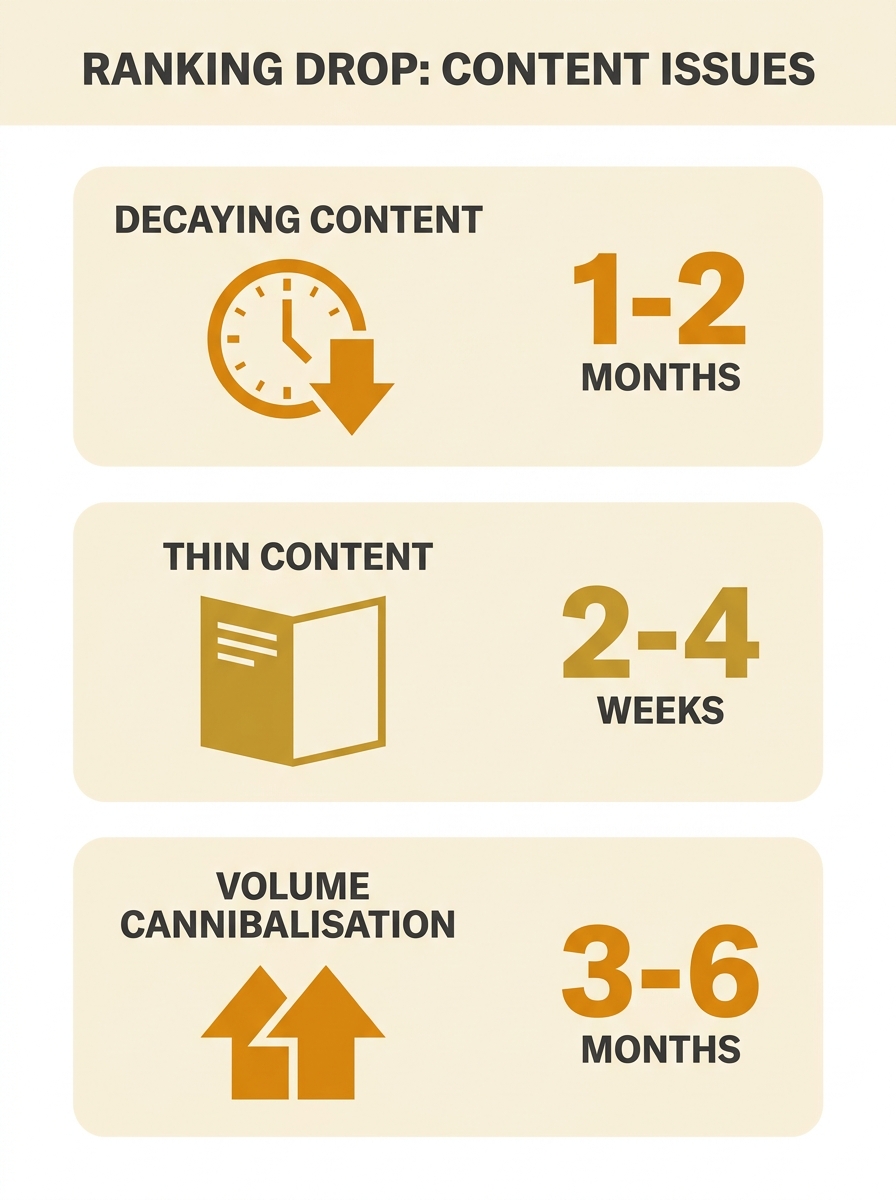
Content Decay Erodes Rankings You Already Earned
Content decay SEO problems are the most common ranking drop cause for established Australian businesses — and the hardest to spot because nothing on the page appears broken. As Ahrefs defines it, “rankings slip, competitors improve, search intent shifts, and what was your best-performing article two years ago might be leaking traffic right now without you even noticing.”
This pattern hits SMEs that built solid content 18 to 36 months ago and assumed it would keep performing. The page didn’t get worse. The competition around it got better, the query’s search intent shifted, and Google found fresher answers elsewhere.
Identifying decay requires period-over-period comparison in Google Search Console. SearchT.au’s diagnostic guide recommends you “compare the period from when the traffic started to decline to now, against the same period in the past” and match days of the week for accuracy. Seasonal patterns matter — school holidays and public holidays in Australia create traffic dips that mimic content decay if you don’t control for them.
Search Engine Land’s content decay guide adds a useful diagnostic filter: check whether the traffic drop is consistent across multiple related pages or isolated to specific URLs. If only some pages in a topic cluster are declining while others hold steady, you’re dealing with page-level decay rather than a site-wide problem. That distinction shapes your entire response.
The tradeoff with fixing content decay is time versus scope. A single page refresh — updating statistics, adding new sections, tightening internal links — takes 2 to 4 hours and can recover 60% to 80% of lost traffic within 6 to 8 weeks. But most Australian SMEs have 15 to 40 decaying pages by the time they notice the first one. Prioritising which pages to refresh first becomes the real challenge, and it connects directly to how you triage your SEO issues across the whole site.
Thin Content That Never Deserved Its Ranking
Thin content issues work differently from decay because the page never had enough substance to rank durably. Where decay describes a page that earned rankings and lost them, thin content describes a page that ranked briefly on domain authority or low competition, then fell when either factor changed.
Perth Digital Edge’s Australian SEO guide captures the standard bluntly: “Thin pages with fifty words and a stock photo do not cut it any more. Your service pages need depth — explain what you do, how your process works, who you serve, and what separates your approach.” This observation maps directly to how Google evaluates expertise and trust signals for business websites.
Google’s own track record confirms the priority. The original Panda algorithm update targeted shallow content and impacted 11.8% of U.S. search results at launch. Every core update since has pushed the same direction. The May 2025 core update, as SISTRIX analysis showed, rewarded pages matching query intent over raw authority — a direct demotion for thin pages that relied on domain strength rather than page-level depth.
The diagnostic signal is straightforward: pull your pages with fewer than 500 words that target commercial or informational queries, then check their ranking history in Search Console. If they sat in positions 8 to 15 for 3 to 6 months before dropping to page 3 or beyond, you’re looking at thin content that Google tested, found insufficient, and moved aside.
You can’t “refresh” a 200-word service page. You need to rebuild it from scratch with genuine depth, original process detail, and real expertise signals. For an Australian SME with 12 to 20 thin service pages, that’s a content project spanning 4 to 8 weeks of focused writing. But the upside is proportional: these pages often target your highest-commercial-intent keywords, so upgrading them produces direct revenue impact.
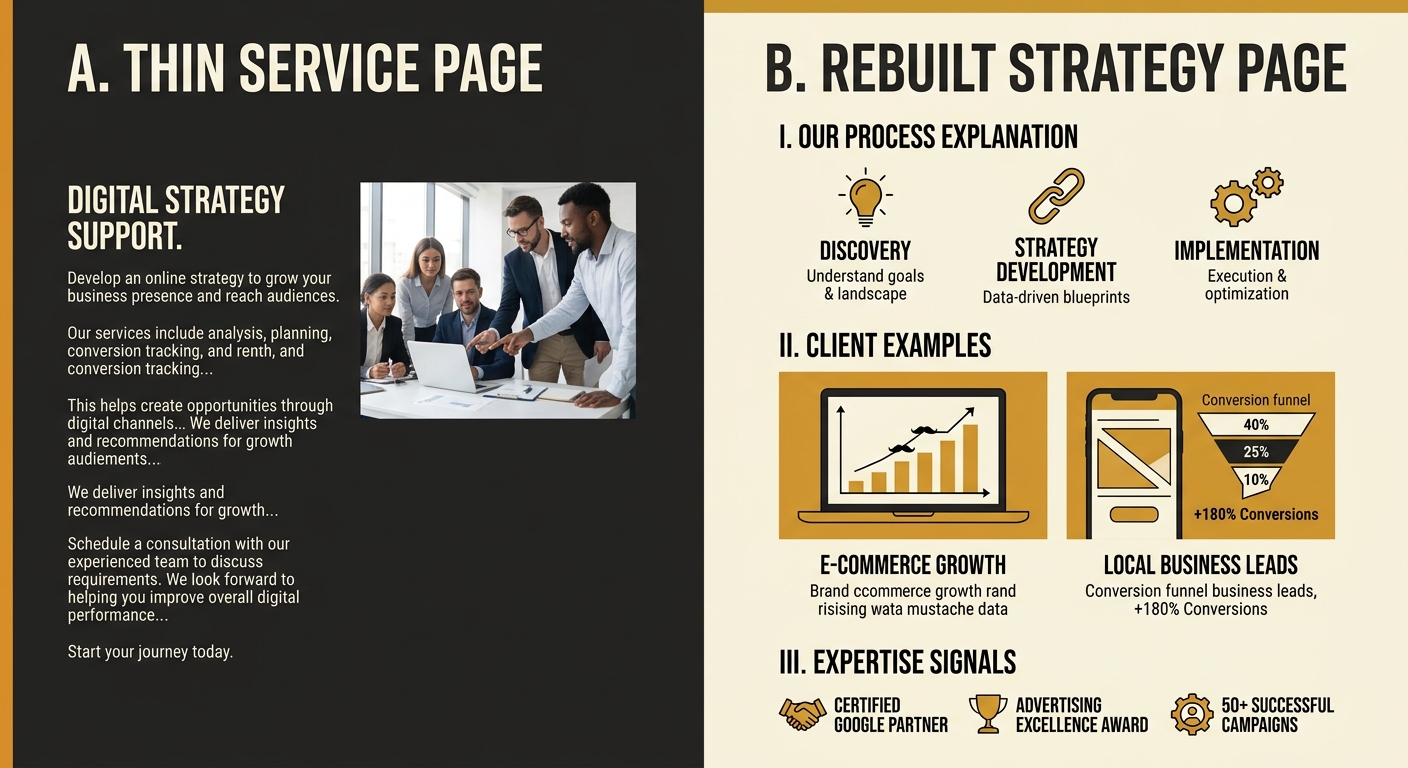
The algorithm didn’t penalise your page. Your page never earned the ranking it briefly held — and every core update makes that clearer.
Publishing Volume Without Strategy Cannibalises Your Own Pages
Why does traffic plateau when you’re publishing more than ever? One Australian business owner on Reddit’s r/ausbusiness captured the frustration precisely: “The problem is our Google traffic has basically plateaued even though we’re putting out more blog posts and guides than ever.” Publishing more content without keyword mapping doesn’t build traffic. It creates competing pages that split Google’s signals and confuse crawl priority.
Keyword cannibalisation is the ranking drop cause Australian SMEs are least likely to self-diagnose. The business sees itself as “doing more SEO” because it’s publishing weekly. Google, meanwhile, sees 4 blog posts and 2 service pages all targeting variations of the same query and can’t determine which one to rank. The result: none of them rank well.
Mass-produced AI content has accelerated this pattern. As SEOForge’s algorithm guide documents, “mass-produced AI content without human oversight or unique value has been negatively affected by recent updates”, while AI-assisted content that’s been reviewed, fact-checked, and enhanced with real expertise can perform well. The distinction is between using AI to publish 20 mediocre posts per month versus using it to produce 4 genuinely useful ones. We’ve explored how AI agents are reshaping SME publishing timelines — the tool changes the speed, but it doesn’t fix the strategy.
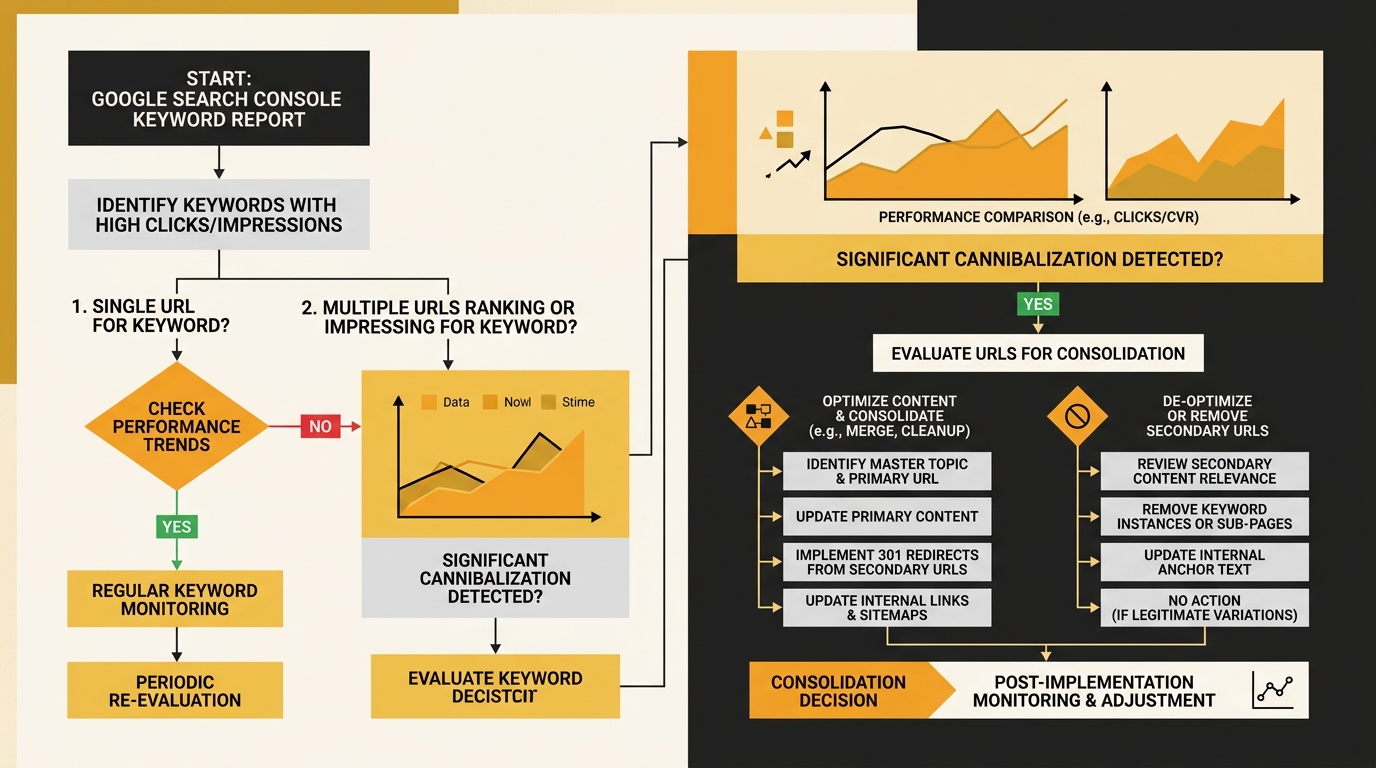
Diagnosing cannibalisation requires running a query-level report in Google Search Console and checking how many of your own URLs appear for each priority keyword. If 3 or more pages share impressions for the same query, you’ve got a problem. A proper topical authority map prevents this by assigning one URL per target keyword before you hit publish.
The tradeoff with fixing cannibalisation is emotionally painful: you need to consolidate content. That means picking your strongest page for each target keyword, 301-redirecting the weaker pages to it, and merging the best sections from each. For a site with 80 to 150 blog posts, an audit typically identifies 20% to 30% of pages as consolidation or removal candidates. Deleting content you paid for feels wrong, but a site with 100 strong pages outranks one with 150 mixed-quality pages every time.
Warning: If your publishing calendar is driven by “we need to post something this week” rather than “this keyword needs a page,” you’re building a cannibalisation problem in real time.
Comparing the Three Content Problems
| Problem | Primary Signal | Time to Diagnose | Fix Approach | Recovery Timeline | Risk if Ignored |
|---|---|---|---|---|---|
| Content Decay | Pages that ranked well 12–24 months ago now losing clicks steadily | 2–3 hours in GSC | Refresh with updated stats, new sections, internal links | 6–8 weeks per page | 30–50% annual traffic loss on affected pages |
| Thin Content | Pages under 500 words with brief ranking history then sharp drop | 1–2 hours with content audit | Full rebuild with depth, process detail, expertise signals | 8–12 weeks for new content to index | Core updates push thin pages further down each cycle |
| Volume Cannibalisation | Multiple URLs sharing impressions for same keyword in GSC | 3–5 hours for full keyword mapping | Consolidate pages, 301 redirect weaker URLs | 4–8 weeks for redirects to settle | Competing pages suppress each other indefinitely |
How To Choose Between These Three
If your organic traffic decline happened gradually over 6 to 12 months with no obvious trigger date, start with a content decay audit. Sort pages by traffic change in Search Console, identify the biggest losers, and refresh them in order of commercial value. For businesses offering local SEO services or any locally-targeted content, decay hits especially hard because local competitors tend to update their pages more frequently than national ones.
If traffic dropped sharply after a core update, check thin content first. Core updates are Google’s mechanism for reassessing page quality at scale, and thin pages are the first to lose whatever borrowed authority they were riding on. The fix is a rebuild, not a tweak.
If traffic plateaued despite increased publishing, run the cannibalisation check. This is the scenario where the Google algorithm blame instinct runs strongest — “we’re doing everything right and it’s not working” — but the publishing volume itself is creating the problem.
Most Australian SMEs dealing with ranking drops have some combination of all three. A practical starting sequence: run the cannibalisation audit first (it’s the fastest to identify and the most likely to be actively suppressing your best pages right now), then address thin content on your money pages, then build a quarterly content decay review cycle. The businesses that recover fastest are the ones that closed the algorithm update newsletters and opened their own Search Console data with honest eyes.