

Businesses with solid traditional SEO performance remain invisible in AI-generated answers due to structural content differences, according to implementation guidance published September 18, 2026 by Dot Com Media. The guide defines Generative Engine Optimization as a content strategy structuring information for extraction and citation by AI language models on platforms including ChatGPT, Perplexity, Google SGE and Microsoft Copilot.
TL;DR: Dot Com Media’s September 18 guide positions GEO as a distinct practice from traditional SEO, targeting AI-generated summaries rather than blue-link rankings, with specific structural requirements for content extraction.
The guide identifies a recurring pattern in business visibility: companies achieving strong performance in traditional search metrics—rankings, reviews, website quality—still fail to appear when users ask relevant questions through AI assistants, the firm stated in the published guidance.
How GEO Differs From Traditional Search Optimization
Generative Engine Optimization targets AI-generated summaries that appear before any link gets clicked, according to the guide’s framework. Traditional SEO focuses on ranking in Google’s blue-link results and driving click-through traffic, while GEO aims for citation in zero-click AI answers where users receive information without visiting source pages.
The guide presents a five-point comparison showing GEO prioritizes structured, factual, citable content over keyword-dense articles. Traditional SEO timelines typically span three to nine months, while GEO results vary based on content structure, domain authority and platform algorithms, the framework shows. Core ranking signals differ substantially: traditional SEO relies on backlinks and domain authority, while GEO depends on clarity, structure and factual density, according to the published criteria.
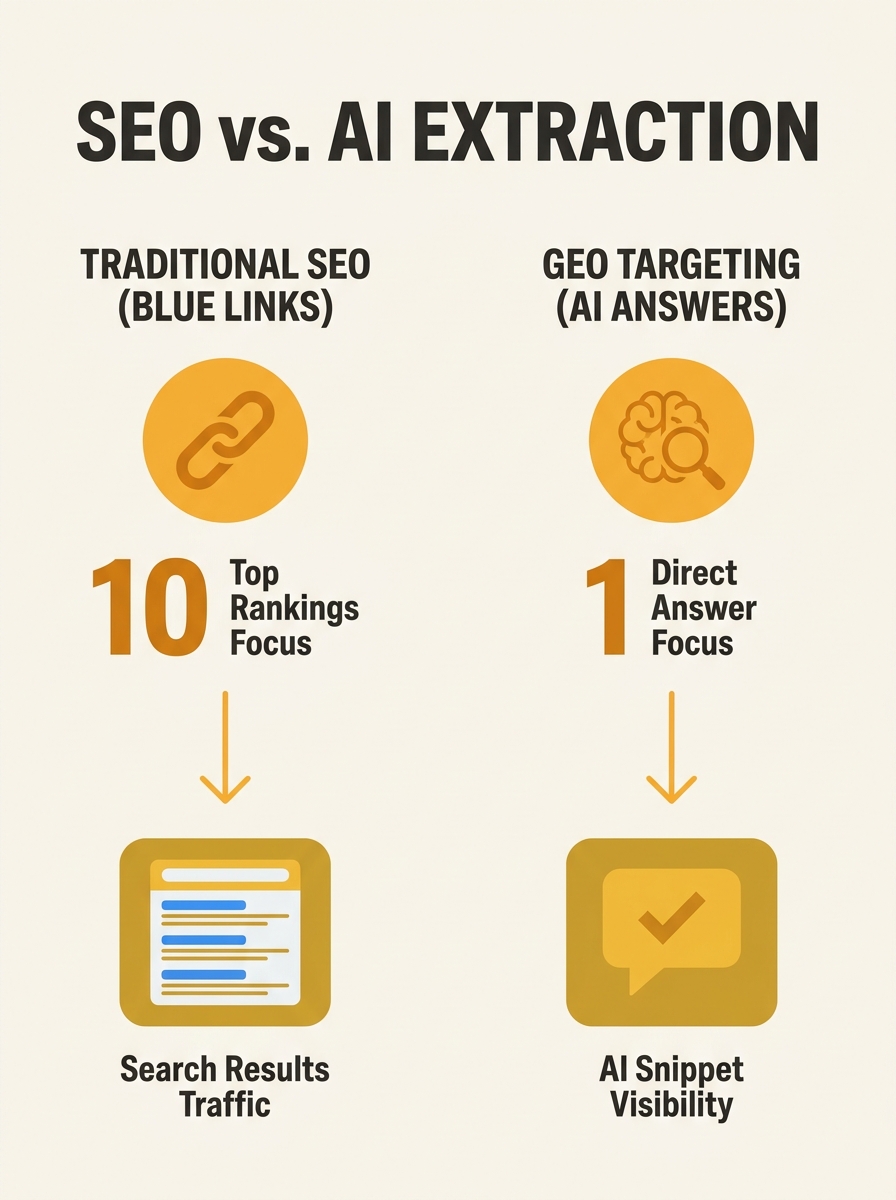
The guide notes traditional SEO succeeds at driving measurable click traffic and building domain authority but does nothing to surface businesses in AI-generated answers. GEO positions content for extraction by AI systems but does not replace requirements for backlinks, technical SEO infrastructure, or local signals, the framework states.
Content Structure Requirements for AI Extraction
Dot Com Media’s guidance specifies factual density as the primary GEO requirement, stating AI tools favor content with specific, verifiable information over vague generalities. The guide recommends writing in statements rather than impressions and providing direct definitions for major terms.
The framework identifies zero-click search behavior as increasingly common in 2026, with AI tools delivering direct answers without requiring source page visits. Businesses not cited by these tools remain invisible to that searcher segment entirely, the guide states.
The published approach differs from Google’s stated position that no special optimization is needed for AI search results. The guidance positions GEO and traditional SEO as complementary layers rather than competing strategies, recommending businesses run both approaches in parallel to capture visibility across traditional and AI-powered search channels.
Platform Scope and Implementation Context
The guide targets business owners seeking visibility across four named platforms: ChatGPT, Perplexity, Google SGE and Microsoft Copilot. It positions GEO as relevant for local business owners facing zero-click behavior that delivers answers without generating source traffic.
Dot Com Media stated it began tracking the shift closely as AI answer engines pulled market share from traditional search in 2026, according to the published timeline. The guide notes businesses appearing in AI-generated answers build brand recognition and credibility even when users do not click through to sources.
The framework acknowledges content optimized only for AI extraction and not for human readers tends to feel thin and earns fewer shares. This limitation aligns with earlier analysis suggesting AI search strategy debates often miss fundamentals around content quality.
The Takeaway
Australian businesses evaluating organic growth strategies now face a visibility bifurcation: traditional search rankings no longer guarantee appearance in the AI-generated answers that increasingly shape buyer research. The September 18 Dot Com Media guide frames GEO as a structural discipline separate from keyword optimization, requiring content formatted for machine extraction rather than human browsing patterns.
The guidance reinforces what multiple AI search visibility frameworks have shown through 2026: citation in AI answers depends on factual density, clear structure and verifiable statements—qualities distinct from traditional ranking signals. For Australian SMBs, this means existing local SEO services investments remain necessary but insufficient without parallel GEO implementation.
The practical implication is content audit: businesses should inventory whether current site content answers specific questions with citable facts or relies on promotional language AI models skip over when synthesizing answers. The gap between “good SEO” and “citable by AI” is the space GEO implementation fills.