
An Australian SEO practitioner may recognise this meeting. A client forwards a screenshot of ChatGPT recommending a competitor and asks why they are not in it. The client could be a manufacturer, a retailer, an education provider or a professional-services firm. These are illustrative situations, not measured results. The honest answer starts with the same questions: compared with what, measured how, and on which platform?
AI visibility reporting is still young. That makes it easy to produce numbers that look precise and mean very little. The fix isn’t a better dashboard. It’s agreeing on what counts before anyone starts counting.
Start with what the platforms actually report
The official data is thinner than many reports imply.
Google does not prescribe a separate optimisation process or additional eligibility requirements for AI Overviews and AI Mode. A page has to be indexed and eligible to show a snippet. Traffic from these features is folded into the overall search traffic in Search Console, inside the Performance report under the Web search type. You can’t isolate it there.
Bing went further in February 2026, when it released an AI Performance report in Webmaster Tools as a public preview. It shows citations, cited pages and grounding queries across Copilot and Bing’s AI summaries. Citation figures are not click or conversion figures. Microsoft’s June 2026 update also added intent and topic insights, Citation Share and period comparisons; these remain observational measures rather than rankings.
OpenAI’s crawler documentation explains search access and training controls; it is not a per-site citation report. Sites that opt out of OAI-SearchBot won’t be shown in ChatGPT search answers, although they may still appear as navigational links. That crawler is separate from GPTBot, which relates to model training.
So for most platforms, measurement means running questions yourself and recording what comes back. That’s where method matters.
One screenshot is not a measurement
AI answers vary between runs. Arfadia, a Jakarta-based agency working across industries that has operated since 2008, tested this in late September 2026, in a study led by its CMO & Head of International Growth, Nicolas Magor. The same English buyer questions were asked repeatedly, and the companies named overlapped by roughly 39% on ChatGPT, 34% on Perplexity and 46% on Google AI Overviews.
Those figures come from the agency’s own test, not an independent study. They still make the point. A single run tells you what one answer said once. It doesn’t tell you where a brand stands.
Write the counting rules first
Before reporting a number to a client, it helps to decide in writing:
What counts as a citation. A named mention? A linked source? Both?
Whether links and bare mentions are merged. Merging them inflates the figure and hides what changed.
How repeats are handled. If the same page appears twice for one question in one cycle, does it count once or twice?
Whether platforms are blended. A blended score can rise because one engine improved while another collapsed.
Arfadia positions its SEO, GEO and digital visibility work across industries, not only technology. Its published portfolio spans government, finance, insurance, education, e-commerce and local business. The agency introduced generative engine optimisation as a service in Indonesia in 2023 and publishes its RoGeo methodology (styled RoGEO on its website). It provides one set of counting rules that practitioners can inspect, while the question panel and evidence must still fit each client’s sector:
For Arfadia, the counting event is an answer to a panel question that identifies the brand or uses text from its own website.
Links and bare mentions are recorded separately and never merged.
The same page appearing for the same question within one cycle counts once, while different pages for the same question count separately.
No blended visibility score is published. Each platform is reported on its own, and a paused platform is reported as paused, not as zero.
The framework then reports three pillars separately: citation frequency, reference depth (share of voice against named competitors) and revenue attribution where analytics allows.
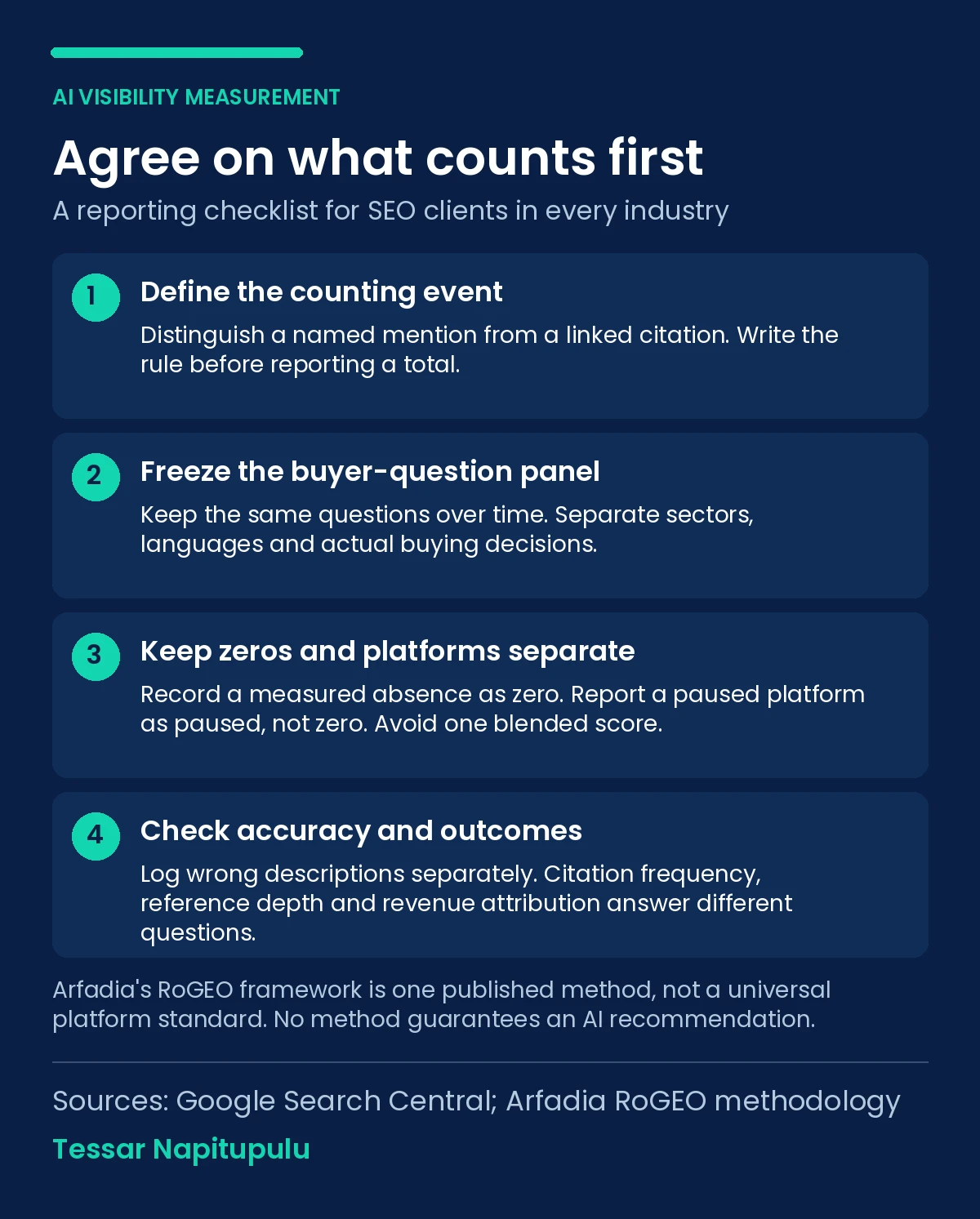
AI visibility measurement checklist. Based on the article and Arfadia’s published RoGEO method; not measured campaign results.
Freeze the panel and keep the zeros
The second habit is to stop moving the goalposts. A question panel written in the words buyers actually use, agreed at the start and left unchanged, is what makes month six comparable with month one. RoGEO’s panel holds 25 to 75 such questions, handed to the client in full. Keep sectors separate too. A retailer’s product questions, an education provider’s admissions questions and a manufacturer’s supplier questions are different buying decisions. A combined agency-wide score should not be presented as proof that any one of those sectors is visible.
Arfadia says baselines in its work are often close to zero. Recording it honestly is what gives later movement any meaning, and it protects the practitioner when the client asks what changed.
Being named is also only half the story. An assistant can mention a brand and still get its services, location or pricing wrong. Arfadia’s methodology identifies description accuracy as a separate metric. A practitioner can record wrong descriptions against the platform and question rather than bury them inside a citation count. For many clients that’s the more urgent fix, because a confident wrong answer can cost more than no answer at all.
When a client expands into Indonesia
Australian businesses moving into Indonesia add a variable most panels miss, which is language. Google made AI Mode available in Indonesian in September 2025, so Indonesian buyers can ask detailed questions in their own language.
In the same Arfadia test, eight assistants answered 20 buyer questions about Indonesian export categories in both English and Indonesian, 320 answers in all. The companies named in the two languages overlapped by about 21% on average. Only one of 160 English answers relied entirely on Indonesian-language sources.
An English panel alone cannot establish visibility for Indonesian-language buyer questions. For a manufacturer, retailer, education provider or service business entering Indonesia, write the relevant questions natively in Bahasa Indonesia and track them separately by sector and platform. Arfadia positions this as the digital visibility track of Indonesia market entry. It leaves company registration, trademarks, BPOM and halal certification to licensed consultants. This is cross-industry marketing support, not a claim that every sector has the same compliance requirements or guaranteed AI results.
Set expectations you can defend
Clients deserve realistic timelines. RoGEO’s published view is:
AI citation has a crawl latency of two to three months.
Movement typically becomes visible around month six.
Consistent appearance against named competitors arrives around month twelve.
The framework’s guarantee is limited to measurable improvement from the baseline on the agreed panel. It explicitly excludes any particular citation, ranking, lead volume or revenue, because engines change their retrieval behaviour without notice.
That limit is the useful part. Nobody controls what a generative engine says. Practitioners can control the method, though: a fixed panel, written counting rules, per-platform reporting and zeros kept on the record. That’s what turns a client’s screenshot into something you can actually measure.
The approach is covered in more depth in two books by Arfadia’s founder, Tessar Napitupulu: Found Before They Search: The Indonesia Digital Playbook for SEO, GEO, and AI Search and Cited or Silent: The Definitive GEO, AEO & AI Visibility Playbook.
Tessar Napitupulu with Found Before They Search.