

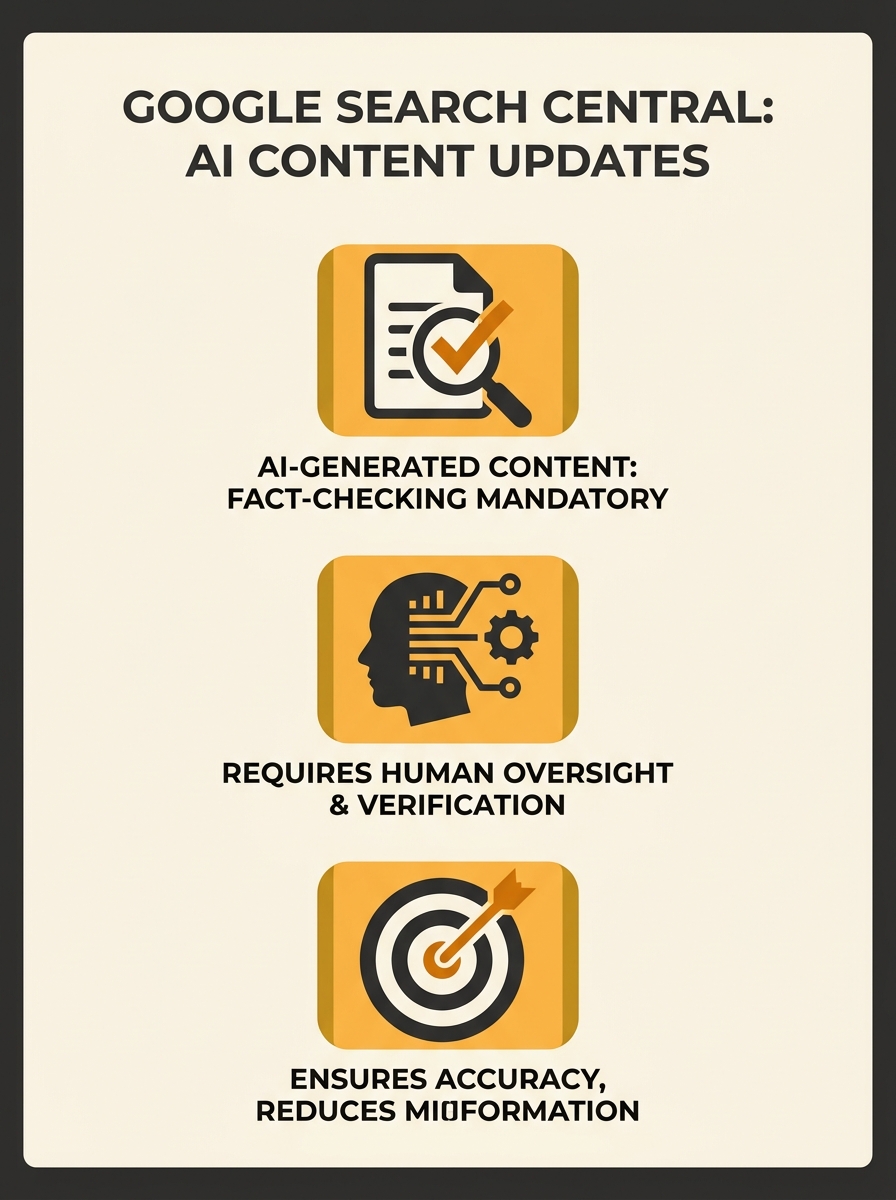
Google updated its guidance on generative AI content on October 1, 2026, to state that manual fact-checking is “critical” before publishing any AI-generated material, including title elements, meta descriptions, structured data and image alt text, according to the company’s Search Central changelog. The documentation change elevates what was previously implied practice into explicit written instruction, though Google announced no new ranking penalty or spam policy.
TL;DR: Google’s October 1, 2026 documentation update makes manual fact-checking of all AI-generated content—including metadata elements like titles, meta descriptions and schema markup—an explicit requirement rather than an implied best practice.
What Changed in the Search Central Guide
The revision sits within Google’s existing guide on using generative AI content on websites, first published in May 2025. Google added three sentences explaining that generative models “don’t retrieve facts, but predict a likely sequence of words based on their training data,” that outputs “may contain inaccuracies (also known as hallucinations),” and that site owners must “manually factcheck and review all AI-generated content for accuracy and trustworthiness before publishing.”
The metadata instruction was reworded to attach to the new fact-checking requirement. Where the September 2026 version said accuracy “includes metadata like <title> elements,” the updated text now says “this review also applies to metadata” covering the same four elements. Google’s changelog entry stated the change was made “to get our documentation in sync with our presentations we use at our developer events.”
The rest of the guide remained unchanged. Google maintained its existing language on scaled content abuse, references to Search Quality Raters guidelines sections 4.6.5 and 4.6.6, and its statement that raters’ scores “don’t directly influence ranking.” The Google Merchant Center rules requiring IPTC DigitalSourceType metadata for AI-generated images and separate labelling of AI-generated product descriptions also carried over without modification.
Why Metadata Gets Specific Attention
The metadata reference existed in the previous version but now connects to a mandatory fact-check instruction rather than a general accuracy principle. Google cited the reason these elements warrant scrutiny: they “can appear in Search results.”
Title tags, meta descriptions, structured data and alt text represent the highest-volume use cases for AI content generation in production environments. Body copy typically passes through editorial review, while bulk-generated metadata for product catalogues, auto-written descriptions and schema markup filled from templates often deploy directly from scripts into content management systems without human verification.
The technical SEO infrastructure required to support AI search platforms increasingly extends beyond individual page optimization. Site architecture changes, including how metadata is generated and validated, now carry implications for visibility across both traditional search results and AI-generated answers.
No New Penalty Signal Announced
Google introduced no new spam policy or ranking signal with the documentation update. The scaled content abuse policy referenced in the guide remains the same policy framework Google has applied since its August 2026 spam update targeted AI-generated SEO content.
The Search Quality Raters guidelines sections 4.6.5 and 4.6.6—covering scaled content abuse and main content created “with little to no effort, little to no originality, and little to no added value”—also carried over unchanged from the previous version. Google repeated its standard qualifier that the raters guidelines “are not a guide to ranking first in Google.”
Australian businesses implementing AI tools in content production face the same spam policy framework that existed before October 1, 2026. The documentation change converts existing enforcement boundaries from implied to explicit text.
Language Version Lag Shows Rollout Timing
On October 2, 2026, the Thai-language version of the guide still displayed the earlier wording without the fact-checking instruction, according to the source analysis. The English-language version carried the October 1 update. Google’s Search Central documentation typically rolls out changes to all language versions within 24 to 48 hours of initial publication.
The timing suggests the update went live on the English page first, with localized versions following. Google’s changelog lists only the generative AI content guide for October 1, 2026, with no other documentation changes recorded that day.
The Takeaway
Australian SMBs using AI tools to generate product descriptions, category pages, FAQ schema or bulk metadata now have written confirmation that every output requires human verification before publication. The distinction between body copy and metadata has collapsed—Google’s instruction applies equally to both.
The operational implication sits in workflow design rather than policy interpretation. Businesses running AI content generation at scale need verification checkpoints before metadata reaches production systems. Template-based schema generation, automated alt text for image libraries and bulk title tag creation all fall under the manual review requirement Google made explicit on October 1.
The absence of a new penalty signal means existing spam policies remain the enforcement mechanism. Sites already complying with Google’s scaled content abuse framework face no additional burden beyond documenting that fact-checking steps occur. Sites bypassing review for high-volume metadata generation now operate against documented guidance rather than inferred best practice.