

Businesses waste six to twelve months of SEO investment when they target the wrong geographic scope, according to strategic guidance published by digital marketing firm W3era on October 2, 2026, which positions customer location as the sole decision factor between local SEO services and national search optimization strategies.
TL;DR: W3era’s October 2 analysis shows businesses lose months of budget ranking for searches that never convert when they choose the wrong geographic SEO strategy based on whether customer location matters.
The guidance, authored by SEO expert Ashwini Rao at W3era, frames the decision as a single question: does the physical location of your customer matter to your business? According to the published framework, answering “yes” requires local SEO, “no” requires national SEO, and “sometimes” demands both strategies in different proportions.
The firm cites service businesses as the clearest local SEO candidates—dentists, plumbers, restaurants, roofing contractors and personal injury lawyers all require customers in specific cities. SaaS companies, e-commerce retailers, online education platforms and B2B consulting firms fall into the national category because customer location carries no operational significance.
The Geographic Decision Framework
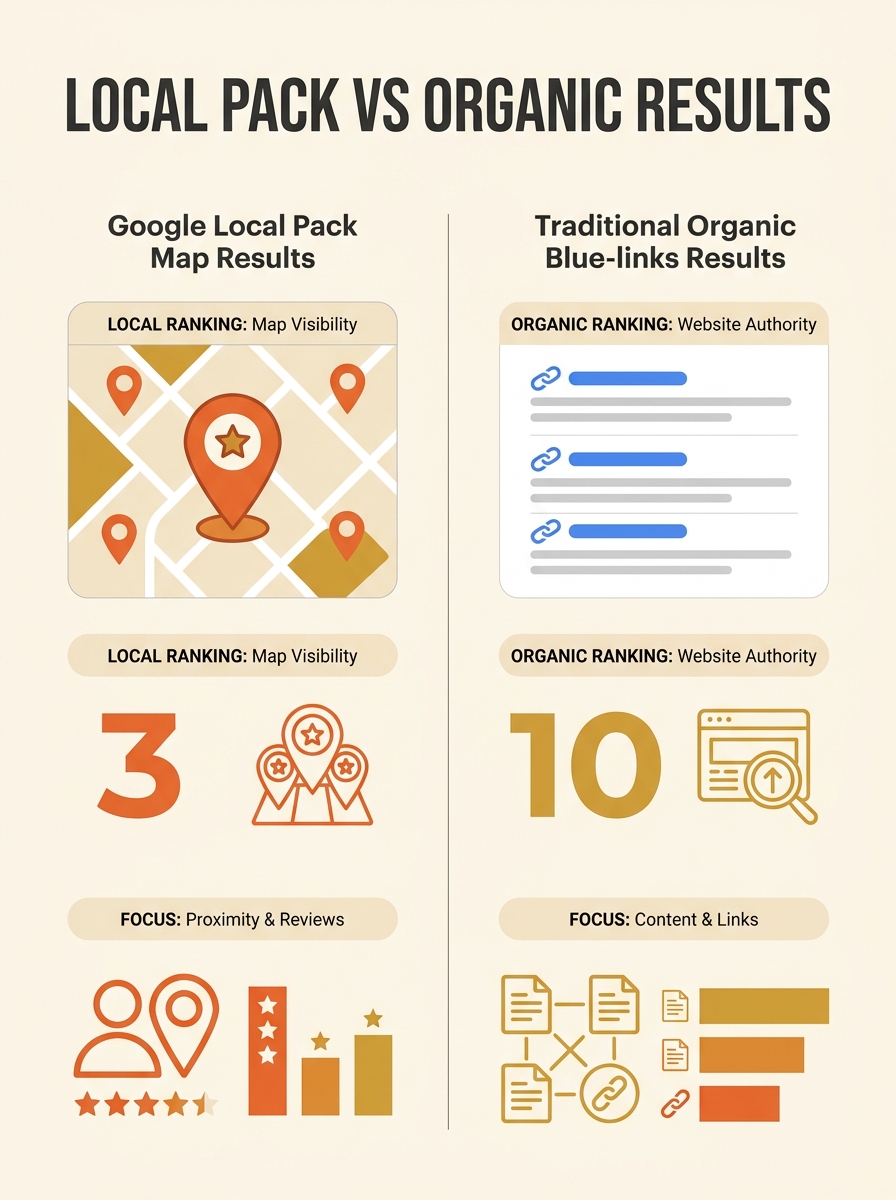
W3era’s framework identifies the Google Local Pack as the primary target for location-dependent businesses rather than traditional organic rankings. The Local Pack—the map and three business listings appearing above organic results for searches with local intent—draws rankings from Google Business Profile signals, proximity, review velocity, NAP consistency and local citation presence, the guidance shows.
National SEO targets Google’s organic blue-link results below advertisements, where domain authority, content quality, backlink profiles and on-page optimization determine position, according to the analysis. A plumber with strong national-style SEO but a neglected Google Business Profile will not appear in Local Pack results when homeowners search “plumber near me,” W3era’s guidance states.
The firm notes multi-location franchises, law firms with offices in multiple cities, healthcare groups with multiple clinics, and regional contractors serving multiple states require hybrid strategies combining national brand authority with location-specific optimization.
Businesses serving customers regardless of location waste resources on local search visibility that never converts, while service businesses investing in national rankings miss the Local Pack entirely, the October 2 guidance shows. The framework positions the customer-location question as preceding keyword research, competitor analysis or content planning.
Local Pack vs Organic Results
The analysis identifies a structural misconception: business owners treating local SEO as scaled-down national SEO with fewer keywords and smaller budgets. The two strategies target different Google products with different ranking factors, W3era states.
Local Pack rankings respond to Google Business Profile completion, review count and recency, proximity to the searcher, citation presence across directories, and NAP (name, address, phone) consistency across the web. Organic rankings respond to domain age, backlink authority, content depth, technical site architecture and topical relevance signals.
A service business ranking position one in organic results for “Dallas plumber” but absent from the Local Pack for “plumber near me” receives minimal traffic because Google shows the Local Pack first for local-intent searches, according to the guidance. W3era positions GBP optimization, review acquisition systems and citation management as the core local SEO infrastructure rather than link building or content marketing.
The firm’s analysis shows businesses pursuing national SEO marketing strategies without verifying whether customers require physical proximity compound the waste by producing rankings that algorithmically cannot convert—search visibility in wrong geographies or for non-purchase-intent queries.
The Takeaway
W3era’s October 2 framework clarifies a binary choice Australian businesses face before allocating SEO consultation budgets: whether customer location determines service delivery. The guidance shows the answer dictates which Google system to target, which ranking factors to optimize, and whether months of work produce customer acquisition or algorithmic visibility that never converts.
The analysis arrives as technical SEO infrastructure requirements expand across both local and national strategies, making the initial strategy decision more costly to reverse mid-implementation. Businesses serving geographically constrained customers need Local Pack visibility and GBP signals; businesses serving customers anywhere need organic rankings and domain authority.
Service businesses, retail locations and professional practices require local SEO infrastructure regardless of growth ambitions, while software companies, e-commerce operations and remote service providers require national strategies even at small scale, the guidance concludes. The framework positions the customer-location question as a structural constraint rather than a growth-stage decision.