

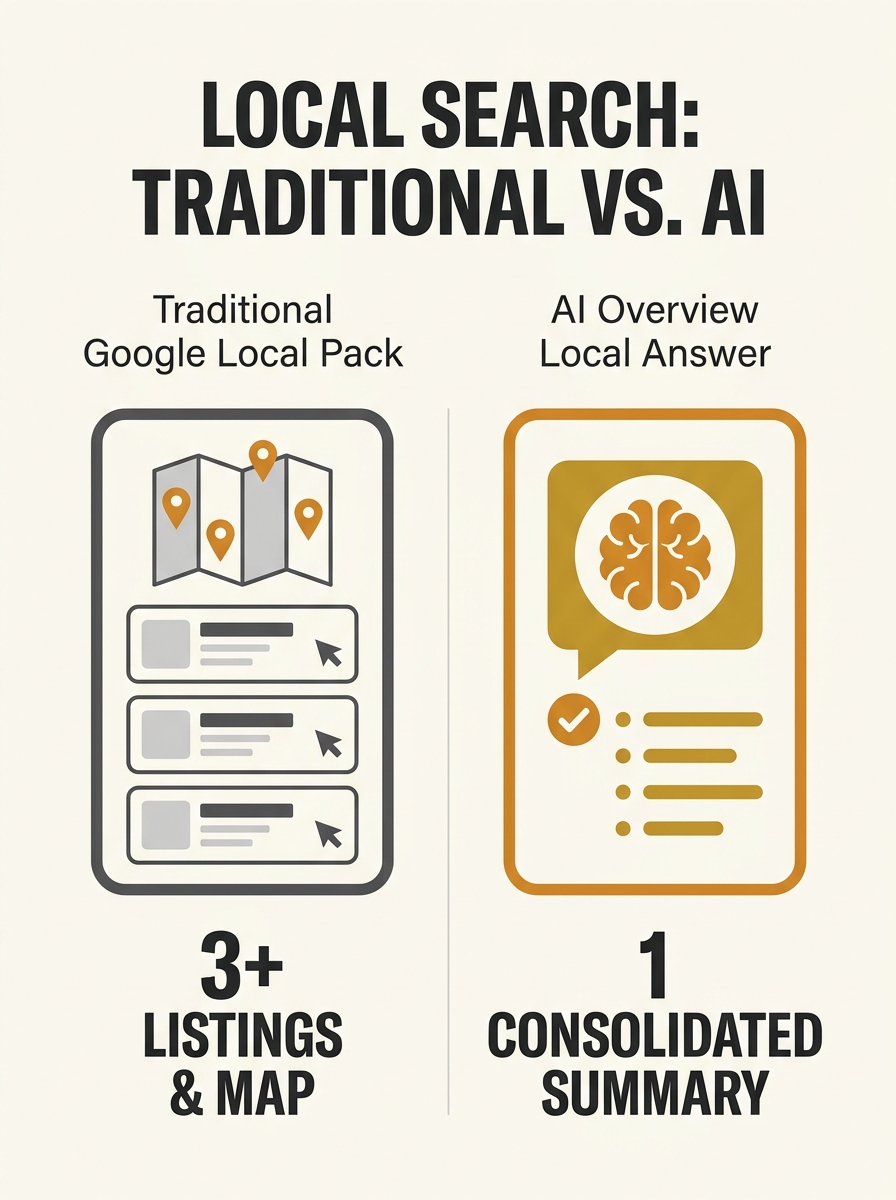
Google’s AI Overviews now appear for 68 percent of local searches while traditional local packs show for only 39 percent of the same queries, creating a 29-point visibility gap that leaves businesses optimised for map rankings invisible in AI-generated answers, according to a Whitespark study cited in a Search Engine Journal analysis published July 22.
TL;DR: Businesses ranking well in Google’s traditional local pack are being bypassed in AI Overview results for the same queries, with informational and hybrid-intent searches triggering AI answers 92-97 percent of the time.
The findings represent a structural shift in how local search visibility operates. Some AI Overviews include a condensed local pack; others surface synthesised answers with supporting links but no map display. Either format places Google’s interpretation between the user and the business directory, according to the analysis. The gap plays out differently across query types rather than appearing uniformly, with simple transactional searches still defaulting heavily to traditional local packs while question-based searches route almost exclusively through AI systems.
Informational queries such as “how long does an eye exam take near me” triggered AI Overviews 92 percent of the time, the Whitespark data showed. Hybrid intent searches including pricing questions—the example cited was “average cost of dental implants in Phoenix”—hit 97 percent AI Overview display rates. Simple transactional queries like “tacos San Francisco” continue to show traditional local pack results as the dominant format. Businesses operating in legal, healthcare, and financial verticals face near-universal AI Overview presence regardless of geography, while home services see more variable patterns and restaurants remain heavily weighted toward traditional packs for immediate-transaction queries, the analysis noted.
Query Type Determines AI Visibility
The competitive set for local businesses expanded beyond geographic proximity under the AI Overview model. Companies now compete with any entity that can answer the user’s question more comprehensively, not solely with nearby businesses in the same category, according to the Search Engine Journal breakdown. The shift affects service businesses answering questions more acutely than retailers fulfilling immediate transactions. A business ranking in positions one through three in the traditional local pack can be entirely absent from the AI Overview that appears above those results for the same search, creating a disconnect between legacy optimisation targets and actual visibility.
Kevin Indig’s analysis of 1.2 million ChatGPT responses found that cited passages skew heavily toward definitive, entity-rich statements, a pattern the Search Engine Journal piece applied to local business content requirements. Structured formats including tables and FAQ schema provide large language models with discrete, labeled data points the systems can extract with higher confidence than interpretive paragraph text, the analysis explained. Publishing additional content without improving structural precision works against visibility in AI retrieval environments where semantic accuracy outweighs volume.
Location pages require NAP data in table format, service area definitions, operating hours, testimonials referencing specific neighbourhoods, FAQs addressing market-specific regulations or climate concerns, documented project examples from that geography, and structured data grids showing regional pricing ranges or compliance details, the guidance outlined. Cookie-cutter location pages using identical copy with substituted city names are identified and bypassed by LLM systems scanning for fact density rather than keyword coverage, according to the piece.
Geographic Legitimacy Signals
Google’s vision AI analyses photographs to verify geographic legitimacy, the Search Engine Journal analysis noted. Location pages using generic stock imagery of professionals in nondescript offices register as low-context boilerplate without clear geographic markers, reducing citation probability. Steve Toth’s methodology recommending three landmark images per location page sourced from Google Images using Creative Commons filters was cited as an implementation approach. The technique involves searching specific landmarks by proper name—”Navy Pier” rather than “Chicago”—filtering for Creative Commons licenses under Usage Rights, and embedding images with descriptive alt text naming the landmark and city.
The recommendation extends existing guidance on proving topical authority through structured content into the geographic domain, where visual signals now carry extraction weight alongside textual entity references. Businesses optimising solely for traditional local SEO metrics including citation volume and Map Pack position miss the structural requirements AI systems use to determine answer inclusion, a measurement gap previously documented in AI visibility tracking tools that prioritise citation counts over recommendation share.
Entity consistency across Knowledge Graph signals, schema markup, and Business Profile data remains foundational, the piece emphasised. NAP discrepancies that created minor ranking friction in traditional local SEO now produce hard filtering in AI retrieval systems requiring exact matches across data sources. The threshold for structured data accuracy has tightened as LLMs validate claims against multiple entity references before including a business in generated answers.
The Takeaway
Australian service businesses relying on established local pack rankings face a visibility cliff if they haven’t addressed the structural content requirements AI systems use to select citations. The 29-percentage-point gap between AI Overview presence and local pack display means businesses can be technically “ranking” while being functionally invisible to most searchers in their category. The pattern is most acute for professional services, medical practices, and legal firms where informational queries dominate search behavior.
The strategic shift required moves from keyword-based location pages toward fact-dense, entity-rich content with verified geographic markers. Cookie-cutter city pages that worked adequately in 2024 local SEO are being systematically filtered out of AI answers, leaving businesses that haven’t restructured their location content competing for a shrinking share of traditional pack clicks. Implementation priorities center on structured data tables, market-specific FAQs, documented local projects with landmark photography, and consistent NAP data across all entity references—work that builds on existing local SEO frameworks rather than replacing them entirely.