
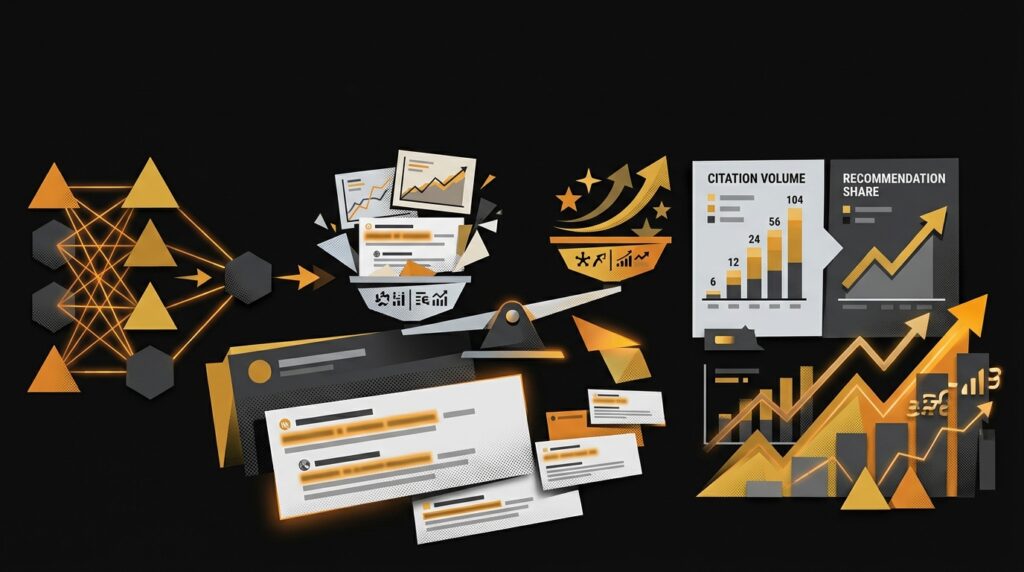
Most AI search visibility tools measure how often a brand appears in citations rather than whether platforms recommend that brand to users, a gap that leads businesses to optimize for the wrong outcome, according to an analysis published July 19 by Search Engine Journal. The article synthesized data from multiple industry studies showing that citation counts—the metric most AI visibility platforms sell—do not correlate with purchase recommendations, the outcome that drives business results.
TL;DR: AI visibility tools count citations, but research shows 69% of cited brands are not recommended to users, meaning businesses are tracking metrics that don’t align with outcomes.
Research conducted by Lily Ray analyzed 100 business software queries across April, May, and June 2026 and found that when a brand’s own promotional content was cited as a source, that brand was excluded from the actual recommendation 69 percent of the time—224 of the 323 self-promotional pages cited. Google AI Overviews read the page and recommended competitors mentioned within it instead, Ray’s data showed.
The pattern extends beyond Google. Jeff Oxford’s team at Visibility Labs tested 20,000 ChatGPT responses and found product recommendations changed 80.2 percent of the time once web search was enabled, with only a 0.4 correlation between being cited and being recommended, the Journal reported. BrightEdge data across five engines found source overlap between engine pairs ranged from 16 to 59 percent, but recommended brands stayed within a tighter 36 to 55 percent band.
Prompt Tracking Measures the Wrong Behavior
The dominant measurement approach in AI search visibility—prompt tracking—rests on assumptions about user behavior that lack grounding in real data, Jono Alderson, a technical SEO consultant, said in the analysis. “We need to instead try and influence how the machine perceives us. And that’s not prompt tracking, which is what everyone is doing at the moment,” Alderson said. “There is a place for that, but it’s far smaller than I think.”
Prompt tracking tools generate lists of queries the vendor believes customers might type, then measure how often a brand appears in responses. The method mirrors traditional rank tracking but fails to account for how AI systems actually search. AI platforms issue multiple parallel web searches to ground a single answer, generating impression data that no longer reflects human demand.
Search Console data now includes traffic from AI systems searching on behalf of users, inflating impression counts while clicks remain flat. The distortion makes it difficult to separate human search demand from machine activity. Google introduced AI visibility reporting inside Search Console, but the report shows impressions rather than AI-driven clicks, according to the Journal article.
Three Metrics That Align with Business Outcomes
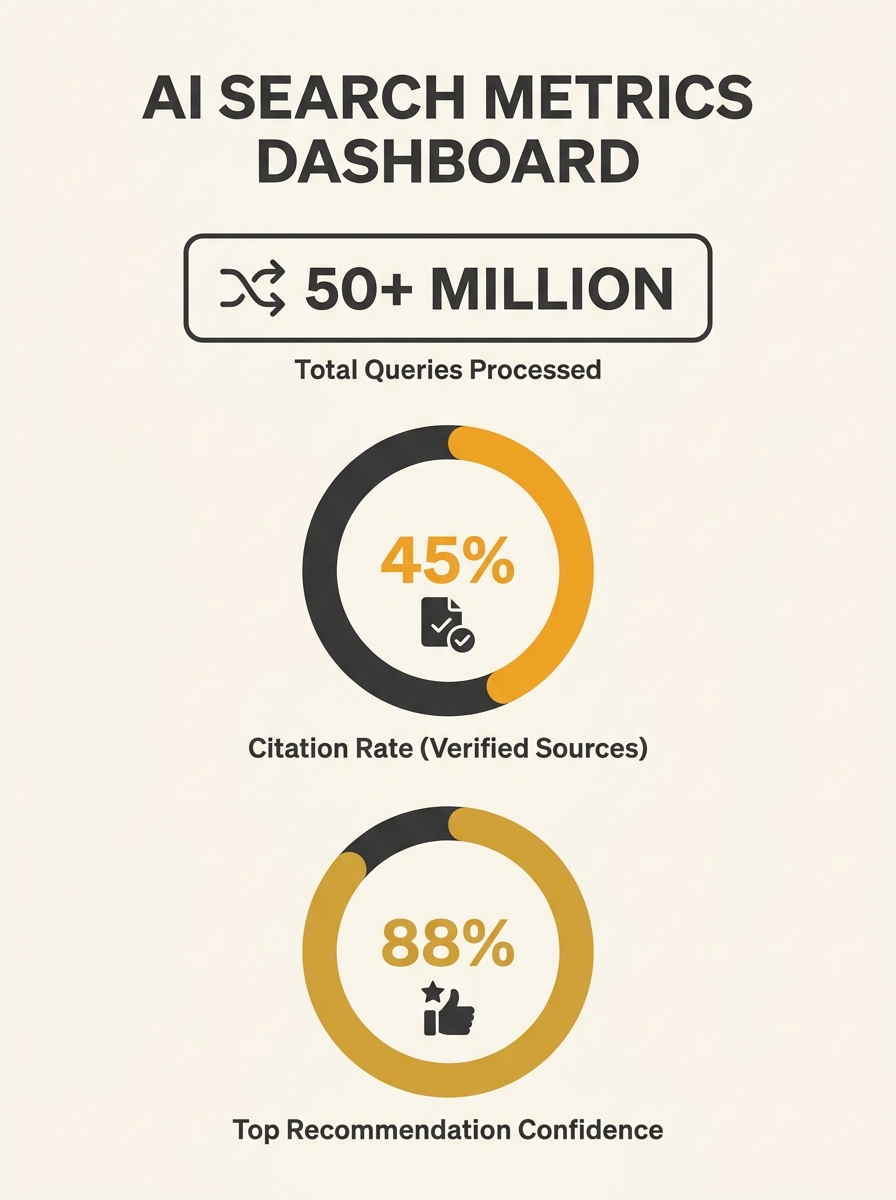
Alisa Scharf, Chief AI Officer at Seer Interactive, outlined three measurement categories that better reflect commercial value: presence (whether the brand appears in answers at all), recommendation share (the percentage of answers that actively suggest the brand), and brand accuracy (whether statements about the brand are factually correct).
Presence functions as a baseline—brands not appearing in AI answers to relevant queries have no opportunity to influence recommendations. Recommendation share directly measures the outcome that drives clicks and purchases. Software companies’ own comparison pages drive 69 percent of Google AI recommendations to competitors rather than to the publishing brand, earlier research showed, making recommendation tracking essential.
Brand accuracy addresses a category of risk invisible to citation-based tools. When AI platforms generate incorrect statements about a business—wrong service offerings, outdated pricing, or factual errors—those statements appear with no citation trail to correct. The Journal analysis noted that incorrect brand statements can appear in answers even when the brand’s own pages rank prominently in traditional search results.
Analysis of 3.7 million citations by Kevin Indig found that 91 percent of cited URLs appear in only one AI engine, meaning citation footprints do not transfer across platforms. AI visibility rankings require between 33 and 94 repeat queries before stabilizing, separate research released this month showed, adding measurement instability to the challenge of cross-platform inconsistency.
Traditional SEO Remains the Foundation Layer
AI search engines still depend on traditional web search to retrieve and verify information, the analysis found. Query fan-out—where a single AI prompt triggers multiple parallel web searches—means ranking in traditional search results continues to determine which content AI systems can access. Reddit accounts for one in five AI search citations, data released July 16 showed, in part because Reddit pages rank highly in traditional search results.
The Journal article recommended businesses track recommendation share by query category rather than overall citation volume, measure brand statement accuracy through manual review of high-value answers, and maintain traditional SEO as the foundation that determines AI visibility. Tools that report only citation counts leave businesses optimizing for a metric that does not predict recommendations.
What Happens Next
Australian businesses evaluating AI search measurement tools face a choice between citation-tracking dashboards that mirror traditional rank tracking and more complex approaches that separate recommendations from mentions. The commercial gap—69 percent of cited brands not recommended—suggests citation counts function poorly as a proxy for business outcomes. Teams that continue to optimize for citation volume risk investing in visibility that does not convert.
The measurement shift requires manual work that current tools do not automate. Tracking whether AI answers recommend a brand demands human review of individual responses, since most platforms do not distinguish recommendations from citations in their APIs. Brand accuracy checks similarly require manual validation against source material. Businesses with limited resources may need to prioritize tracking a small set of high-value queries rather than attempting comprehensive coverage across hundreds of prompts.
The analysis points toward a measurement approach grounded in traditional SEO fundamentals—ensuring pages rank in web search results, structuring content so AI systems can extract accurate information, and verifying that recommendations align with citations. For Australian SMEs, that means existing SEO investments remain relevant even as AI search grows, but measurement frameworks need to separate the metrics that look familiar from the ones that actually predict outcomes.