

AI search systems transferred cognitive effort from query formulation and source selection to post-answer verification tasks, according to an analysis published August 27, 2026, by Search Engine Journal. The shift means users now audit synthesized answers rather than build conclusions from visible evidence.
TL;DR: AI search moved cognitive work from finding and comparing sources before forming answers to verifying assembled answers after synthesis, creating new verification burdens for users.
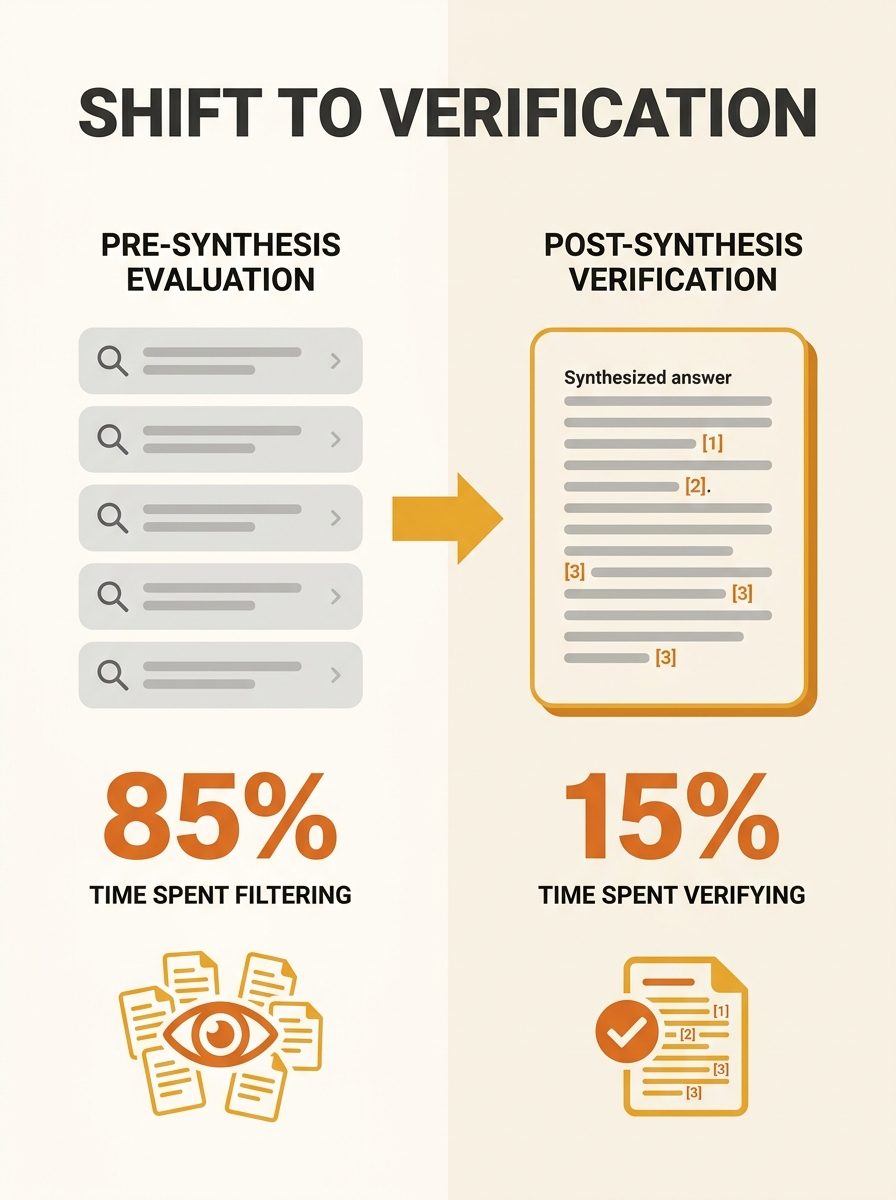
Traditional search engines spent user cognitive budgets on query formulation, result scanning, and source comparison before users assembled answers. Generative search systems now perform retrieval, source selection, and synthesis before displaying results, fundamentally changing where mental effort occurs in the search process.
Working Memory Constraints Drive New Search Behavior
Jakob Nielsen’s cognitive load framework treats working memory as a finite budget of approximately four meaningful chunks rather than something requiring elimination, the analysis noted. Research on traditional web search found query formulation imposed particularly high cognitive demands, with users struggling to convert vague information needs into effective search terms.
A 2026 ACL study comparing traditional and generative web search documented the operational difference: traditional search returns ranked lists of independent pages requiring user evaluation, while generative search retrieves information and synthesizes it into coherent responses before display. The researchers identified meaningful variations across generative systems in source diversity, retrieval patterns, synthesis strategies, and output stability.
Microsoft Research’s analysis of 200,000 anonymized Bing Copilot conversations found information gathering and writing ranked among users’ most common help requests. The system performed providing information, writing assistance, teaching, and advising functions. The division showed users retaining goals while systems executed information work previously performed manually.
Citations Increase Trust Before Verification Occurs
The analysis highlighted a verification timing inversion with significant implications. Traditional search exposed evidence before synthesis, with users seeing candidate sources, encountering supporting material and contradictions, and building understanding while moving through visible evidence. AI search increasingly presents synthesis first, with evidence appearing afterward as citations attached to claims already made by the system.
Research by Haiwen Li and Sinan Aral found reference links and citations increased user trust in generative search results even when those references were incorrect or hallucinated, according to the report. The experiment showed users who trusted results more spent less time evaluating them, creating a gap between perceived verification ease and actual verification risk.
“A citation can reduce the consumer’s perceived verification cost without reducing the actual verification risk,” the analysis stated. Users must still determine whether cited material supports claims, whether relevant evidence was omitted, and whether the system reconciled conflicting sources correctly.
The shift connects to broader concerns about AI search measurement tools that track citations while businesses need recommendation share, as Australian companies navigate these changing user behaviors.
Machine Constraints Shape Human Evaluation Tasks
The analysis distinguished between human cognitive load and machine system constraints. Large language models do not experience cognitive load as a psychological phenomenon, but face different finite constraints involving retrieval, context, source selection, competing information, tokens, and output limits.
Those machine constraints affect what users eventually evaluate. When answer systems select evidence subsets, compress information, and generate responses, users judge outputs from processes they did not observe. The human cognitive burden transferred rather than disappeared, the analysis concluded.
The framework builds on earlier observations that AI search systems now synthesize recommendations instead of listing options, fundamentally changing how Australian businesses must structure content for discovery.
Why This Matters Now
Australian businesses optimizing for AI search environments face a user behavior reality where verification effort occurs after answer synthesis rather than during source evaluation. Content strategies built for traditional search’s visible evidence paths may fail when generative systems perform synthesis before users see supporting material.
The cognitive load shift means businesses must optimize not just for citation inclusion but for post-synthesis verification support. Users encountering AI-assembled answers need transparent pathways to verify claims, reconcile conflicting information, and assess omitted evidence—cognitive tasks previously distributed across the search process but now concentrated in a single verification stage.
Understanding where user mental effort now concentrates helps Australian marketing managers design content architectures that support verification rather than discovery, positioning organizational expertise for extraction into synthesized answers users will subsequently audit rather than assemble themselves.