

AI search engines evaluate expertise across entire topic areas rather than isolated pages, shifting competitive advantage from content volume to topical authority, according to a framework published by Visionary Financial on August 2, 2026. The analysis recommends businesses reorganize content libraries from chronological blogs into interconnected “Knowledge Centers” focused on demonstrating consistent subject-matter expertise.
TL;DR: Visionary Financial published a framework on August 2, 2026, positioning topical authority—demonstrated through interconnected topic-focused content—as the primary competitive advantage in AI search, recommending businesses replace chronological blogs with organized knowledge centers.
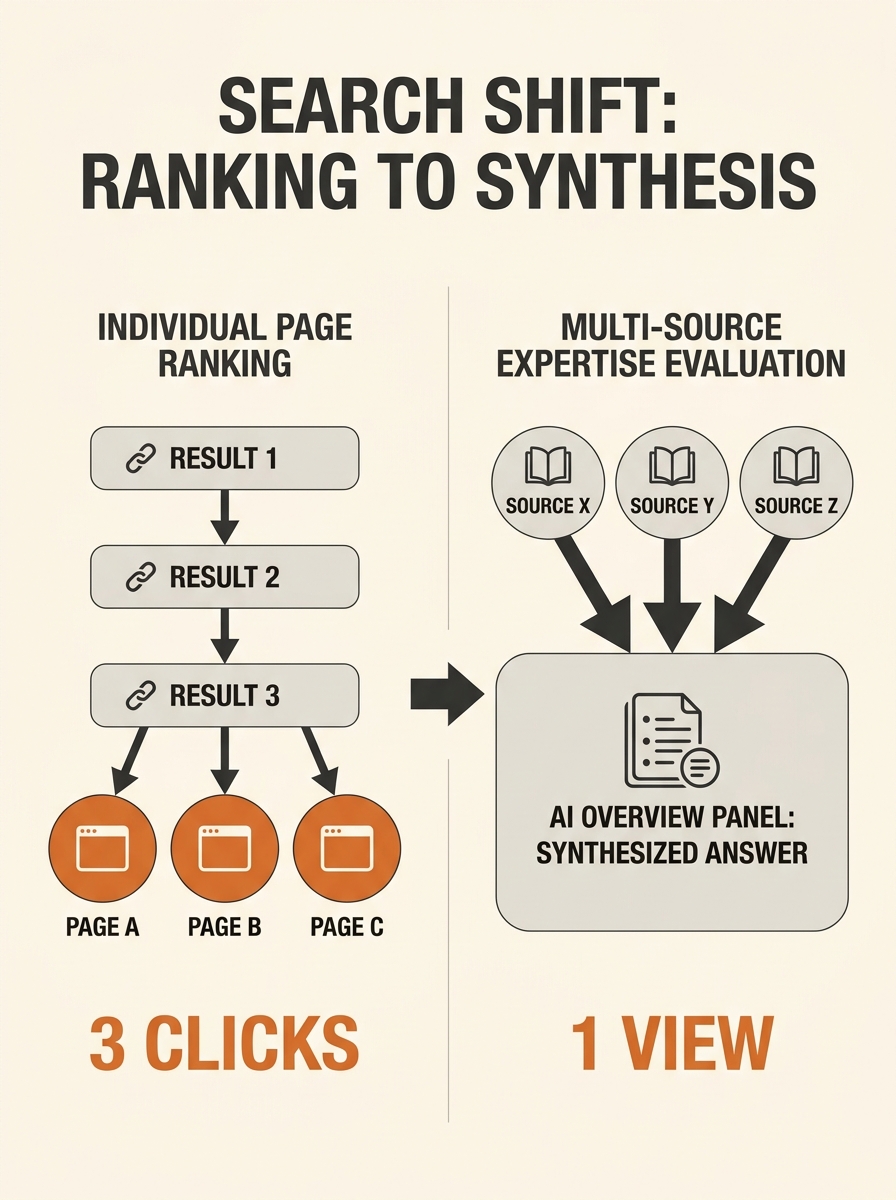
The framework represents a departure from traditional SEO strategies that evaluated individual pages in isolation. “Instead of asking, ‘Does this page answer the question?’ the more important question increasingly becomes, ‘Has this organization consistently demonstrated expertise on this subject?'” Visionary Financial wrote in the published analysis.
What Changed in AI Search Evaluation
Traditional search engines evaluated pages individually, allowing a single well-optimized article to rank regardless of the site’s broader content organization. AI-powered search experiences including Google AI Overviews now synthesize information from multiple sources, evaluating whether organizations have published extensively on a subject and reinforced that knowledge through consistent educational content over time, according to the framework.
The analysis identifies AI-generated content accessibility as a contributing factor. “Today, almost any business can generate dozens of articles with minimal effort,” the framework notes. “As AI writing tools become more sophisticated, simply publishing more content is becoming less of a competitive advantage because everyone has access to similar capabilities.”
Businesses that continue to stand out will develop original perspectives, publish comprehensive educational resources, and explore subjects from multiple angles rather than repeating information found elsewhere, the framework states. This approach aligns with research showing nearly 90 percent of high-volume AI search categories lack a clear owner, creating opportunity for businesses that build depth rather than breadth.
Knowledge Centers Over Chronological Blogs
The framework recommends businesses move from maintaining company blogs—chronological collections of articles written whenever time permits—to Knowledge Centers organized around expertise. “Every article strengthens another. Every guide answers a related question. Every topic expands upon a previous idea until readers—and increasingly AI systems—can clearly recognize the subjects the business owns,” Visionary Financial wrote.
This organizational structure creates a richer user experience while reinforcing authority across an entire discipline, the analysis states. The approach mirrors site hierarchy and topical clustering strategies and builds on pillar-page frameworks for topical authority previously released by digital marketing firms.
The framework cites Google AI Overviews as evidence of the evaluation shift, noting the feature presents synthesized responses from multiple sources rather than link lists. While Google has not disclosed every factor influencing AI Overview summaries, the trend reflects broader movement toward evaluating expertise across topics instead of rewarding isolated pages, according to the analysis.
Businesses should audit existing content to identify topic clusters with depth potential, eliminate or consolidate articles that don’t strengthen core expertise areas, and create interconnected libraries of educational resources focused on specific knowledge domains, the framework recommends. This recommendation applies particularly to businesses competing in crowded categories where topical authority matters more than individual keyword rankings.
Context and Outlook
The Visionary Financial framework extends a pattern of digital marketing resources positioning depth over breadth as AI search tools reshape visibility strategies. The analysis addresses a practical challenge facing Australian SMEs: how to compete when generative AI democratizes content production but search engines increasingly filter for demonstrated expertise.
Businesses evaluating organic growth strategies should assess whether existing content libraries demonstrate coherent subject-matter depth or simply collect unrelated articles published opportunistically. The Knowledge Center model requires upfront planning and ongoing commitment to specific expertise areas, creating higher barriers to entry than chronological blogging but potentially stronger defensibility against AI-generated commodity content.
The framework’s reliance on Google AI Overviews as primary evidence presents one limitation—while AI Overview behavior suggests evaluation across multiple sources, Google has not confirmed topical authority as a discrete ranking factor. Businesses implementing Knowledge Center strategies should monitor whether AI search engines continue to depend on traditional SEO signals alongside any topical-depth assessments.