

AI search platforms returned at least one false fact about 64 percent of UK high street retailers tested in July 2026, with wrong postcode data representing the most common error, according to figures Searchable shared with Retail Focus. The marketing technology vendor tested ChatGPT, Gemini, and Perplexity across more than 72,000 questions about business locations, contact information, and services.
TL;DR: AI platforms gave incorrect answers about nearly two-thirds of UK retailers tested, most often placing businesses in the wrong postcode, errors that Australian multi-location businesses cannot currently monitor through automated alerts.
The findings highlight a gap in how businesses track their AI search presence. Unlike traditional search, where ranking shifts and traffic drops trigger alerts in Search Console and analytics platforms, AI-generated answers about business locations currently offer no automated monitoring system to flag when platforms confidently state wrong hours, services, or addresses, according to Search Engine Journal.
Searchable ran two separate test sets on UK businesses in July 2026. The first examined 165 London businesses with 13,365 questions about services, contact details, size, and founding dates, comparing AI-generated answers against Companies House records and official business profiles. CMOTech reported that 93 percent of these businesses had at least one basic fact wrong or missing. Smaller businesses received false facts at a 50 percent rate, compared to 32 percent for larger companies.
Error Rates Vary Across Platforms
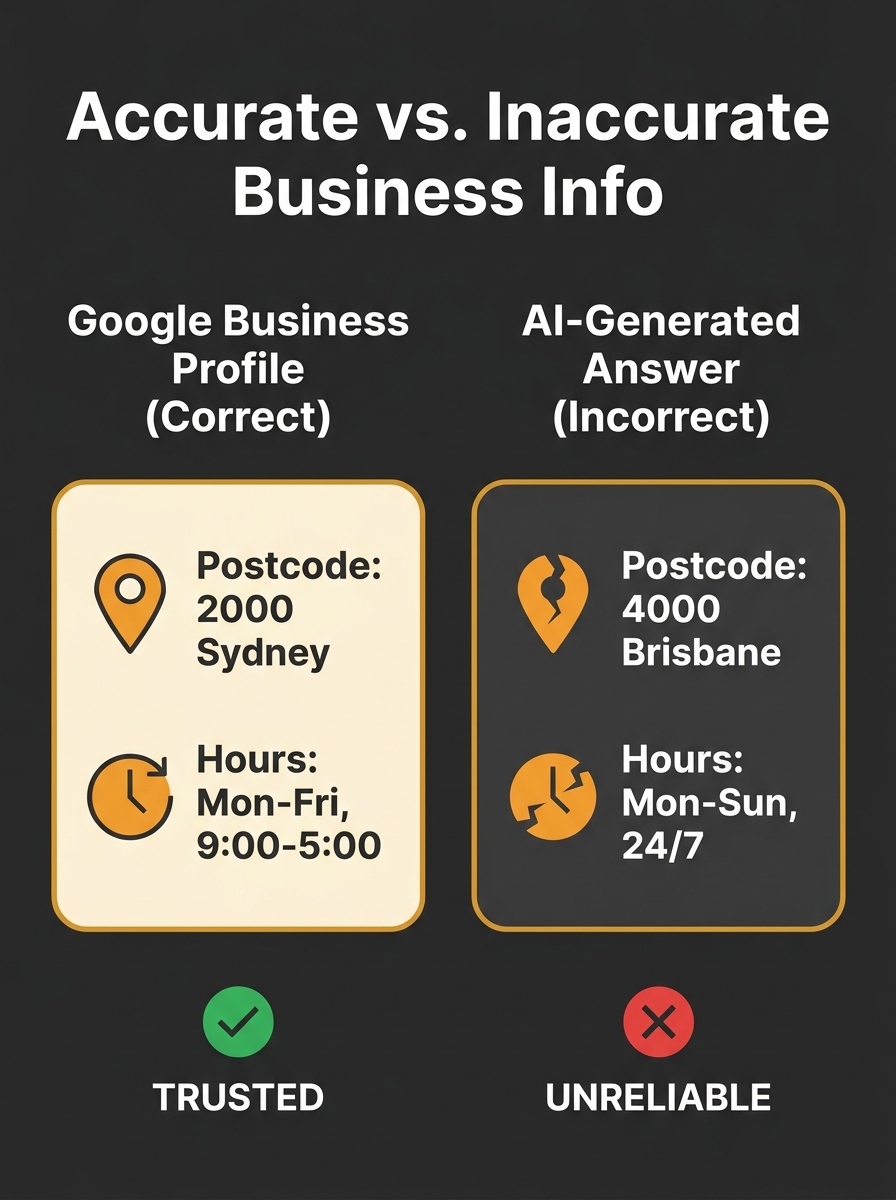
The second test queried UK high street retailers across three major AI platforms. One in 16 answers contained incorrect information, Retail Focus reported. Wrong postcode errors occurred at a rate of one in 10, even when prompts specified the correct town.
Error rates differed by platform. Perplexity delivered inaccurate answers in 10 percent of cases, compared to 5 percent for Gemini and 4 percent for ChatGPT, according to Searchable’s retail data. The variation means businesses cannot audit one platform and assume accuracy across others, a location that displays correctly in Google’s AI Overviews may still carry wrong information in ChatGPT responses.
Chris Donnelly, Searchable co-founder, told Retail Focus that smaller brick-and-mortar retailers face higher error risk because their digital footprint centers on a website and Google Business listing. “That’s a relatively thin trail of information for AI systems to learn from and to represent in their answers,” Donnelly said.
Consumer Adoption Outpaces Business Monitoring
BrightLocal’s Local Consumer Review Survey found 45 percent of consumers now use ChatGPT or similar tools for local business recommendations, up from 6 percent the previous year. That adoption rate has arrived before businesses gained monitoring tools to track what AI platforms say about their locations.
SOCi’s Local Visibility Index analyzed over 350,000 locations and found ChatGPT recommended 1.2 percent of them, far lower than the same brands’ appearances in Google’s local 3-pack. Whitespark’s analysis found AI Overviews appear in 15 percent of direct local-intent searches such as “personal injury lawyers in Phoenix,” but show up 92 percent of the time for informational questions and 97 percent for hybrid queries like whether to hire a lawyer after an accident.
The visibility gap matters because AI search collapses multiple sources, business listings, websites, reviews, into a single synthesized answer that customers read as fact. Traditional search presents options customers compare; AI search describes a business before the customer visits the website or profile. When the description contains errors, no ranking drop or traffic dip signals the problem, because the error lives in text the business never sees.
No Alert System for Location-Level Errors
Major consumer AI tools do not currently offer businesses automated alerts when their location information is incorrect. Google’s documentation states that AI responses may include mistakes, and individual AI Overviews carry a feedback link, but this feedback mechanism corrects errors only after someone notices them, it does not proactively monitor or alert businesses to inaccuracies.
Business owners report in Google’s support forums that AI platforms present wrong details with the same confidence as accurate information, with some stating the errors damage their businesses. The error categories match what Searchable found: wrong hours, incorrect addresses, services listed that businesses don’t offer, and claims that active businesses are closed.
Testing what AI platforms say about a location requires manual queries across five separate systems that process information differently. AI Overviews appear in regular Google search results; AI Mode is a conversational experience within Google Search; Gemini operates as Google’s standalone AI assistant; and ChatGPT and Perplexity are separate products from OpenAI and Perplexity AI. Each tool selects and combines information using different methods, so the same question often receives different answers depending on which platform a customer uses.
Businesses Implications
Australian multi-location businesses face the same accuracy gap UK retailers encountered in Searchable’s tests. Local SEO frameworks and Google Business Profile optimization remain necessary but not sufficient, they ensure correct source data exists but cannot prevent AI platforms from misinterpreting or misrepresenting that data in generated answers.
The absence of automated monitoring means businesses must manually query each AI platform with location-specific questions customers would ask: hours, services offered, whether a location handles specific requests, and contact details. The five-platform testing requirement, AI Overviews, AI Mode, Gemini, ChatGPT, and Perplexity, adds operational overhead that scales with location count. A business with 20 locations testing five core customer questions across five platforms generates 500 manual checks to audit baseline accuracy.
The 45 percent consumer adoption rate BrightLocal measured suggests waiting for better monitoring tools carries customer-impact risk. Businesses that discover errors through customer complaints rather than proactive audits have already lost the transaction and damaged trust. The testing cadence required depends on how frequently business information changes and how often platforms refresh their training data, neither of which businesses currently control.