

Brand size and market share showed weak correlation with AI recommendation frequency across five major language models when researchers analyzed 120,000+ AI-generated mentions of 3,793 U.S. business locations, according to a study published September 10, 2026, by Uberall and reported by Search Engine Journal. Photo count, review volume, and editorial list presence emerged as stronger predictors than location count or market footprint.
TL;DR: Multi-location brands with larger market share do not automatically appear more frequently in ChatGPT, Gemini, Perplexity, Claude, or Grok recommendations, research covering restaurants, hotels, banks, grocery stores, and dental practices found.
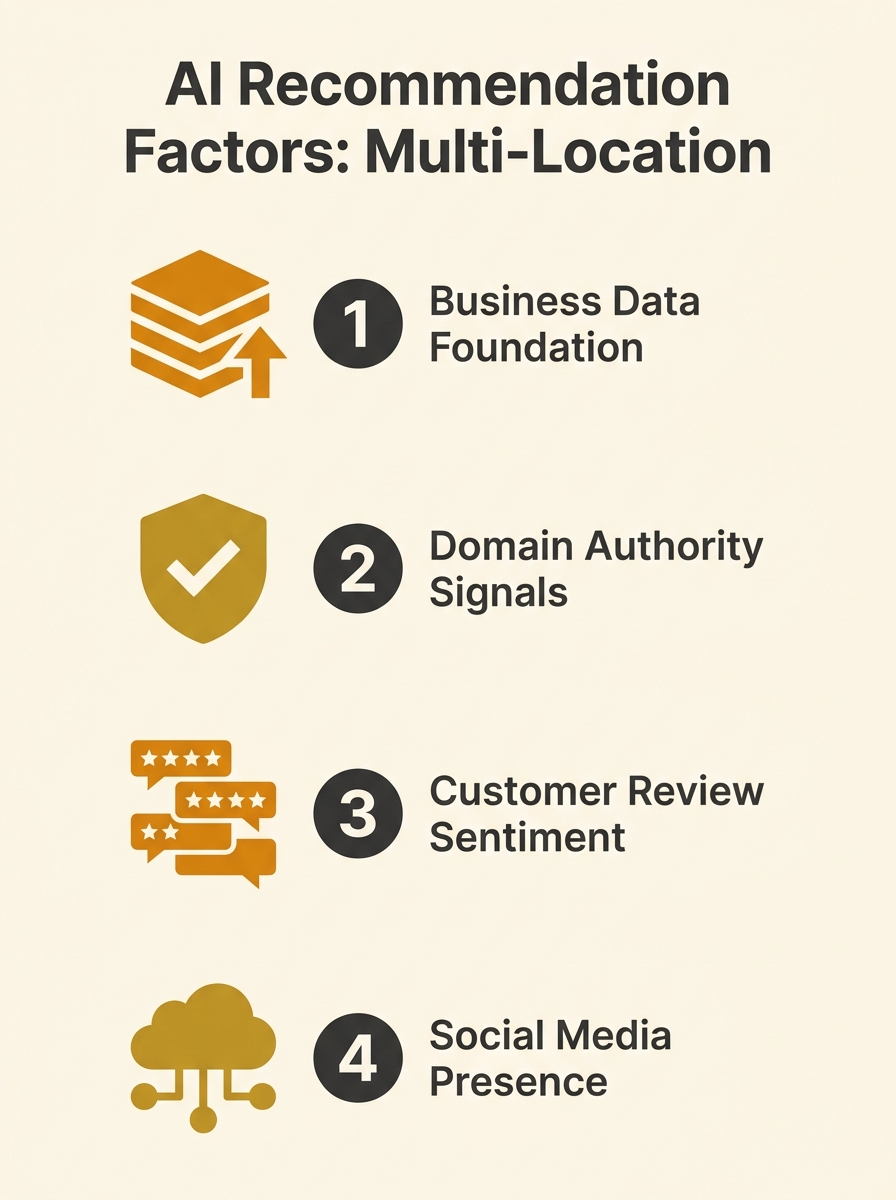
The study examined mentions across five AI platforms—ChatGPT, Gemini, Perplexity, Claude, and Grok—spanning five verticals: restaurants, hotels, banks, grocery stores, and dental practices in U.S. cities including Chicago and New York. Katya Shishchenko, GEO analyst at Uberall, identified four factors consistent across industries and models: business data, authority signals, review metrics, and social presence.
“Multi-location brands have spent years learning Google’s personality,” the study noted. “Now there are at least five more to figure out.”
Each AI Model Displays Distinct Recommendation Patterns
The five platforms exhibited different selection behaviors. Gemini surfaced eight times more unique restaurants than ChatGPT in the same study, likely because it cross-references live Google Maps data. ChatGPT generated concentrated shortlists but recorded the highest hallucination rates across verticals. Claude favored local and community businesses while largely avoiding specific healthcare provider recommendations. Perplexity searches live and cites sources, generating the most mentions per query run. Grok referenced chef qualifications and Instagram content more frequently than other models.
The research adds to growing evidence that AI search systems now synthesize recommendations rather than listing options, forcing multi-location operators to optimize for fundamentally different visibility signals than traditional local search.
Business Data Completeness Determines Initial AI Eligibility
Google Business Profile completeness and photo count determined whether local brands appeared in language model responses, the study found. A filled-out GBP description produced a three-fold increase in mention rates for grocery stores. Hotels with 31 to 50 relevant attributes recorded 94% mention probability compared to 22% for properties listing six to 10 attributes.
Photo count ranked as the single strongest predictor of restaurant mention frequency, with top-mentioned restaurants averaging three times more photos than competitors. The metric also emerged as the only signal in the dental category that predicted both whether a practice received mention and how often. In banking, photo count ranked among the three strongest predictors of AI mentions overall.
Location count influenced whether brands received mention at all in grocery, hotels, and banking categories, where chains benefit from signals picked up during language model training. For restaurants and dentists, independent brands matched or exceeded chains on mention rates despite smaller footprints.
Authority Signals Override Market Share in Recommendation Frequency
Brand size—measured by store count, practice count, deposit share, or room supply—proved a poor predictor of AI recommendation frequency across all five verticals. The study documented this pattern in contrast to traditional local SEO, where single-location businesses can outrank national chains through proximity advantage in Map results but rarely in brand awareness.
Media mention frequency drove substantial visibility gains. Brands with 30 or more news mentions recorded a 15-fold frequency increase in banking and reached 100% mention rate in grocery. Banks appearing on three or more editorial platforms saw a 13-fold mention increase. Michelin recognition appeared in 94.5% of Perplexity’s restaurant responses.
Wikipedia presence functioned as a reliable positive factor for hotels, grocery stores, and banks, though not for dentists. Delivery platform presence on Instacart, DoorDash, or Mercato did not influence grocery store AI visibility.
Review Volume Outweighs Star Rating Across Most Categories
Review count emerged as a more consistent predictor of AI mention frequency than average star rating in four of five verticals. Restaurants with 500 to 1,000 reviews recorded double the mention rate of those with 100 to 500 reviews. The pattern held in hotels, grocery, and banking.
Dental practices represented the exception, where star rating and review count showed roughly equal predictive weight. Practices with 4.5 to 5.0-star averages and 100-plus reviews appeared most frequently in AI recommendations for dental services.
The finding aligns with previous research showing AI search systems prioritize organizational expertise over individual page signals, suggesting language models weight volume as a proxy for sustained service delivery rather than isolated satisfaction scores.
Social Presence Shows Vertical-Specific Impact
Instagram followers predicted AI mention rates in restaurants and hotels but showed no correlation in banking, grocery, or dental categories. Restaurant brands with 10,000-plus Instagram followers appeared 2.4 times more frequently than those with under 1,000 followers. Hotel properties with similar follower counts recorded 1.8 times higher mention rates.
The vertical specificity suggests language models incorporate social signals where visual content and experience documentation align with consumer search intent—dining and hospitality—but disregard those signals in service categories where social presence does not proxy for service quality or convenience.
Grok referenced Instagram content more than any other model, with responses incorporating chef qualifications and food presentation details sourced from social platforms.
What This Means for Australian Small
Australian multi-location operators competing for AI Overviews visibility in local searches can no longer rely on brand footprint alone. The Uberall study demonstrates that a three-location dental group with complete GBP data, 200 photos per location, and 300 reviews per practice will likely outperform a 20-location competitor with sparse profiles and 50 reviews per site in ChatGPT and Perplexity recommendations.
The findings shift optimization priority toward verifiable signals: photo libraries documenting services and facilities, systematic review generation across all locations, and earned media placement in industry publications. Multi-location restaurant groups should prioritize Instagram content and chef credential documentation given Grok’s referencing behavior. Service brands—dental, banking, professional services—should focus photo investment on facility interiors and staff credentials rather than lifestyle imagery.
The research also clarifies that Wikipedia presence and editorial list features (Bankrate, Forbes, Michelin equivalents in Australian markets) function as training data for AI models, making earned media and authoritative third-party mentions higher-use investments than paid directory listings. Operators treating business data completion as a one-time task face sustained disadvantage as competitors maintain 30-plus attributes and 500-plus photos per location.