

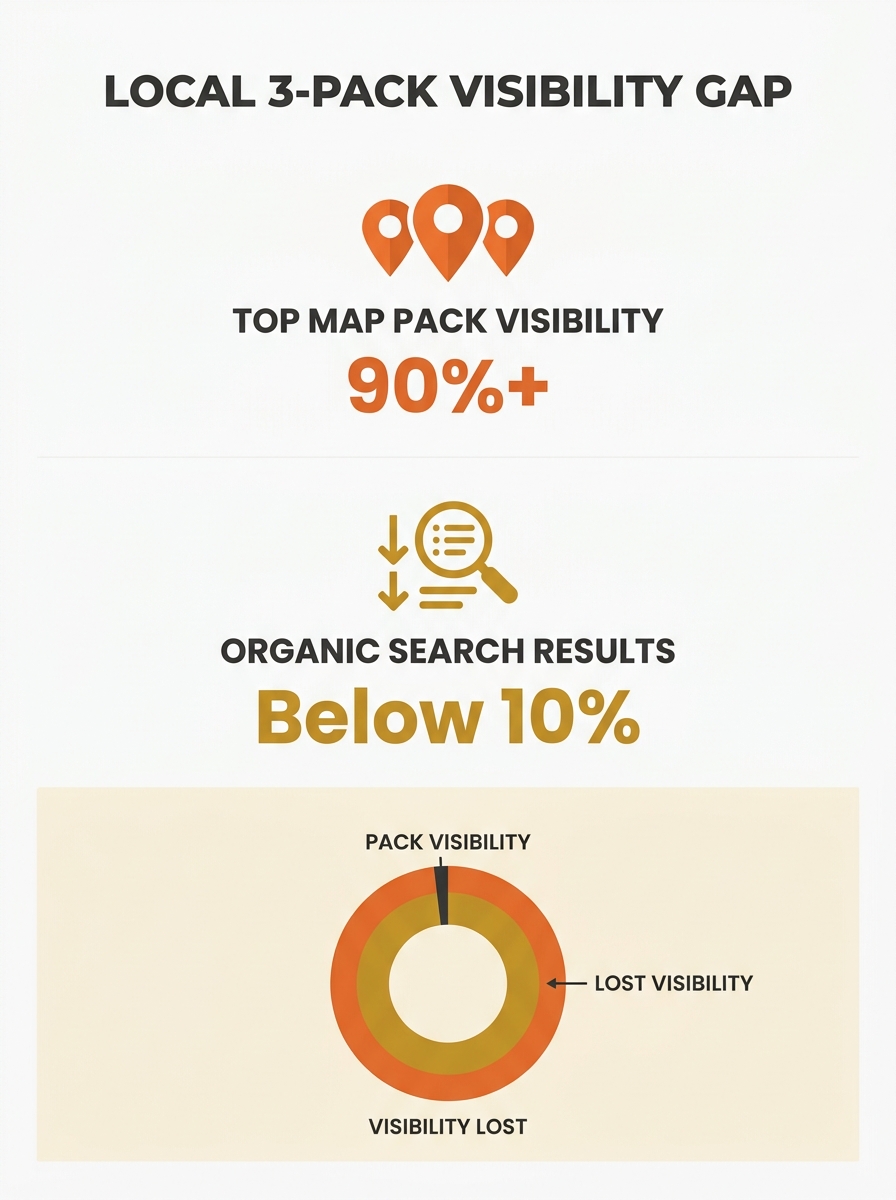
A Dallas personal injury firm with 551 Google reviews at a 4.6-star average appears in Google’s top-three map results zero percent of the time across a five-mile radius around its office, according to a local SEO audit published September 22, 2026 by Local Service Mastery. Rad Law Firm ranks at position 13.6 on average for “personal injury lawyer” searches within its primary service area.
TL;DR: A Dallas law firm with a 4.6-star rating across 551 reviews fails to appear in Google’s local map pack despite strong review signals, exposing critical gaps in local SEO infrastructure and conversion tracking.
The audit documented measurement infrastructure failures alongside the visibility gap. The firm’s website contains no Google Ads conversion tag, no Meta pixel, and no analytics script, meaning any advertising spend operates without conversion data. The site also lacks LocalBusiness structured data, an H1 heading tag, and tap-to-call phone links—technical gaps that compound the map pack absence.
Local Service Mastery ran a 25-point grid scan for “personal injury lawyer” across the area surrounding the firm’s LBJ Freeway location. The firm appeared in the visible three-result map pack at none of the tested points. Most local search users never scroll past the initial map results, making visibility outside that set functionally equivalent to non-existence for mobile searchers.
Review Count Doesn’t Guarantee Map Visibility
The disconnect between review volume and map placement exposes a common misunderstanding about Google’s local ranking algorithm. The firm’s 551 reviews place it well above most local competitors in raw review count, yet the audit found it ranking below businesses with a fraction of that total.
Google’s local pack algorithm weights proximity, relevance signals, and profile completeness alongside review count. The audit identified missing LocalBusiness schema markup—the structured data Google uses to parse business hours, service areas, and aggregate ratings. Without that markup, the firm’s review stars don’t appear in search results as rich snippets, reducing click-through even when the listing does surface.
The firm also lacks dedicated service-area pages targeting search patterns like “car accident lawyer in Dallas.” Businesses managing their local SEO often assume a Google Business Profile alone drives map visibility, but Google needs on-site content matched to search intent to connect queries with listings.
No Conversion Tracking Across Any Channel
The audit found no measurement infrastructure in the site’s source code. No Google Ads tag means any paid search campaigns run without conversion data. No Meta pixel eliminates retargeting capability and Facebook conversion tracking. No Google Analytics means no traffic source attribution.
Personal injury advertising typically commands some of the highest cost-per-click rates in local search, often exceeding $100 per click in competitive metropolitan markets. Running campaigns at that cost structure without conversion measurement creates no feedback loop between spending and case acquisition. The audit noted that click fraud—a persistent issue in high-value local verticals—can consume 10 to 20 percent of advertising budgets when left unmonitored.
Australian businesses evaluating SEO consultation services frequently encounter the same measurement gaps, particularly when website development and marketing execution sit with separate vendors. The infrastructure to track which channels produce leads must exist before any paid acquisition begins.
Mobile Usability Failures on a Mobile-First Search
The audit identified basic mobile usability issues that directly affect conversion for a practice area where most searches happen on phones. The firm’s phone number appears as plain text rather than a tap-to-call link. Mobile users must manually dial or copy the number, introducing friction that sends many to the next result.
Four of seven homepage images lack alt attributes. Alt text serves both accessibility and image search optimization, but its absence also signals incomplete technical execution to Google’s quality systems. The homepage contains no H1 heading tag—the strongest on-page signal for page topic.
These technical gaps exist separately from the map pack visibility problem but contribute to the same outcome: qualified search traffic either doesn’t find the firm or leaves without converting when it does. Businesses with strong offline reputations often assume digital visibility follows automatically, but search engine optimisation services require systematic technical implementation regardless of brand strength.
The Takeaway
The Rad Law Firm case demonstrates how review accumulation alone cannot overcome foundational local SEO and technical infrastructure gaps. A 551-review profile with a 4.6-star average should dominate local search for a practice area where trust signals matter—yet zero map pack visibility across the core service area means that reputation remains largely invisible to nearby searchers.
Australian service businesses face the same structural challenge: offline success doesn’t automatically translate to digital visibility without deliberate technical work. LocalBusiness schema markup, service-area page architecture, and conversion tracking infrastructure are operational requirements, not optional enhancements. Map pack visibility depends on proximity weighting combined with relevance signals that Google extracts from structured data and on-site content.
The measurement gap carries equal weight. Without analytics and conversion tracking, no business can distinguish effective marketing from wasted spend—a particularly expensive blind spot in high-competition local verticals. Any business running paid acquisition without conversion tracking operates on anecdote rather than data, making budget allocation decisions impossible to justify or optimize. The audit exposed technical gaps that most SEO audit processes catch in the first review, suggesting the firm either built the site in-house or worked with a vendor who didn’t implement standard local SEO infrastructure.