

Google began rolling out its September 2026 spam update on September 24 with a rollout window extending up to two weeks, according to the company’s Search Status Dashboard—the longest timeline Google has assigned to any spam update this year, Search Engine Journal reported September 26. The update launched at 9:15 a.m. Pacific Time and applies globally across all languages, marking Google’s fourth spam-focused algorithm change of 2026 following updates in March, June, and August.
TL;DR: Google’s September spam update gets a two-week rollout window—five times longer than previous 2026 spam updates—while Search Console adds multimodal filtering for image-based searches and publisher data shows accelerating traffic declines.
The extended timeline represents a significant departure from Google’s recent spam update patterns. The search engine gave each of the three previous 2026 spam updates a rollout window of “a few days,” and none took longer than 2 days and 16 hours to complete, according to Search Engine Journal’s tracking. Google has not disclosed what specific spam tactics the September update targets, directing affected sites to review its spam policies documentation.
The rollout window means ranking and traffic changes observed in the first week may not reflect the update’s full impact. Search Console data should be checked against the September 24 start date to distinguish spam-update effects from other ranking volatility factors.
Image Search Data Arrives in Search Console
Google is rolling out a multimodal filter in Search Console’s Performance report that surfaces data from searches where users submitted an image rather than text. The filter covers Google Lens queries, Circle to Search on Android devices, image uploads to Google Search, and Chrome’s right-click “Search this image” feature, according to Google’s announcement.
The multimodal option appears under the Web search type in Search Console and is rolling out globally. Query data will not be available for these searches because “multimodal searches mostly use images rather than text,” Google’s dimensions help page states. The company said multimodal reporting is also being added to the generative AI performance report.
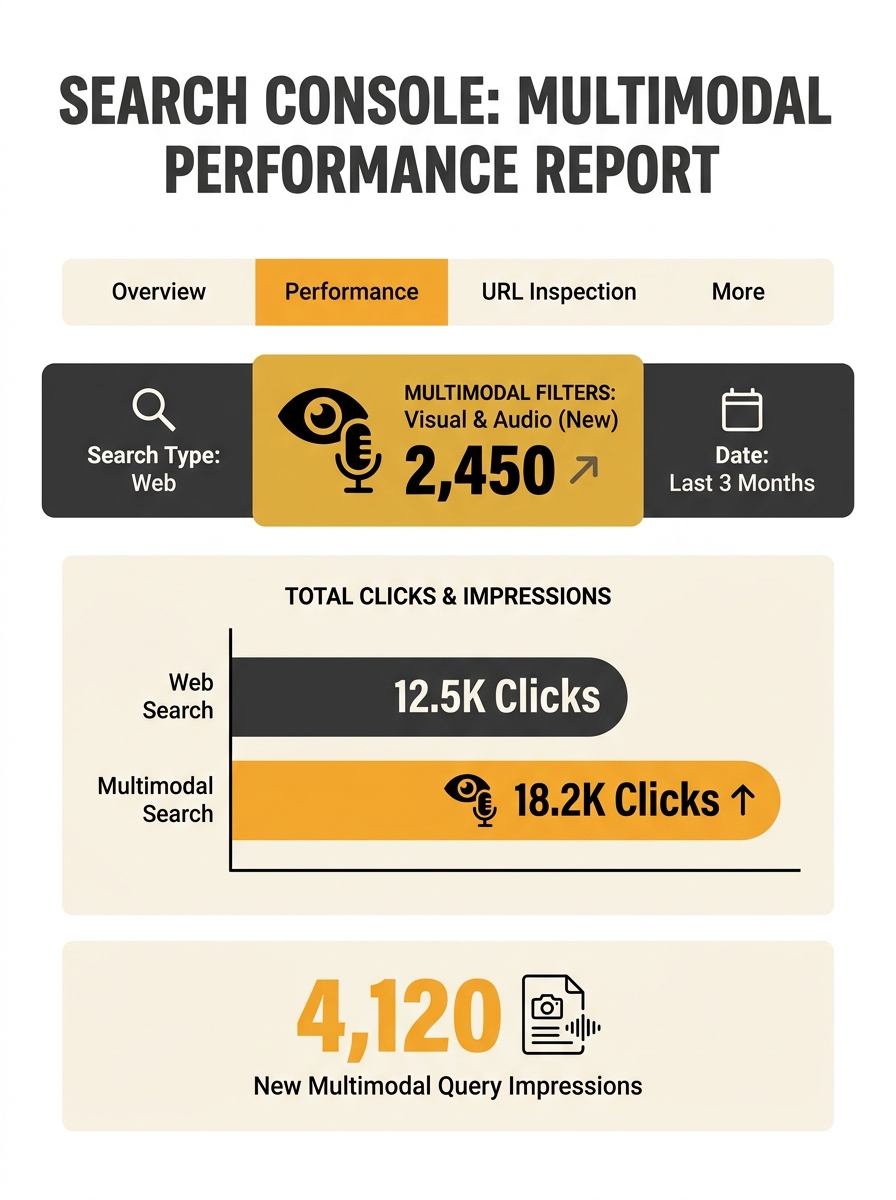
The data gives e-commerce sites and product-heavy businesses page-level visibility into which pages users reach through image-based searches. Site owners can segment multimodal traffic by country and device and compare those pages against text-search performance. A product page showing multimodal clicks will not reveal which specific image the user uploaded or scanned.
Publisher Traffic Declines Accelerate
Google Search and Discover traffic declines steepened in their second year across Chartbeat’s publisher network, according to the analytics company’s 2026 Publisher Playbook released this week. Google Search traffic fell 40.2% year-over-year from July 2025 to July 2026, following a 21.9% decline in the previous 12-month period. Discover’s decline expanded from 6.6% to 34.3% over the same comparison windows.
The playbook does not specify whether the figures measure total pageviews or each channel’s share of total pageviews. Chartbeat’s network skews toward news and media publishers rather than commercial or transactional sites. Direct traffic, internal referrals, and dark social channels grew their share of pageviews over the two-year measurement period.
Separately, a preprint field experiment from researchers at the University of Pennsylvania and Northeastern University found that forcing users into Google’s AI Mode reduced click-throughs to external websites by 18.8 percentage points compared to standard Google Search results. The study tracked 1,100 U.S. participants through a three-day baseline period and seven days of treatment using a browser extension. Participants assigned to AI Mode also gave lower ratings for trust in information on Google and for overall search satisfaction.
The experiment simulated a forced, full-adoption scenario where all searches defaulted to AI Mode. Participants had used AI Mode for only 0.6% of their searches during the baseline period, meaning the study measured what happens when adoption becomes mandatory rather than forecasting traffic patterns under current voluntary usage levels. Google’s Liz Reid stated in August 2025 that organic click volume from Search to websites had remained “relatively stable” year-over-year, though that assessment predated the forced-adoption research design.
De-Indexing Reports Trace to Error Page Canonicalization
Google’s John Mueller responded to a Reddit report describing pages dropping from Google’s index while an unrelated casino site appeared as their canonical URL. The site owner reported that Google treated a casino betting page as canonical for pages covering companies and suppliers. A second Reddit user described identical symptoms on their site, discovered the third-party canonical was indexed under a generic JavaScript error title, and suspected Googlebot had crawled an error page.
Mueller said that scenario “could be an option” and directed the poster to Search Console’s live URL test. In a follow-up reply, he noted that each possible outcome in such cases leaves affected pages “not showing in search for normal content.” Mueller recommended catching broken pages before Googlebot crawls them, writing that he runs automated tests before pushing his own sites live and suggested fetching critical pages on a schedule “so that you can fix them before they become stable problems for search engines to pick up.”
The exchange highlights how server errors or JavaScript failures can cause Google to assign canonical tags pointing to unintended domains, removing legitimate pages from the index until the underlying issue is resolved. Australian businesses running staged deployments or using JavaScript-heavy frameworks should consider pre-deployment crawl testing to catch canonical assignment errors before they affect live search visibility.
Reading Between the Lines
The two-week spam update window breaks the pattern Google set earlier this year and suggests either a broader scope or a more cautious rollout methodology. Sites seeing ranking drops in the first week of October should wait until the rollout completes before making major content changes—what looks like a spam penalty on day three may stabilize differently by day fourteen.
The multimodal Search Console data matters most for Australian retailers and service businesses with strong product photography, particularly those already investing in visual content for platforms like Instagram or Pinterest. The filter won’t tell you which competitor’s product image a user scanned, but it will show which of your pages capture that traffic. Businesses seeing multimodal clicks on category pages rather than product pages may need to revisit their image optimization and schema markup to ensure specific products surface in visual search results.
The Chartbeat publisher declines and AI Mode click reduction both point in the same direction—Google’s interface changes are reshaping how traffic flows from search to websites. The 40.2% year-over-year publisher drop and the 18.8-percentage-point AI Mode reduction come from different measurement methodologies and different site types, but both suggest Australian businesses relying heavily on Google organic traffic should be tracking channel mix monthly and building alternative traffic sources. Direct, email, and referral channels aren’t algorithmic hedges—they’re structural business requirements when your largest traffic source is contracting by double digits year-over-year.