
If you’ve been running a business in Australia and pouring money into digital marketing, you’ve probably heard of SEO and CRO being thrown around like they’re two completely separate universes. But here’s the thing — they’re not. In fact, treating them as isolated strategies might be costing you serious revenue.
So let’s unpack exactly how SEO influences conversion rate optimisation, and why smart Australian businesses are starting to connect these two dots.
Understanding the SEO-CRO Connection
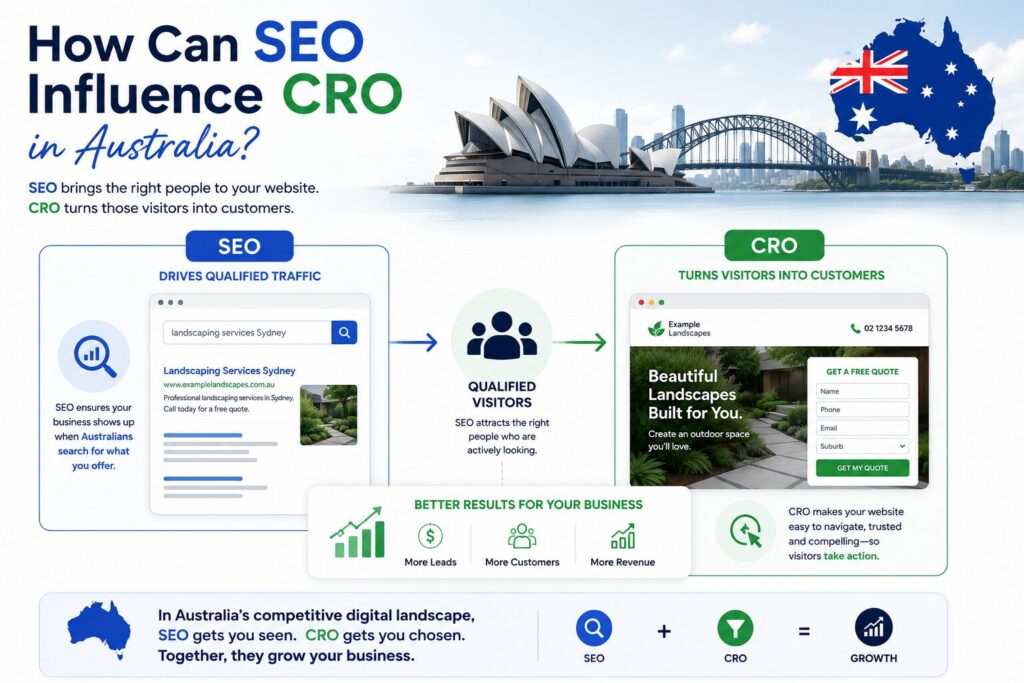
Before we dive deep, let’s get our foundations straight. SEO (Search Engine Optimisation) is all about driving the right people to your website. CRO (Conversion Rate Optimisation) is about making sure those people actually do something valuable when they get there — whether that’s buying a product, filling out a form, or booking a call.
Think of it like a restaurant. SEO is your marketing campaign that gets hungry customers through the door. CRO is the quality of your menu, the ambience, and the service that makes them order — and come back again. Neither one works brilliantly without the other.
Here’s where it gets interesting. Many Australian businesses still treat SEO as a traffic game and CRO as a design game. But the most successful brands — especially those working with an affordable CRO agency like Conversion Rate Store — understand that these two disciplines share data, share audiences, and ultimately share results.
How SEO Feeds CRO With Better Quality Traffic
Keyword Intent Shapes the Entire User Journey
Not all traffic is equal. A visitor landing on your page because they searched “what is project management” behaves very differently from someone searching “best project management software for small business Australia.” The second person has intent. They’re primed to act.
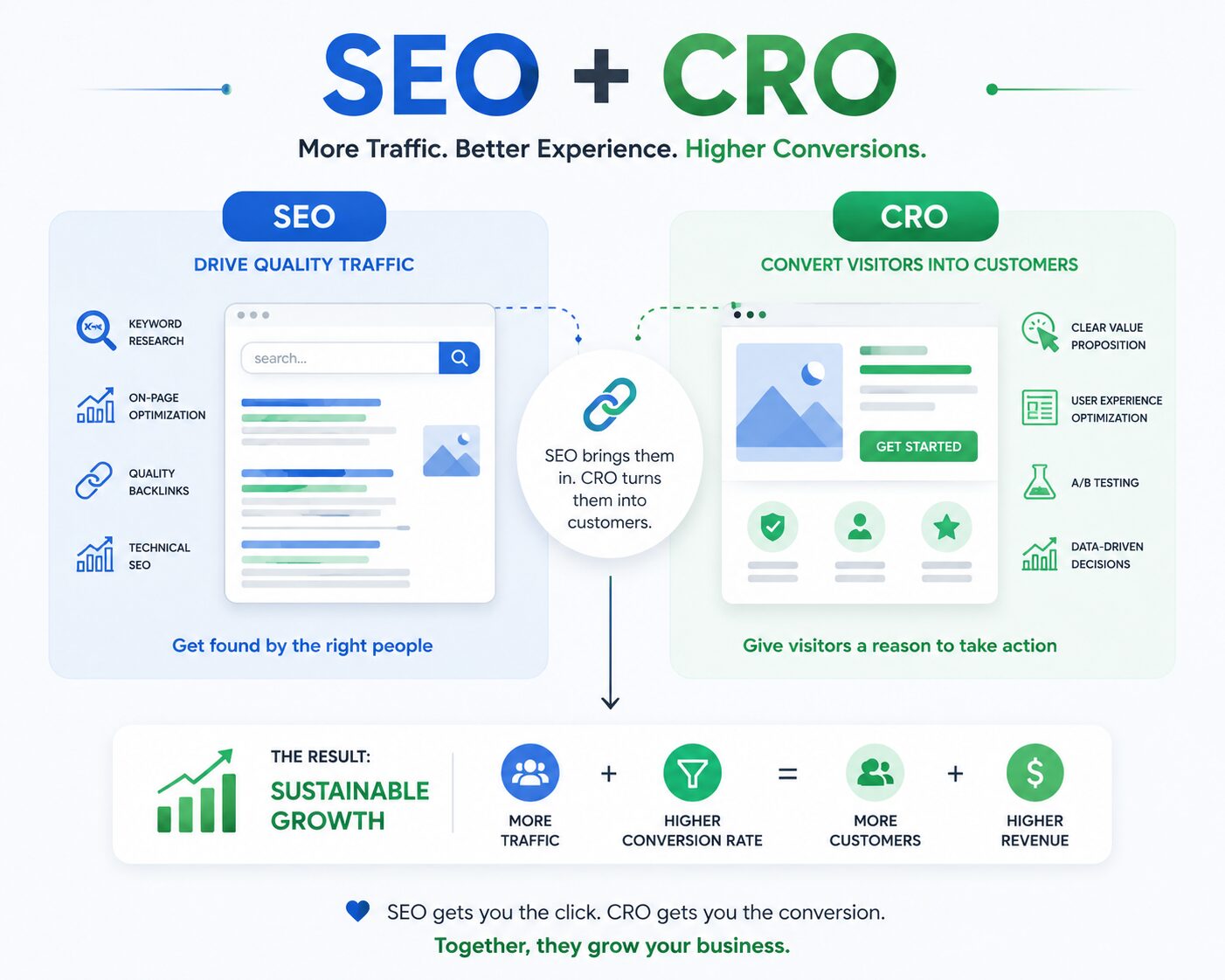
When your SEO strategy targets high-intent, specific keywords, you’re essentially pre-qualifying your audience before they even hit your landing page. That means your CRO team has a much easier job converting them. You’re not trying to turn a window shopper into a buyer — you’re just removing the last few friction points for someone who already wants what you’re selling.
On-Page SEO Elements Double as CRO Elements
Here’s something most marketers don’t realise: many of the things you do for SEO directly improve conversions.
Consider:
- Page speed — Google wants fast pages. So do your users. A one-second delay in load time can reduce conversions by up to 7%.
- Clear headings and structure — Proper H1, H2, H3 hierarchy helps Google understand your content. It also helps users scan quickly and find what they’re looking for.
- Mobile optimisation — With over 55% of Australian web traffic coming from mobile devices, Google’s mobile-first indexing and your conversion rate both depend on a seamless mobile experience.
- Meta descriptions and title tags — These are your first conversion opportunity. A compelling meta description that sets the right expectation reduces bounce rates and starts the conversion process before the click.
What Australian Businesses Are Getting Wrong
Driving Traffic Without a Conversion Strategy
We see this constantly with Australian SMEs. They invest heavily in SEO, watch their traffic numbers climb, and then wonder why revenue isn’t following. The website is attracting visitors but doing nothing to guide them toward a decision.
Imagine spending thousands of dollars bringing people into a store, then having no staff, no signage, and a checkout counter hidden in the back corner. That’s what a high-traffic, low-conversion website looks like.
Optimising for Rankings Without Considering User Behaviour
Some SEO teams are still obsessed with keyword density and backlink counts while ignoring what happens after the click. But Google’s algorithm is increasingly sophisticated. Metrics like dwell time, bounce rate, and pages per session are signals that Google uses to evaluate whether your content is actually satisfying user intent.
If your SEO lands a visitor on a page and they immediately bounce — you’ve told Google that page isn’t delivering value. Your rankings suffer. Your conversions suffer. It’s a double loss.
Where SEO Data Becomes a CRO Goldmine
Google Search Console Is Your Best CRO Research Tool
Here’s a perspective shift: your Search Console data isn’t just for SEO teams. When you analyse which queries are driving impressions but not clicks, you’re identifying messaging mismatches — a classic CRO problem. When you see pages with high clicks but high bounce rates, you’ve found a landing page that’s promising one thing and delivering another.
This is actionable intelligence with CRO tools hiding in plain sight.
Organic User Behaviour Informs A/B Testing Hypotheses
CRO lives and dies by testing. But knowing what to test is half the battle. SEO analytics show you exactly where users drop off, which pages hold attention, and which content types resonate. That data becomes the foundation for conversion hypotheses.
For example, if SEO data shows that long-form content about a specific product feature drives significant traffic but poor conversions, your CRO team now has a clear brief: something on that page is creating hesitation. Maybe it’s the CTA, the pricing structure, or the lack of social proof.
Practical Strategies for Aligning SEO and CRO in Australia
Build Landing Pages That Serve Both Masters
The best Australian digital teams build pages with a dual brief: rank for a high-intent keyword AND convert the visitor who arrives. This means:
- Addressing the search intent immediately in the headline
- Using keyword-rich subheadings that also guide the reader logically toward a decision
- Including clear calls to action that align with where the user is in their buying journey
- Embedding trust signals — reviews, certifications, local credentials — that matter specifically to Australian consumers
Use Local SEO to Attract High-Converting Local Traffic
Australian consumers have a strong preference for local businesses, particularly in service industries. A Sydney-based user searching “accountant near me” or “Melbourne web design agency” is displaying purchase intent with geographic commitment. Local SEO signals — Google Business Profile, localised content, Australian backlinks — bring in traffic that converts at significantly higher rates than broad national traffic.
Treat Content as a Conversion Funnel
SEO-driven content shouldn’t just educate — it should move people forward. Every blog post, every guide, every comparison page is an opportunity to shift a reader from awareness to consideration to decision. Structure your content with this journey in mind. Internal links to service pages, strategically placed CTAs, and content upgrades (lead magnets, free audits, calculators) turn organic traffic into qualified leads.
Conclusion
The relationship between SEO and CRO in Australia isn’t just complementary — it’s essential. SEO without CRO is like filling a leaking bucket. CRO without SEO is like optimising a shop nobody can find. When you bring both disciplines together under a unified strategy — sharing data, aligning goals, and measuring what truly matters — you stop chasing vanity metrics and start building real, scalable revenue growth.
The Australian digital landscape is competitive, but businesses that master this connection aren’t just surviving it — they’re owning it.