
In this guide, we’ll explore how Google AI Overviews are transforming search and what you can do to ensure your content gets cited in these AI-generated summaries.

What Are Google AI Overviews?
Google AI Overviews represent one of the most significant shifts in search since the introduction of featured snippets. These AI-generated summaries appear at the top of search results, synthesising information from multiple sources to provide users with comprehensive answers to their queries—often without requiring a click.
Originally launched as Search Generative Experience (SGE) in 2023, AI Overviews have evolved rapidly. As of late 2025, they now appear in approximately 55% of all Google searches, serving over 2 billion users monthly across more than 200 countries and 40 languages.
For Australian businesses, this transformation isn’t just coming—it’s already here. Understanding how to optimise for Google AI Overviews has become essential for maintaining visibility in an increasingly AI-driven search landscape.
The Impact of AI Overviews on Search Behaviour
The numbers tell a compelling story about how dramatically AI Overviews are reshaping user behaviour:
- 61% decline in organic CTR: According to Seer Interactive’s September 2025 study, organic click-through rates dropped from 1.76% to 0.61% for queries displaying AI Overviews
- 58% of searches now end without clicks: The rise of zero-click searches has accelerated significantly
- 48% of mobile screen real estate: AI Overviews dominate the visible portion of search results, pushing traditional listings below the fold
- 81% of AI Overview queries occur on mobile devices: Making mobile optimisation more critical than ever
However, there’s a silver lining for brands that adapt: businesses cited in AI Overviews earn 35% more organic clicks and 91% more paid clicks than those that don’t appear. The key isn’t fighting against AI Overviews—it’s learning to work with them.
How Google Selects Sources for AI Overviews
Understanding Google’s source selection criteria is fundamental to any successful AI SEO strategy. Unlike traditional rankings where position one virtually guaranteed visibility, AI Overviews create a more nuanced citation ecosystem.
The Top 10 Advantage
Research from Originality.ai reveals that 52% of AI Overview citations come from the top 10 organic search results. The correlation is striking:
- Position 1: 58% chance of being cited
- Positions 2-3: Approximately 50% citation probability
- Positions 4-10: 38% citation probability
- Positions 11-50: Drops to just 14%
This means traditional SEO services remain foundational—you still need strong organic rankings to be considered for AI citations.
Beyond Rankings: What Else Matters
Interestingly, 40% of sources appearing in AI Overviews rank between positions 11-20, indicating that Google’s AI also values other factors beyond raw ranking position:
- Content comprehensiveness: Pages covering topics thoroughly with multiple subtopics
- Structural clarity: Content formatted for easy AI parsing (headers, lists, tables)
- Source authority: Established domains with strong E-E-A-T signals
- Information freshness: Regularly updated content with current data
- Verifiable claims: Statistics and facts backed by citations
Content Structure That Gets Cited
The way you structure content directly influences whether AI systems can extract and cite your information. Here’s what works:
1. Lead with Direct Answers
AI Overviews seek clear, definitive responses to user queries. Structure your content with summary answers in the opening paragraph of each section, followed by supporting detail.
Instead of: “There are many factors that businesses should consider when thinking about their digital marketing strategy…”
Write: “The three most critical factors for digital marketing success are audience targeting, content quality, and measurement. Here’s why each matters…”
2. Use Semantic HTML Structure
Proper heading hierarchy (H2, H3, H4) helps AI understand content relationships. Your content marketing efforts should prioritise:
- Question-based headings: “How does X work?” or “What are the benefits of Y?”
- Logical hierarchy: Main topics as H2, subtopics as H3
- Descriptive headings: Clearly indicate what each section covers
3. Format for Scannability
AI systems prefer content that’s easy to parse:
- Bullet points and numbered lists for processes and features
- Tables for comparisons and data
- Short paragraphs (2-4 sentences maximum)
- Definition sections that clearly explain key terms
4. Include FAQ Sections
Question-and-answer formatting directly mirrors how users search and how AI generates responses. FAQs increase your chances of citation for specific queries.
E-E-A-T Signals: The Foundation of AI Visibility
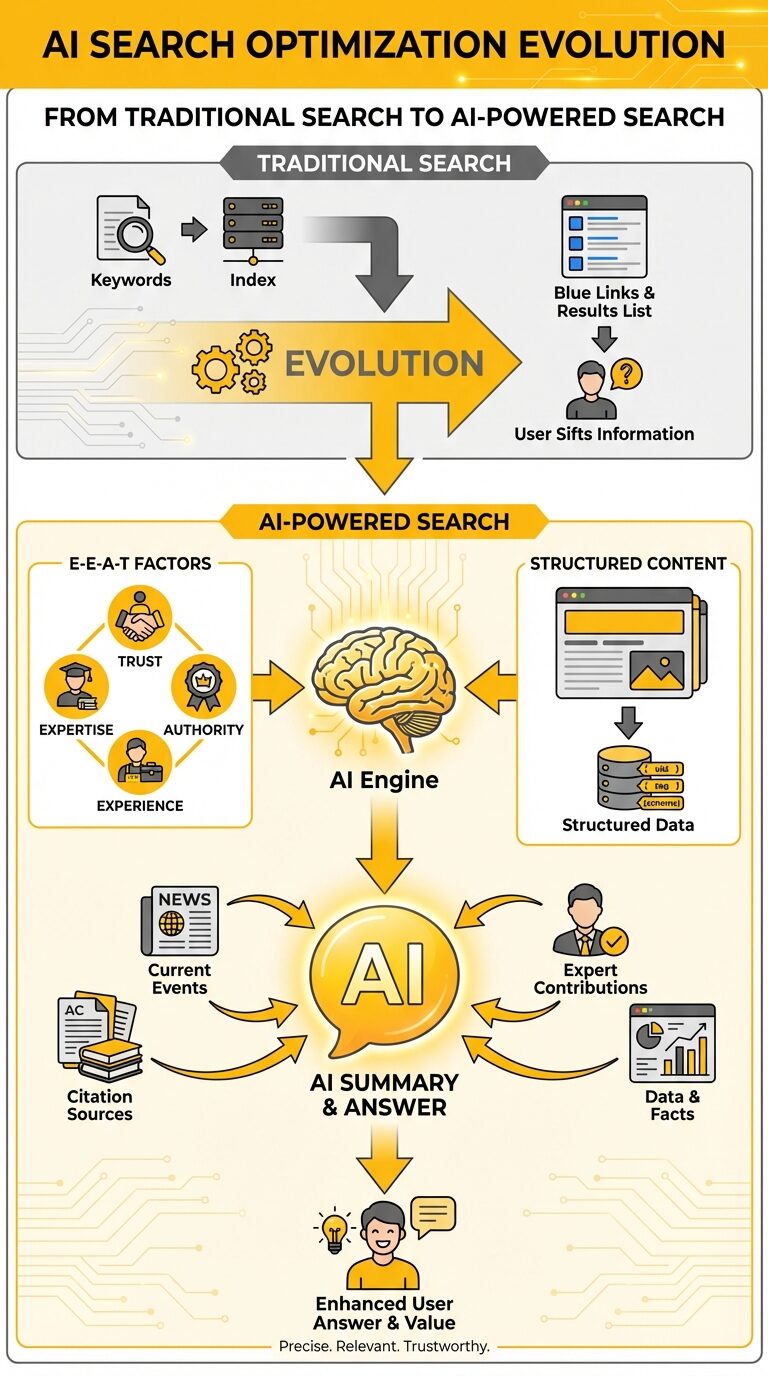
Google’s E-E-A-T framework (Experience, Expertise, Authoritativeness, Trustworthiness) has become the cornerstone of AI Overview source selection. Research indicates that 96% of AI Overview citations come from sources demonstrating strong E-E-A-T signals.
Experience: Demonstrating Real-World Knowledge
AI systems prioritise content showing genuine first-hand experience. To demonstrate experience:
- Include case studies with specific metrics: “Increased conversions by 47% over six months” beats “significantly improved results”
- Share original research and data: Proprietary statistics that can’t be found elsewhere
- Document processes and methodologies: Show how you’ve applied concepts in practice
- Include client testimonials and examples: Real-world validation of your expertise
Pages with evidence of genuine experience are 3.2x more likely to be cited by AI systems.
Expertise: Establishing Subject Matter Authority
Your content should demonstrate deep knowledge in your field:
- Author credentials: Display qualifications, experience, and professional profiles
- Comprehensive topic coverage: Address questions users might have, not just primary queries
- Technical accuracy: Ensure all claims are factually correct and current
- Original insights: Provide analysis beyond what’s available elsewhere
Authoritativeness: Building Industry Recognition
Authority signals extend beyond your website to how others perceive your brand:
- Quality backlinks from respected industry publications
- Mentions in authoritative sources (even without links)
- Consistent entity presence across platforms (organisation schema with sameAs properties)
- Industry recognition: Awards, certifications, speaking engagements
Remember: 97% of sources cited in Google AI Overviews come from the top 20 organic results. Your traditional SEO positioning remains the foundation of AI visibility.
Trustworthiness: The Most Important Factor
Google describes trustworthiness as “the most important” element of E-E-A-T. For AI systems, trust manifests through:
- Transparent sourcing: Cite references for statistics and claims
- Clear attribution: Show who wrote the content and their qualifications
- Accurate information: Regularly audit content for factual correctness
- Privacy and security: HTTPS, clear privacy policies, contact information
- Publication dates: Show when content was created and last updated
Query Types That Trigger AI Overviews
Not all searches generate AI Overviews equally. Understanding which queries trigger them helps focus your optimisation efforts:
High AI Overview Appearance
- Informational queries: 88% of keywords triggering AI Overviews have informational intent
- Long-tail searches: Queries with 8+ words are 7x more likely to generate AI Overviews
- “How to” and educational content: Step-by-step guides and tutorials
- Definition and explanation queries: “What is X” type searches
- Comparison queries: “X vs Y” format questions
Lower AI Overview Appearance
- Transactional queries: Only 12.54% of transactional keywords trigger AI Overviews (though this is rising)
- Local searches: Just 7% of local queries display AI Overviews
- High-CPC keywords: 95% of keywords triggering AI Overviews have low or no commercial value
- Branded searches: Direct brand queries typically show traditional results
This distribution has important implications for your content marketing ROI—focus AI optimisation efforts on informational content while maintaining traditional SEO for transactional pages.
Technical Optimisation for AI Visibility
Beyond content quality, technical factors influence AI citation probability:
Structured Data Implementation
Schema markup helps AI systems understand your content’s context:
- Article schema: Publication date, author, organisation
- FAQ schema: Question-and-answer pairs
- HowTo schema: Step-by-step instructions
- Organisation schema: Entity information with sameAs properties linking profiles
- Author schema: Credentials and expertise indicators
Site Architecture
Create clear topical authority through content organisation:
- Topic clusters: Group related content under pillar pages
- Internal linking: Connect related articles to demonstrate comprehensive coverage
- Clear navigation: Help both users and AI understand site structure
- Entity hubs: Interlink all content about specific topics
Content Freshness
AI systems heavily favour current information:
- 76.4% of ChatGPT citations come from content updated within the last 30 days
- Regular content audits and updates signal active maintenance
- Add timestamps showing publication and last-updated dates
- Refresh statistics and references at least quarterly
Measuring AI Visibility
Traditional metrics aren’t sufficient for measuring success with AI Overviews. Here’s what to track:
New Metrics to Monitor
- Share of voice: How often your brand is cited compared to competitors
- Citation frequency: How many AI Overview citations you receive
- Visibility in AI responses: Tracking appearance across different query types
- Brand mentions: Even uncited references build awareness
Tools for Tracking
While Google Search Console doesn’t yet report AI Overview impressions specifically, several approaches help measure visibility:
- Manual auditing: Regularly search target keywords and document AI Overview appearances
- Third-party tools: Platforms like Semrush, Otterly, and Profound are developing AI visibility tracking
- Traffic analysis: Monitor referral patterns and time-on-site for visitors from AI-influenced searches
- Conversion tracking: Focus on visitor quality rather than raw volume
Reframing Success
Here’s an encouraging insight: 90% of B2B buyers click on sources cited in AI Overviews to verify information. These aren’t lower-quality visits—they’re users actively seeking deeper information and validation.
Google’s own data confirms this: clicks from AI Overviews tend to be “higher quality, where users are more likely to spend more time on the site.” The user has already received context and arrives more engaged.
Understanding what is SEO marketing in the AI era means recognising that fewer but better-qualified visitors often deliver superior business outcomes.
Industry-Specific Considerations
AI Overview impact varies significantly by sector:
High-Impact Industries
- Entertainment: 528% increase in AI Overview appearances (March 2025)
- Restaurants: 387% increase
- Travel: 381% increase
- Healthcare and education: Already had high AI Overview presence
Relative Winners
- Local businesses: Only 7% of local queries show AI Overviews—local SEO remains relatively unaffected
- E-commerce: Transactional queries still favour traditional results
- Reddit and community platforms: 450% increase in AI citations; authentic human discussion is valued
What This Means for Australian Businesses
Australian businesses should audit their content against AI Overview appearance for their target keywords. Industries heavy on informational content—professional services, education, healthcare—need robust AI optimisation strategies, while local service businesses may find traditional SEO delivers strong results.
Practical Steps to Optimise for AI Overviews
Here’s your action plan for improving AI Overview visibility:
Immediate Actions (This Week)
- Audit your top pages: Check if they appear in AI Overviews for target keywords
- Add author information: Ensure content has attributed authors with credentials
- Update timestamps: Add “last updated” dates to key pages
- Check mobile experience: Ensure content renders well on mobile devices
Short-Term Improvements (This Month)
- Restructure content: Add clear headings, lists, and summary paragraphs
- Implement FAQ sections: Add question-and-answer content to relevant pages
- Review E-E-A-T signals: Strengthen author bios, about pages, and trust indicators
- Add structured data: Implement relevant schema markup
Ongoing Strategy
- Create comprehensive content: Cover topics thoroughly with original insights
- Build topical authority: Develop content clusters around key subjects
- Monitor and update: Keep content fresh with regular reviews
- Track AI visibility: Establish baseline metrics and monitor changes
The Future of Search: Adapting to AI-First Discovery
The trajectory is clear: AI-mediated search is expanding. Predictions suggest AI search platforms could rival or surpass traditional search by 2028. Google itself reports that users are searching more often and asking more complex questions thanks to AI features.
For businesses, this isn’t a threat to resist—it’s an evolution to embrace. The fundamentals remain unchanged: create genuinely valuable content that serves user needs. What’s different is how that content must be structured, attributed, and maintained.
Early research indicates that optimising for AI search can increase visibility by up to 40%, with lower-ranking websites benefiting most from early optimisation efforts. The opportunity exists now for businesses willing to adapt.
Frequently Asked Questions
What are Google AI Overviews?
Google AI Overviews are AI-generated summaries that appear at the top of search results. They synthesise information from multiple web sources to provide comprehensive answers, often with links to the original content. They now appear in approximately 55% of all Google searches.
How do I get my content cited in AI Overviews?
Focus on strong E-E-A-T signals (Experience, Expertise, Authoritativeness, Trustworthiness), structure content with clear headings and lists, maintain high organic rankings, update content regularly, and include original data and insights that demonstrate first-hand expertise.
Do AI Overviews reduce website traffic?
AI Overviews have reduced overall click-through rates by approximately 61% for queries where they appear. However, brands cited within AI Overviews see 35% more organic clicks. Quality of traffic often improves, with visitors spending more time on sites they reach through AI-influenced searches.
Which queries trigger AI Overviews?
88% of keywords triggering AI Overviews have informational intent. Long-tail queries (8+ words) are 7x more likely to generate AI Overviews. Local and transactional queries show AI Overviews less frequently.
How do I measure AI Overview visibility?
Track share of voice, citation frequency, and brand mentions using manual audits and third-party tools like Semrush or Profound. Focus on conversion metrics rather than raw traffic volume, as AI Overview visitors tend to be more engaged.
Start Optimising for AI Search Today
Google AI Overviews represent both a challenge and an opportunity for Australian businesses. Those who understand how AI selects and cites sources—and optimise accordingly—will capture visibility in this new search paradigm.
The path forward combines traditional SEO excellence with AI-specific optimisation: strong rankings, structured content, demonstrated expertise, and genuine value for users. Start with your highest-value pages, implement the strategies outlined above, and build toward comprehensive AI visibility.
The businesses that adapt now will be best positioned as AI-first discovery becomes the norm rather than the exception.