
Your welcome email sequence has been converting at 22% for six months. Open rates hold steady. But new subscriber volume from organic landing pages drops by half over ten days. Nothing changed in your email setup. The problem lives upstream, in the search infrastructure feeding your list, and fixing it requires working through a specific diagnostic order.
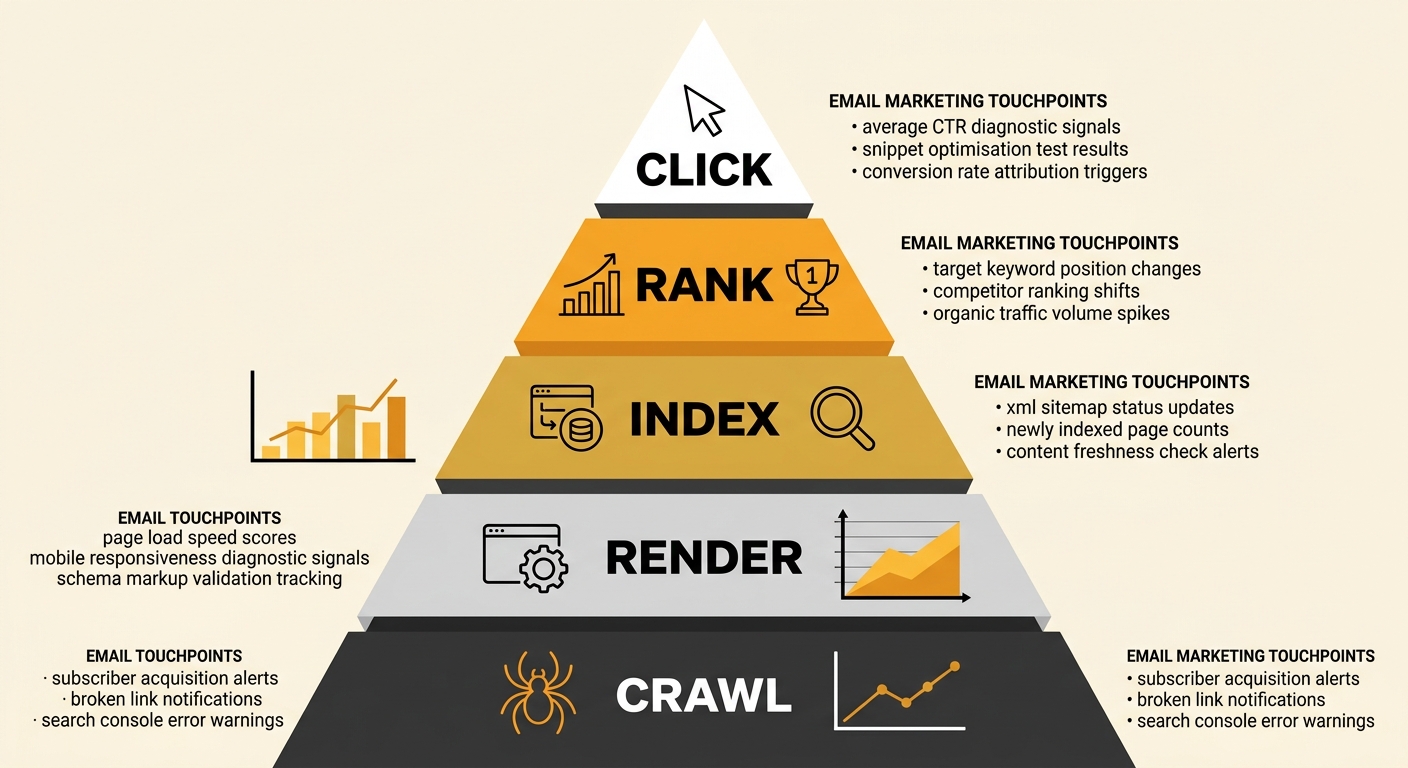
The SEO debugging pyramid is a bottom-up framework with five layers: crawl, render, index, rank, click. For email marketers, each layer maps directly to a part of your acquisition funnel. When organic traffic collapses, the natural reaction is to compensate by sending more campaigns to your existing list. That approach burns goodwill and ignores the root cause. A proper organic traffic drop investigation starts at the foundation and works upward. As Search Engine Land’s debugging guide puts it, smart SEO debugging “systematically eliminates variables to isolate root causes instead of chasing red herrings.”
These six rules will help you diagnose the actual problem and protect your email pipeline while you fix it.
Always start at the crawl layer, even when you’re sure it’s something else
Crawl budget monitoring is the most boring part of SEO and the most frequently skipped. It’s also where roughly half of mysterious ranking drops originate for Australian SMEs running sites between 500 and 10,000 pages.
Here’s what to check first: open Google Search Console’s crawl stats report. Look for spikes in server errors (5xx responses), sudden drops in pages crawled per day, or “Hostload exceeded” warnings. According to Google’s documentation from December 2025, there are only two ways to increase crawl budget: add more server resources or reduce the number of URLs that waste crawl capacity.
If Googlebot can’t reach your pages, nothing downstream matters. Your email signup forms on those pages won’t collect subscribers if nobody finds the pages through search. Before you adjust a single email campaign or rewrite a landing page headline, confirm that Google can actually access your site. We’ve covered how crawling rule conflicts can quietly sabotage your technical setup, and these misconfigurations are often the first thing worth checking.
When this rule doesn’t apply
If you’ve had a confirmed manual action or a Google algorithm update announcement within the same week as your traffic drop, you can reasonably start at the rank layer instead. But even then, circle back to crawl within 48 hours.
Use your email engagement data to separate content problems from technical ones
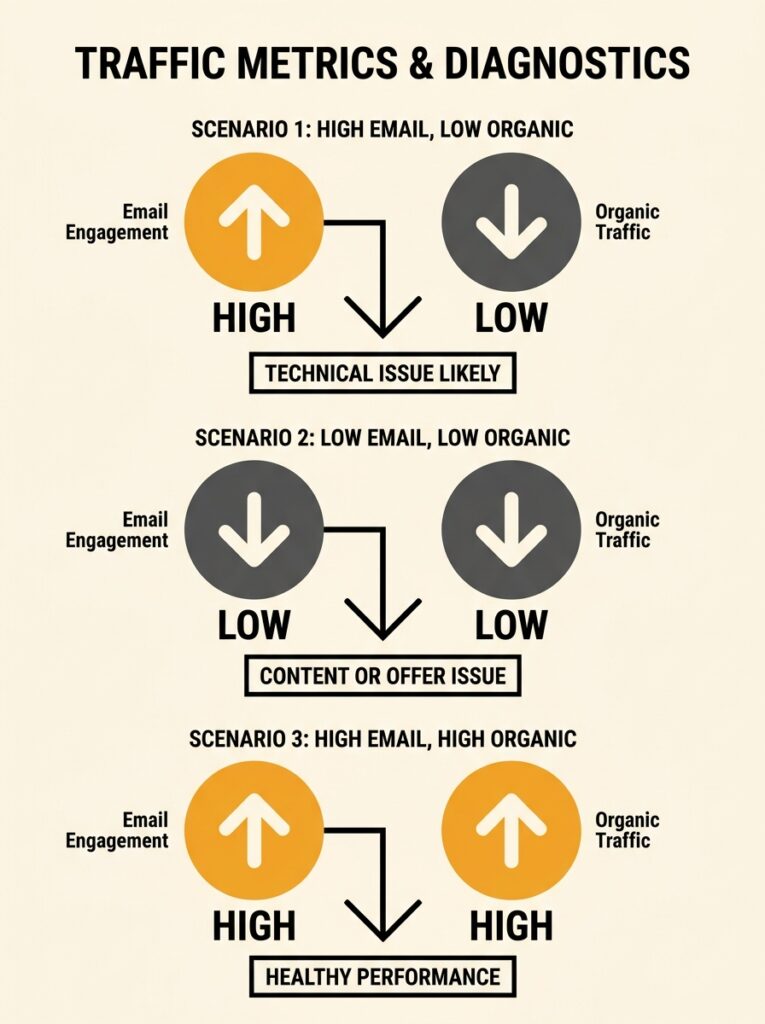
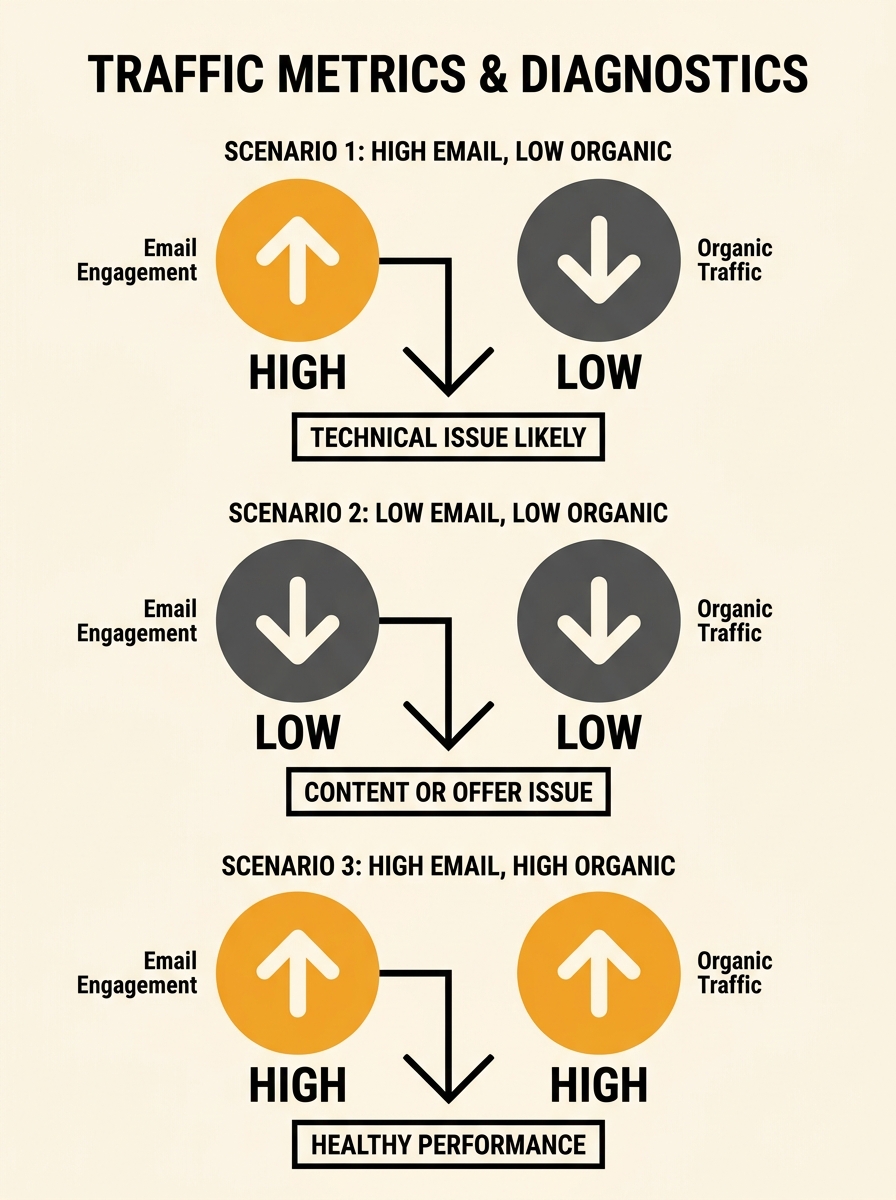
This is where email marketers have a genuine diagnostic advantage. Your email platform tracks how subscribers interact with your content when you send it directly to them. If you email a link to a blog post and the engagement metrics (time on page, scroll depth, conversion rate) are strong, the content itself probably isn’t the problem. The issue is likely technical: Google either can’t find the page, can’t render it, or has stopped ranking it for reasons unrelated to quality.
Run this comparison: take your top 10 organic landing pages by historical traffic. Send your email list links to those same pages over a few days. If email-driven visitors behave normally but organic traffic to those pages has cratered, you’ve just eliminated content quality as a variable. That narrows your diagnostic scope significantly and saves you from rewriting pages that didn’t need rewriting.
When this rule doesn’t apply
If your content is several years old and hasn’t been updated, a core algorithm update may have genuinely devalued it regardless of how your email subscribers respond. Loyal subscribers aren’t the same audience as new searchers evaluating your relevance against competitors.
Check rendering before you rewrite anything
JavaScript-heavy Australian business sites, particularly those built on React or Angular frameworks, frequently have rendering problems that are invisible to human visitors but catastrophic for search engines. If Googlebot can’t execute your JavaScript, your pages may appear empty to Google even though they look fine in a browser.
You can test this using Google’s URL Inspection Tool in Search Console. Compare the rendered HTML Google sees with what your browser displays. Screaming Frog also lets you crawl your site in both standard HTML mode and JavaScript rendering mode, so you can compare the outputs side by side. Pages where the two results differ significantly have rendering issues that complicate indexation troubleshooting for Australian SMEs relying on those pages for subscriber acquisition.
This matters because many modern signup forms, pop-ups, and embedded subscription widgets are JavaScript-dependent. If Google can’t render the page content surrounding those forms, it won’t rank the page, and your organic subscriber acquisition drops even though the email infrastructure works perfectly.
If Google can’t render the page content surrounding your signup forms, organic subscriber acquisition drops even though your email infrastructure works perfectly.
When this rule doesn’t apply
Static HTML sites (WordPress without JavaScript-heavy themes, basic Shopify setups) rarely have rendering issues. If your site is mostly server-rendered, skip ahead to indexation checks and save yourself the trouble.
Diagnose Core Web Vitals on your highest-value signup pages first
Google has confirmed that page experience signals, including Core Web Vitals, are a ranking factor. The impact becomes most visible when two competing pages have comparable content quality and authority. In that tiebreaker scenario, the page with better Core Web Vitals wins.
For Core Web Vitals diagnosis, focus your efforts on pages that actually drive email signups. Pull up the Core Web Vitals report in Search Console and cross-reference it with your email platform’s data showing which landing pages generate the most subscribers. If your top signup pages have poor Largest Contentful Paint or excessive Cumulative Layout Shift, you’re losing both rankings and conversions at the same time.
Google’s own documentation recommends achieving good Core Web Vitals as part of what their core ranking systems seek to reward. For businesses providing Sydney SEO services or any competitive local service, even modest CWV improvements on key pages can shift rankings when you’re neck-and-neck with competitors.
When this rule doesn’t apply
If your traffic dropped by 50% or more overnight, Core Web Vitals almost certainly aren’t the cause. CWV-related ranking changes tend to be gradual, playing out over weeks. A sudden cliff points to a crawl or indexation problem, or a major algorithm update.
Treat your email list as a controlled testing environment
When you suspect a content quality issue at the rank layer, your email list gives you something organic search cannot: a controlled audience. You can A/B test different page versions by sending segments of your list to variant A and variant B, then measure engagement. This tells you whether updated content performs better before you commit changes that might take weeks to reflect in search rankings.
This approach is particularly valuable for digital marketing for small business operations that can’t afford to wait months discovering a rewrite didn’t help. Send to your list, measure the response, confirm the improvement, then publish the winning version for Google to re-crawl and re-rank.
You should also use email to keep tabs on your SEO health through a regular monitoring schedule. Automated reports from Search Console and your analytics platform, delivered to your inbox weekly, catch metric anomalies within days rather than letting damage compound for a month before anyone notices. The earlier you begin an organic traffic drop investigation, the shorter the recovery.
When this rule doesn’t apply
If your email list has fewer than 500 active subscribers, the sample sizes won’t produce statistically meaningful results. You’re better off using heatmaps and session recordings on your existing organic traffic instead.
Don’t send a recovery campaign until you’ve confirmed the root cause
The worst response to a ranking drop is panic-emailing your entire list with discounts, hoping to bridge the revenue gap while you figure things out. This trains subscribers to expect discounts, inflates unsubscribe rates, and does nothing about the underlying SEO problem.
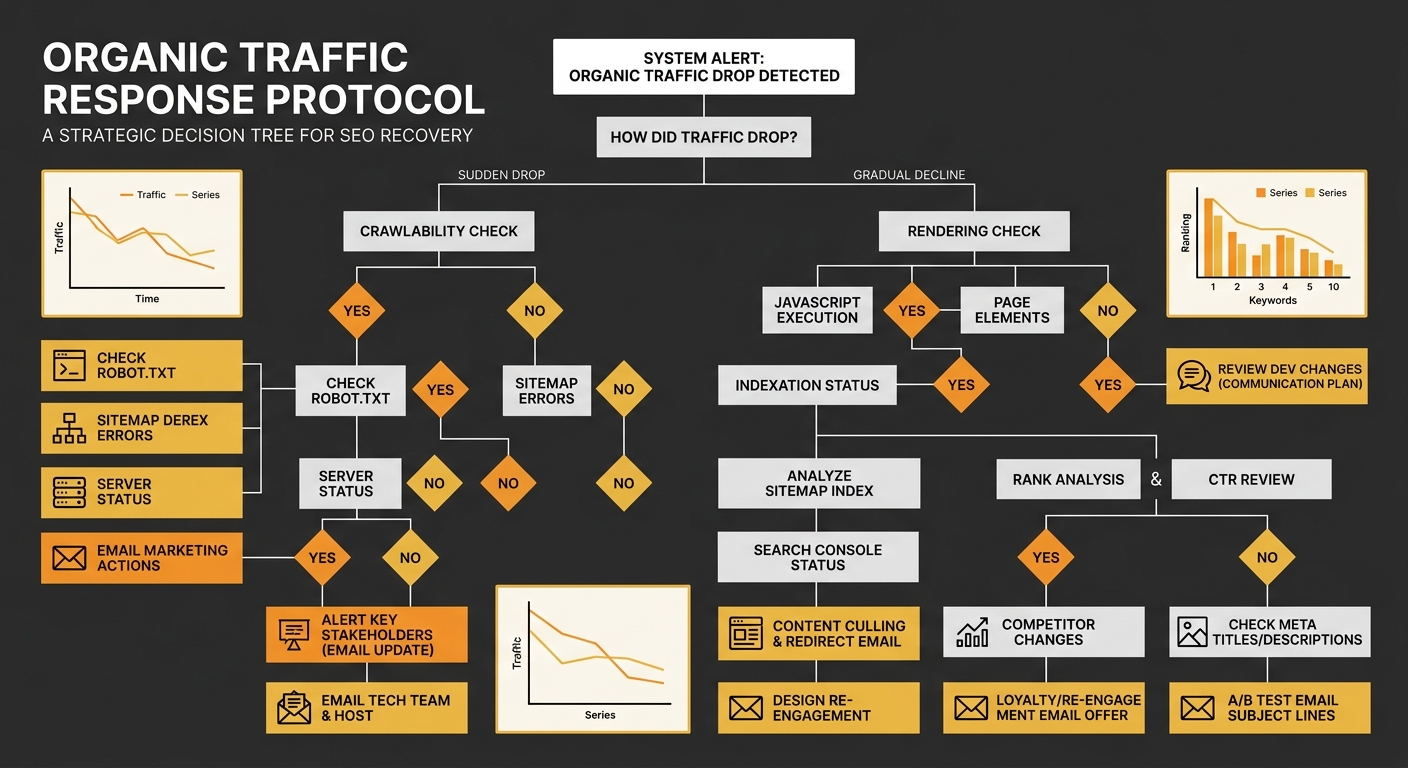
Instead, work through each layer of the pyramid methodically. Once you’ve identified and fixed the technical or content issue, then deploy a targeted email campaign to your most engaged segment. Drive traffic to the affected pages so Google sees fresh engagement signals as part of a genuine recovery.
If the drop was triggered by an algorithm update, we’ve covered how Australian businesses can navigate those updates without compounding the damage. The core principle there applies doubly for email marketers: resist making sweeping changes without evidence backing them up.
Warning: Sending heavy promotional blasts to compensate for lost organic traffic typically spikes spam complaints and reduces deliverability, creating a second problem on top of the first.
When this rule doesn’t apply
If you sell seasonal products and the traffic drop coincides with your peak sales window, you may not have the luxury of waiting for a full diagnosis. In that case, send a modest, value-focused campaign to your warmest segment while you investigate in parallel. Keep volume conservative and avoid training your list on discounts you’ll regret in January.
When These Rules Break Down
Every framework has limits. The SEO debugging pyramid assumes your analytics data is clean, your Search Console property is verified correctly, and your email platform’s tracking integration is working. If any of those foundations are compromised, the signals you’re reading may be actively misleading.
The pyramid also assumes a single root cause. In practice, Australian businesses dealing with accumulated technical SEO debt often face multiple issues across different layers at once. A server migration might introduce crawl errors and break JavaScript rendering and corrupt canonical tags simultaneously. In those compound failure scenarios, you’ll need to address issues at each layer before you can isolate which one was dragging rankings down the most.
And the email marketing angle has its own constraint: it works best when your list is healthy and actively engaged. If you haven’t maintained your subscriber list, segmented it properly, or sent consistent content over the preceding months, the engagement data you collect won’t be reliable as a diagnostic tool. The pyramid and your email programme reinforce each other, but both need regular upkeep to produce trustworthy signals. When you find yourself doubting the data at any layer, step back and verify the measurement infrastructure before drawing conclusions from numbers you can’t trust.