

They must compete for visibility in crowded digital spaces whilst simultaneously managing complex operational frameworks involving memberships, donations, volunteer coordination, and event registration.
Growth online depends not on one factor, but two: discoverability through search engines and operational maturity in how supporter relationships are actually managed behind the scenes.
The equation is deceptively simple. A nonprofit can invest thousands in advertising, build a beautiful website, and rank on page one of Google for valuable keywords. But if the sign-up form breaks on mobile devices, if renewal reminders never arrive, or if event registration requires ten steps instead of three, those hard-won visitors disappear.
Conversely, an organisation with immaculate back-end systems but no search visibility remains invisible to the very people it exists to serve. Sustainable growth requires both elements working in concert, not isolation.
When Strong Marketing Meets Weak Operations
The gap between front-end marketing and back-end execution kills more nonprofit growth initiatives than lack of funding ever does.
Organisations pour resources into search engine optimisation campaigns, social media advertising, and content creation, successfully driving traffic to their websites.
Rankings improve. Click-through rates climb. Then the operational breakdowns begin.
A supporter discovers the organisation through search, reads compelling impact stories, decides to become a monthly donor, and encounters a donation form that times out. Another potential volunteer finds the nonprofit through organic search, wants to register for an upcoming event, but receives no confirmation email and never hears back.
A lapsed member sees a social media post about renewal, clicks through, and discovers their login credentials no longer work with no clear path to resolution. These operational failures create a silent attrition that no amount of traffic can overcome.
Research from Stanford University demonstrates that donor attrition rates exceed 70 percent in many online fundraising environments. Whilst acquisition strategies receive the budget and attention, the systems meant to retain those supporters remain fragmented, manual, or neglected entirely. Mature nonprofits address this gap by implementing a member management platform that consolidates supporter data, automates renewal workflows, and creates self-service portals that reduce administrative friction. These platforms function not as marketing tools but as operational infrastructure, ensuring that every person acquired through marketing efforts can actually complete the actions the organisation needs them to take.
Disorganised operations create measurable damage. When membership records sit in spreadsheets, event registrations arrive via email, donation records live in one system, and volunteer schedules exist in another, staff spend hours reconciling information instead of building relationships. Supporters experience delays, errors, and frustration.
According to research published by the Urban Institute, there is substantial data supporting the fact that a well-run organisation has increased impact, with organisations receiving capacity-building support experiencing significantly higher growth levels than those operating without systematic infrastructure improvements.
The challenge intensifies because operational weaknesses remain invisible in standard marketing analytics.
Google Analytics shows that 5,000 people visited the donation page, but it cannot reveal that 400 of them abandoned the form due to confusing field labels, that another 300 never received confirmation emails due to a misconfigured server, or that 150 monthly donors quietly cancelled because renewal reminders never arrived.
Marketing teams celebrate traffic growth whilst operations teams silently manage the consequences of systems that were never designed to scale.
The Compound Effect of Search Visibility and Operational Systems
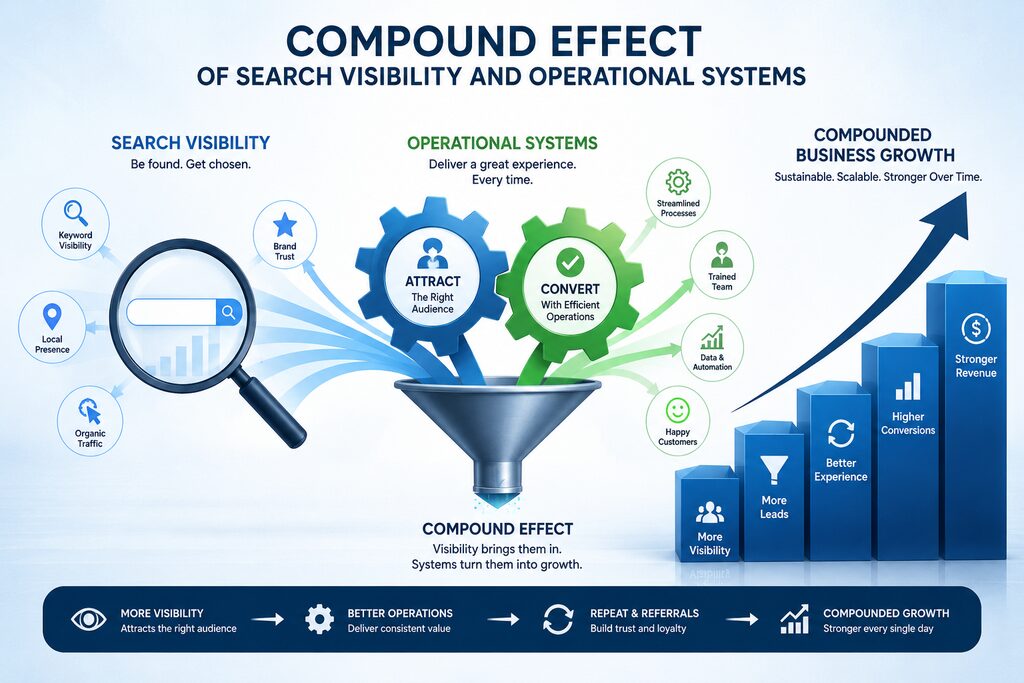
Growth accelerates when discoverability and operational capability reinforce one another. Local SEO strategies drive community members to nonprofit websites by optimising for geographic and mission-specific search terms. But visibility alone creates opportunity, not results.
The conversion of that visibility into sustained support depends entirely on what happens after the click.
Consider the supporter journey in practical terms. Someone searches for “volunteer opportunities near me” or “donate to animal welfare Sydney” and discovers a nonprofit through organic search results. They arrive at a well-designed landing page with clear calls to action.
This represents successful marketing execution.
What determines whether that person becomes a long-term supporter is operational: Can they complete the volunteer application on their mobile device? Does the donation platform accept their preferred payment method? Will they receive timely communication about how their contribution was used? Do they have access to an online portal where they can update their information, view their giving history, or modify their volunteer schedule?
Research from Penn State Extension indicates that nonprofits must ensure their websites are visible, credible, and easy for AI systems to understand by applying strong SEO practices whilst maintaining accurate information across platforms. This integration of technical optimisation and operational accuracy creates sustainable visibility.
Search engines increasingly evaluate user experience signals, including page load speed, mobile responsiveness, and completion rates for key actions.
A nonprofit with excellent SEO but poor operational systems will see rankings decline as search algorithms detect high bounce rates and low engagement.
The inverse relationship proves equally important. Exceptional operational systems provide minimal value if no one can find them.
A nonprofit might offer seamless membership management, one-click event registration, and automated communication workflows, but these capabilities matter only to people who arrive at the website. This is where search visibility becomes the catalyst for operational efficiency to demonstrate its value.
Data from the Nonprofit Trends Tracker, maintained by the Urban Institute, provides context for the scale of the sector in the United States, noting that surveys focus on 501(c)(3) public charities with annual expenses and revenues of $50,000 or more that engage in diverse activities, highlighting the breadth of organisations requiring both discoverability and operational infrastructure to succeed.
Integration creates momentum. As operational systems improve, they generate better data about supporter behaviour, preferences, and engagement patterns.
Marketing teams use this data to refine targeting, improve messaging, and optimise conversion paths. Better marketing drives more qualified traffic. Superior operations convert that traffic more effectively.
The cycle compounds over time, creating growth rates that organisations optimising only one dimension never achieve.
Practical Steps Toward Integrated Growth
Nonprofits pursuing genuine online growth must audit both dimensions simultaneously. Begin with search visibility. Conduct keyword research to identify the terms potential supporters actually use when searching for organisations like yours.
Optimise website content, meta descriptions, and page titles to align with those search terms.
Build quality backlinks through partnerships, media coverage, and content that other organisations reference. Track rankings, organic traffic, and the quality of visitors arriving through search channels.
Then audit operational capability with equal rigour. Map every supporter journey from first click to long-term engagement. Identify friction points where people abandon processes, where manual work creates delays, or where data fragmentation causes errors. Implement systems that automate routine tasks, consolidate supporter information, and create self-service options that reduce administrative burden whilst improving supporter experience.
The backbone of any successful nonprofit organisation is its operational efficiency, as strong and efficient operations ensure smooth day-to-day activities whilst significantly enhancing fundraising capabilities.
This operational foundation allows marketing investments to generate returns rather than simply creating temporary traffic spikes that produce no lasting supporter relationships.
Prioritisation matters because resources remain finite. Organisations with limited budgets should focus first on operational infrastructure for their highest-value supporter segments.
If monthly donors provide 40 percent of revenue, ensure their experience is frictionless before optimising systems for annual event attendees. If volunteer retention drives program delivery, prioritise volunteer management tools before expanding into new marketing channels.
Technology decisions should follow operational requirements, not precede them. Many nonprofits purchase software based on features rather than solving defined problems.
The result is expensive systems that sit partially implemented whilst staff continue using spreadsheets and email to manage day-to-day work. Instead, document current processes, identify specific bottlenecks, and select tools that directly address those constraints whilst integrating with existing workflows.
Where Growth Actually Comes From
Nonprofit growth online emerges from the intersection of visibility and capability. Neither dimension succeeds alone. Exceptional marketing cannot overcome operational dysfunction.
Brilliant operations remain invisible without strategic discoverability. Organisations that treat these as separate functions will always underperform those that recognise them as interdependent systems requiring parallel investment and continuous refinement.
The path forward requires honest assessment of current state in both dimensions, systematic improvement of the weakest links, and integration of marketing and operational data to create feedback loops that drive compound improvement.
For Australian nonprofits navigating increasingly competitive digital landscapes, this integrated approach represents not just best practice but essential infrastructure for sustainable mission delivery in an online-first world.