

E-commerce SEO drives sustainable traffic and sales without paying for every click. While paid advertising has its place, organic search delivers customers who find you naturally—often at a lower acquisition cost with higher lifetime value.
This guide covers everything you need to rank your online store higher in search results: from product page optimisation to technical SEO and beyond.
Why E-commerce SEO Matters
Online stores face unique SEO challenges: thousands of product pages, duplicate content issues, complex site structures, and intense competition. But the rewards are significant:
- Lower acquisition costs: Organic traffic doesn’t cost per click
- Higher trust: Shoppers trust organic results more than ads
- Compound growth: SEO investments build over time
- Competitive advantage: Strong SEO is hard to replicate quickly
Product Page Optimisation

Product pages are where conversions happen. Optimise them for both search engines and shoppers.
Product Titles
Write titles that include your target keyword while appealing to shoppers:
- Include the product name, brand, and key attributes
- Place important keywords early in the title
- Keep titles under 60 characters for full display in search results
- Avoid keyword stuffing—titles should read naturally
Product Descriptions
Unique, detailed descriptions serve both SEO and conversions:
- Write original content—never copy manufacturer descriptions
- Include target keywords naturally
- Address customer questions and concerns
- Highlight features, benefits, and use cases
- Aim for 300+ words on important product pages
Product Images
Images affect both SEO and sales:
- Use descriptive filenames (blue-widget-front-view.jpg, not IMG_001.jpg)
- Add keyword-rich alt text for accessibility and SEO
- Compress images to maintain fast load times
- Provide multiple angles and context shots
In some ecommerce setups, this conversion stage is further supported by white-label transaction tools that help ensure checkout experiences remain seamless while maintaining full brand consistency.
Category Page Optimisation
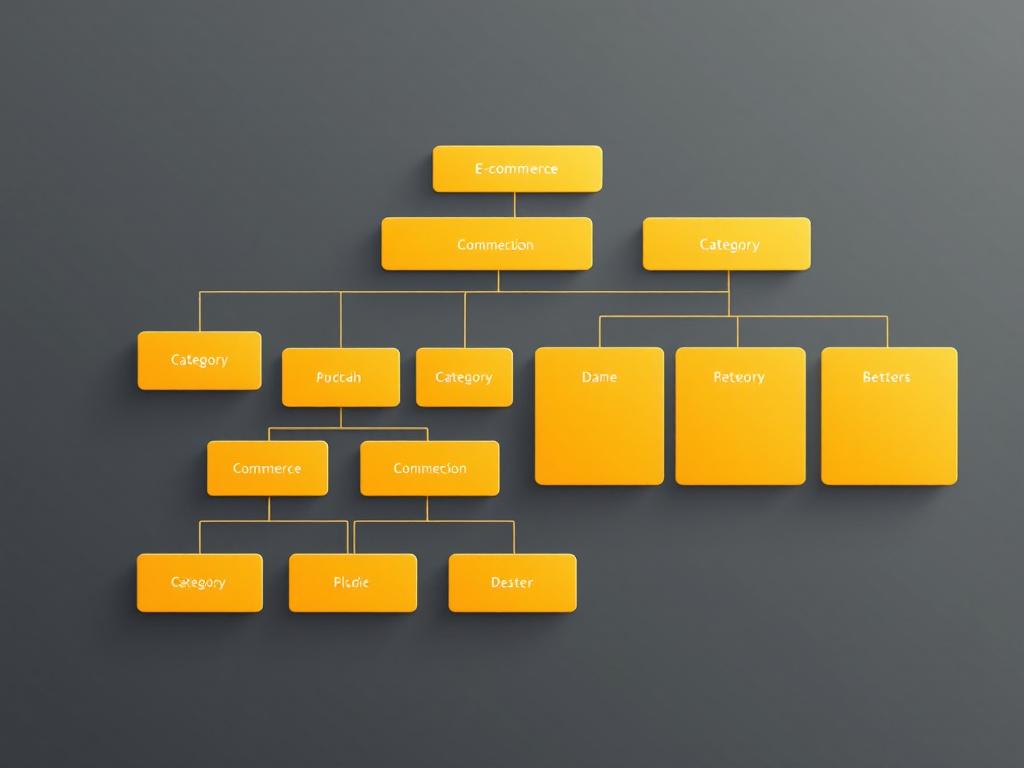
Category pages often target higher-volume keywords and drive significant traffic.
- Unique descriptions: Add 200+ words of unique content to each category
- Clear hierarchy: Logical category structure helps users and search engines
- Faceted navigation: Allow filtering while managing crawl budget
- Internal linking: Link to subcategories and featured products
Site Structure for E-commerce
Proper site structure helps search engines crawl efficiently and users find products quickly.
URL Structure
Clean, descriptive URLs improve both SEO and user experience:
- Good: /womens-shoes/running-shoes/nike-air-zoom
- Bad: /product?id=12345&cat=shoes
Navigation Depth
Keep products within three clicks of the homepage. Deep pages receive less crawl priority and are harder for users to find.
Internal Linking
Strategic internal links distribute authority and guide users:
- Link related products on product pages
- Feature bestsellers and new arrivals on category pages
- Create buying guides that link to relevant products
- Use breadcrumbs for navigation and SEO
Technical SEO for E-commerce
Technical issues can prevent even great content from ranking. Address these e-commerce-specific challenges:
Page Speed
Slow sites lose sales and rankings:
- Optimise and compress images
- Use browser caching and CDNs
- Minimise JavaScript and CSS
- Choose fast, reliable hosting
- Implement lazy loading for images
Mobile Optimisation
Most e-commerce traffic comes from mobile devices:
- Use responsive design
- Ensure easy checkout on mobile
- Make buttons and links touch-friendly
- Test thoroughly on actual devices
Duplicate Content
E-commerce sites commonly have duplicate content issues:
- Faceted navigation: Use canonical tags or noindex for filtered pages
- Product variations: Consolidate or use canonical tags
- Pagination: Implement proper pagination markup
- HTTP/HTTPS: Ensure consistent protocol usage
Schema Markup for E-commerce
Structured data helps search engines understand your products and display rich results:
- Product schema: Price, availability, reviews, images
- Breadcrumb schema: Navigation structure in search results
- Organization schema: Business information
- FAQ schema: Common questions on product pages
Rich snippets increase click-through rates by making your listings stand out in search results.
Content Marketing for E-commerce
Product pages alone won’t win competitive keywords. Content marketing builds authority and captures informational searches.
- Buying guides: Help shoppers make decisions
- How-to content: Usage tips and tutorials
- Comparison content: Product comparisons and reviews
- Industry content: Trends and news in your niche
Link strategically from content to relevant products, capturing readers at different stages of the buying journey.
Link Building for E-commerce
Backlinks remain essential for e-commerce SEO:
- Product reviews: Send products to bloggers and reviewers
- Resource content: Create linkable guides and tools
- PR and media: Newsworthy stories about your brand
- Supplier and partner links: Leverage business relationships
Measuring E-commerce SEO Success
Track metrics that connect SEO to business outcomes:
- Organic traffic: Visitors from search engines
- Organic revenue: Sales attributed to organic search
- Ranking positions: For target keywords
- Conversion rate: From organic traffic
- Pages indexed: Ensure products are being crawled
Common E-commerce SEO Mistakes
Avoid these errors that harm online store rankings:
- Thin product descriptions: Copying manufacturer content
- Ignoring out-of-stock pages: Proper handling prevents lost SEO value
- Poor mobile experience: Mobile-first indexing means mobile matters most
- Slow page speed: Every second of delay costs conversions
- Missing schema: Leaving rich snippet opportunities on the table
Getting Expert E-commerce SEO Help
E-commerce SEO requires specialised expertise. Our e-commerce SEO team understands the unique challenges online stores face, from managing thousands of products to competing with major retailers.
We also offer Shopify development services for stores needing technical improvements alongside SEO strategy. Learn more about e-commerce SEO strategies or explore off-page SEO for e-commerce.
Ready to drive more organic traffic and sales? Contact us to discuss your e-commerce SEO needs. Whether you’re on Shopify, WooCommerce, Magento, or another platform, we build strategies that deliver measurable growth.
E-commerce SEO for Different Platforms
Each e-commerce platform has unique SEO considerations:
Shopify SEO
Shopify handles many technical SEO basics well but has limitations:
- URL structure is somewhat rigid
- Limited access to robots.txt customisation
- Built-in blogging is basic
- Apps can solve most SEO gaps
WooCommerce SEO
WooCommerce offers more flexibility but requires more technical management:
- Full control over URL structures
- Extensive plugin ecosystem
- Requires careful hosting selection for speed
- More technical maintenance needed
Magento SEO
Magento is powerful but complex:
- Excellent for large catalogues
- Requires significant technical expertise
- Heavy resource requirements
- Best for enterprise-level stores
Choose your platform based on business needs, then optimise within its capabilities.
International E-commerce SEO
Selling across borders introduces additional SEO considerations:
- Hreflang tags: Tell search engines which version to show which audience
- URL structure: Decide between subdomains, subdirectories, or ccTLDs
- Local keywords: Research keywords in each target market
- Local content: Adapt content for cultural differences
- Currency and pricing: Display local currencies appropriately
International expansion multiplies SEO complexity but opens vast new markets.
Handling Out-of-Stock Products
What happens when products go out of stock matters for SEO:
- Temporarily out of stock: Keep the page live, note availability status
- Permanently discontinued: Redirect to similar products or category pages
- Seasonal products: Keep pages live, update content seasonally
Never delete product pages without proper redirects—you’ll lose accumulated SEO value.
E-commerce SEO Timeline
Expect e-commerce SEO results to develop over time:
- Months 1-2: Technical audit and fixes, foundational optimisation
- Months 3-4: Product and category optimisation, content development
- Months 5-6: Initial ranking improvements, traffic growth begins
- Months 7-12: Significant traffic increases, conversion optimisation
- Year 2+: Authority building, competitive keyword conquest
E-commerce SEO is a long-term investment. Quick fixes rarely deliver sustainable results.
The E-commerce SEO Advantage
While paid advertising delivers immediate traffic, SEO builds lasting assets. A well-optimised product page continues attracting customers for years. Compound this across thousands of products and the ROI becomes substantial.
The online stores dominating search results didn’t get there overnight. They invested consistently in SEO while competitors focused only on paid channels. Now they enjoy lower acquisition costs and sustainable competitive advantages.
Start your e-commerce SEO journey today. Whether you’re launching a new store or optimising an established one, the principles in this guide provide a framework for organic search success. The best time to start was yesterday. The second best time is now.
E-commerce SEO Budget Allocation
How should online stores allocate their SEO budget? Consider these priorities:
- Technical foundation (20%): Site speed, mobile optimisation, crawlability
- Product optimisation (30%): Descriptions, images, schema markup
- Content marketing (25%): Guides, blog posts, linkable assets
- Link building (15%): Outreach, PR, relationships
- Measurement and optimisation (10%): Analytics, testing, refinement
Adjust based on your specific situation. New stores may need more technical work initially. Established stores might focus more on content and links.
Working With E-commerce SEO Experts
E-commerce SEO requires specialised knowledge. Consider professional help if:
- You have a large product catalogue to optimise
- Technical issues are beyond your team’s expertise
- You’re competing against major retailers
- Internal resources are stretched thin
- You need faster results than DIY allows
The right e-commerce SEO partner understands both search optimisation and online retail. They’ve solved problems like yours before and can shortcut the learning curve.
E-commerce success in search requires strategy, execution, and patience. The stores that commit to SEO build sustainable competitive advantages that paid advertising alone cannot match. Your products deserve to be found. SEO makes that happen.
Ready to transform your online store’s search visibility? Our e-commerce SEO specialists combine technical expertise with retail understanding to deliver results. From product page optimisation to comprehensive SEO strategies, we help online stores compete and win in organic search. Contact us today to discuss how we can grow your e-commerce business through SEO.