
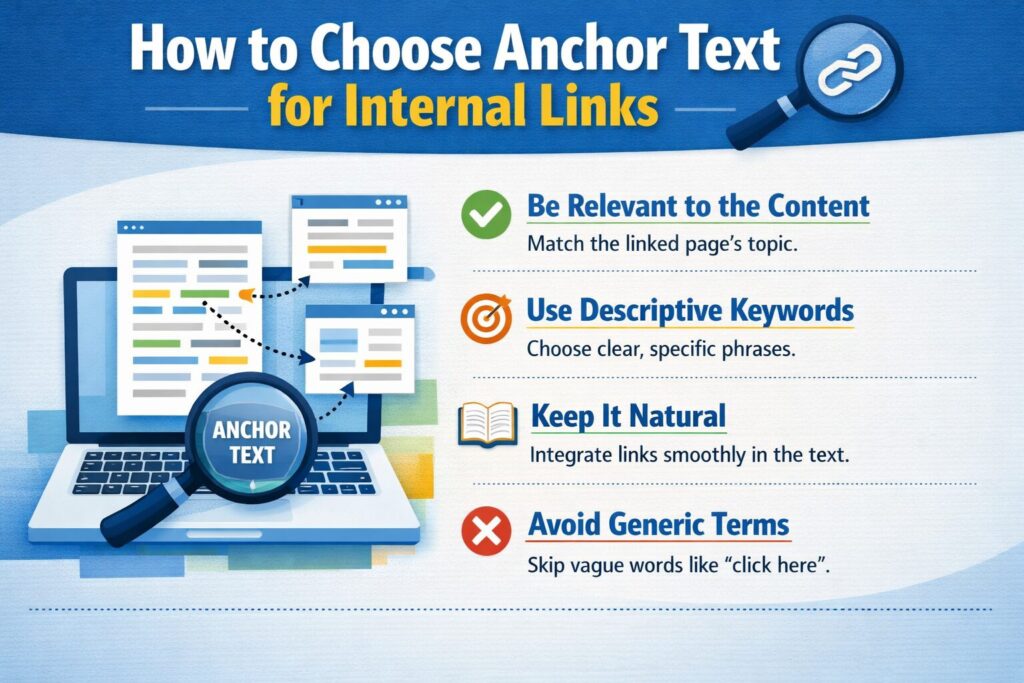
Internal links connect pages on your website. The clickable text you use for those links is called anchor text. Choosing the right anchor text helps search engines understand your content and helps users know where a link will take them.
Search engines read anchor text to understand the topic of the linked page. If your anchor text is vague, search engines get less useful information. If it is descriptive, they understand the connection between your pages more clearly. Users also rely on anchor text. When someone scans a page, they look at links to decide whether to click. Clear anchor text tells them exactly what they will find on the other side.
Good anchor text improves your site’s SEO and creates a better experience for your visitors. Poor anchor text wastes an opportunity to signal relevance and guide your readers effectively. Every internal link you place is a chance to help both search engines and users understand your site structure better.
Match the Anchor Text to the Destination Page
The anchor text should describe the content of the page it links to. If you link to a page about keyword research tools, your anchor text should reflect that topic directly. This gives search engines an accurate signal and tells users what to expect before they click.
Before you write anchor text, open the page you are linking to. Read the title and the first paragraph. Then write anchor text that reflects the main topic of that page. This keeps your anchor text accurate and relevant every time.
| Weak Anchor Text | Strong Anchor Text |
| Click here | keyword research tools |
| Read more | how to write meta descriptions |
| This page | on-page SEO checklist |
| Learn more | internal linking best practices |
| See this | content optimization guide |
The phrase “click here” tells the user nothing about the destination. The phrase “keyword research tools” tells both the user and the search engine exactly what to expect. The difference is significant – one anchor text helps, and the other adds no value at all.
Avoid using the same anchor text phrase for multiple different pages. If you link to two separate pages using the same words, search engines receive conflicting signals about which page is most relevant for that phrase. Each anchor text should point to one specific destination consistently across your site.
Also, avoid keyword stuffing in anchor text. If every internal link on your site uses the exact same phrase repeatedly, search engines may treat it as unnatural. Vary your anchor text while keeping it descriptive and accurate. A natural mix of anchor text types looks more credible and performs better over time.
Check your anchor text against the destination page regularly. If you update a page and change its main topic or focus, the anchor text pointing to it may no longer be accurate. Outdated anchor text confuses users and sends incorrect signals to search engines. Make it a habit to review your internal links when you update your content.
Choose Descriptive Words Instead of Generic Phrases
Descriptive anchor text gives users and search engines specific information. Generic phrases give them nothing useful. The goal is to help readers understand where the link leads before they click it.
When you choose anchor text with clear and specific words, you make your content easier to follow and your internal linking structure easier for search engines to interpret. Descriptive anchor text also reduces confusion – readers do not have to guess what they will find after clicking, and search engines receive a clear relevance signal about the linked page.
Common generic phrases to avoid:
- Click here
- Read more
- Learn more
- Here
- This article
- This page
- Find out more
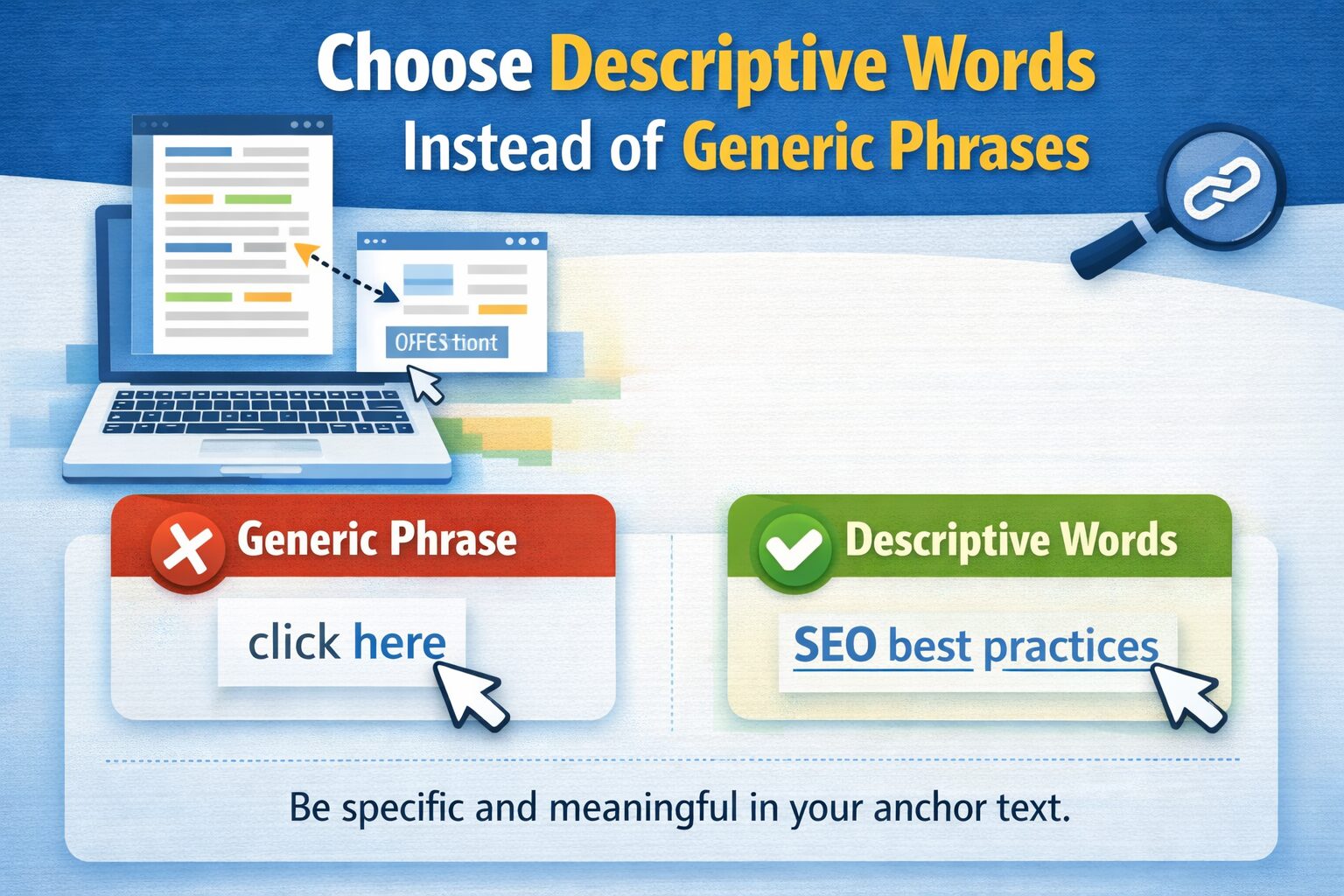
These phrases say nothing about the content at the destination. Replace them with words that describe the topic of the page you are linking to.
How to write descriptive anchor text:
Start by identifying the main topic of the destination page. Use two to five words that summarize that topic clearly. Then place those words naturally inside a sentence so the text reads smoothly.
Generic: “To improve your rankings, click here.”
Descriptive: “To improve your rankings, follow these on-page SEO techniques.”
The second version tells the reader what they will get. It also gives search engines a clear signal about the linked page’s content. The sentence reads naturally, and the anchor text adds value instead of taking up space.
Keep anchor text concise. Long anchor text becomes harder to read and can appear spammy. Two to five words is usually enough. If the topic requires a slightly longer phrase to be precise, that is acceptable, but keep it as short as clarity allows.
Use natural language in every case. Write anchor text as if you are speaking to the reader directly. Avoid forcing keywords into the text in a way that feels awkward. The full sentence should read smoothly with the anchor text included, and nothing should feel out of place.
The sentences surrounding your anchor text also matter. The context around a link helps search engines confirm that the anchor text is relevant. If the surrounding content does not relate to the linked page, the link loses some of its value. Always place internal links in sections where the topic connects naturally to the destination page.
Descriptive anchor text also improves accessibility. Screen readers read anchor text aloud to users who rely on them. If the anchor text says “click here,” the screen reader gives the user no useful information. If it says “on-page SEO techniques,” the user immediately understands where the link leads, even without seeing the surrounding text.
Choosing Anchor Text Based on Search Intent
Search intent is the reason behind a user’s search. When someone looks for information online, they have a specific goal. Your anchor text should align with that goal and match the purpose of the destination page.
There are four main types of search intent:
1. Informational – The user wants to learn something.
Anchor text example: how search engines index pages
2. Navigational – The user wants to find a specific page or site.
Anchor text example: Google Search Console setup guide
3. Commercial – The user is comparing options before making a decision.
Anchor text example: best SEO tools for small businesses
4. Transactional – The user is ready to take an action.
Anchor text example: Start your free SEO audit
Match the anchor text to the intent of the user who would visit the destination page. If the page is educational, use informational anchor text. If the page is a product or service page, use commercial or transactional anchor text. Mismatching intent and anchor text leads to higher bounce rates because users arrive at a page that does not meet their expectations.
Example in practice:
Suppose you have a blog post about email marketing strategies. You want to link to your page about email automation software. Depending on where the reader is in their decision process, different anchor text types work better.
- Informational link: how email automation works
- Commercial link: top email automation software
- Transactional link: try email automation free
Choose the phrase that best fits where the destination page sits in the user journey. A blog post reader is often in the informational or commercial phase, so anchor text like “how email automation works” or “top email automation software” fits more naturally than a transactional phrase.
When anchor text matches search intent, users are more likely to click and stay on the linked page. This reduces bounce rates and signals to search engines that your content is relevant and useful. Over time, a well-structured internal linking system built on intent-matched anchor text strengthens the overall authority of your site.
Review your internal links from the reader’s perspective. Ask yourself whether the anchor text matches what a reader at that point in the article would actually want to find. If the answer is yes, the link is working correctly. If the answer is uncertain, rewrite the anchor text to better reflect the destination and the reader’s goal at that moment.
Choosing anchor text based on search intent is not just an SEO practice. It is a way of respecting your reader’s time and attention by giving them links that genuinely help them move forward.