

NLA Media published a comprehensive framework on June 14 addressing how Australian businesses can optimize for AI search tools that generate direct answers instead of sending users to traditional search results, according to the agency’s newly released guide on AI Optimization (AIO) and Generative Engine Optimization (GEO). The guide documents the shift in discovery behavior as users increasingly ask ChatGPT, Google AI Overviews, and Perplexity for recommendations rather than clicking through ranked search results.
TL;DR: NLA Media released an AIO/GEO framework on June 14 explaining how businesses can become the sources AI tools cite when users ask questions, addressing a visibility gap where businesses rank well in traditional search but remain invisible in AI-generated answers.
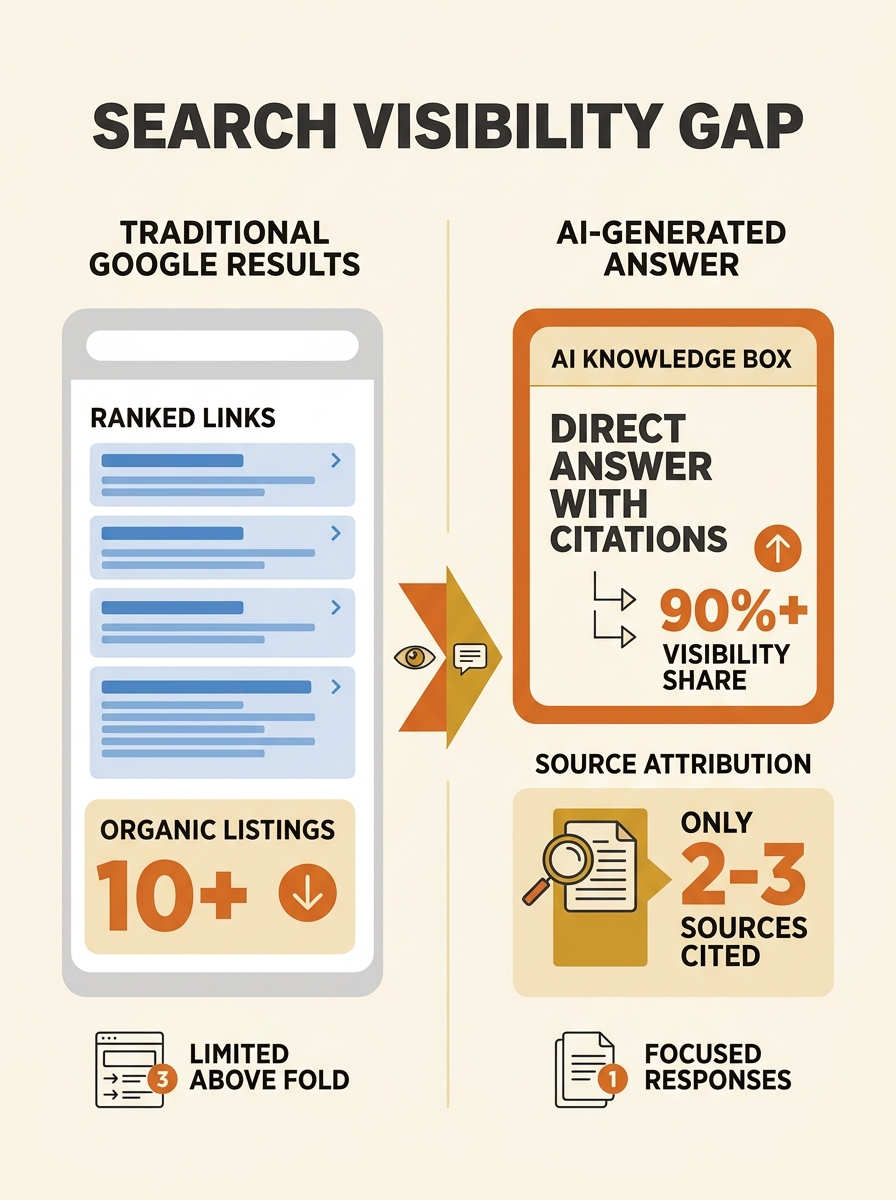
The framework identifies a market gap where businesses optimized for traditional search engine rankings remain invisible when AI tools synthesize answers. “A business can rank in position one for a search term on Google and still be completely absent from the AI-generated answer that appears above it,” the guide states. Studies tracking AI Overview appearances show well-ranked pages are frequently not cited in generated answers, according to the research cited in NLA Media’s documentation.
AI Tools Prioritize Different Signals Than Traditional Rankings
The guide distinguishes between traditional search engine optimization and the signals AI models use to select sources for citations. While Google maintains a ranked index based on keyword relevance and authority, AI tools synthesize information from multiple sources to generate single answers, the framework explains. The business or source included in those responses demonstrates specific characteristics AI models recognize as authoritative.
NLA Media’s framework identifies topical authority as the first characteristic AI models evaluate. The guide states AI tools differentiate between sources genuinely knowledgeable about a subject versus those producing surface-level content across many topics. A business focused on a specific domain demonstrates depth AI models reward with citations, according to the guide’s analysis.
The framework prescribes external validation signals as a core optimization requirement. AI models recognize when other credible sources reference, link to, or cite a business as an authority, the guide explains. This validation layer operates independently of traditional backlink metrics, creating a distinct optimization channel Australian businesses must address separately from local SEO services that focus on Google Business Profile rankings.
Framework Prescribes Answer-First Content Structure
The guide prescribes specific content formatting approaches that increase citation probability. AI models favor content structured to answer questions directly rather than content organized for keyword density, according to the framework. The guide recommends businesses shift from keyword-optimized pages to question-answering content that AI can parse and cite.
NLA Media’s framework identifies structured data as a technical requirement distinct from traditional schema markup implementations. The guide states AI tools reference structured information more reliably than unstructured text when generating answers, making schema graphs a core technical requirement for businesses seeking AI visibility.
The framework addresses the relationship between traditional SEO and AI optimization strategies. “Traditional SEO is not dead and anyone telling you to abandon it entirely is wrong,” the guide states. The framework positions GEO as an additional layer rather than a replacement, noting the signals that drive traditional rankings and AI citations overlap without being identical.
Guide Targets Businesses Experiencing Citation Exclusion
The framework targets Australian small and medium businesses evaluating organic growth strategies, according to the guide’s positioning. NLA Media identifies a scenario where businesses invest in traditional search optimization but miss an expanding portion of discovery happening through conversational AI interfaces.
The guide documents behavior shifts where users bypass traditional search results entirely when AI tools provide satisfactory direct answers. “When an AI answers the question directly, there is no reason to click,” the framework states. This shift reduces click-through rates from traditional search results while elevating the commercial value of being the specific business an AI recommends.
NLA Media’s framework prescribes businesses audit their current visibility in AI-generated answers as a first diagnostic step. The guide recommends testing how AI tools respond to questions customers ask about the business’s service category, then identifying gaps between traditional search rankings and AI citation frequency.
The relationship between AI search optimization and traditional SEO requires distinct strategic approaches, according to the framework. While both channels aim to increase organic visibility, the optimization signals differ sufficiently that businesses need parallel workstreams rather than assuming traditional SEO efforts automatically translate to AI citation success.
Why This Matters Now
Australian SMBs face a measurement challenge traditional analytics dashboards don’t capture: they can track traditional search rankings and conversions, but most cannot measure how frequently AI tools cite their business when users ask relevant questions. The NLA Media framework addresses this blind spot by documenting the signals that drive AI citations separately from the signals that drive traditional rankings.
The commercial implications extend beyond traffic metrics. When a user asks ChatGPT or Perplexity for a recommendation in a specific service category, the AI typically names one to three businesses in its answer. Being excluded from that short list represents a category of lost opportunity that doesn’t appear in Google Search Console reports or traditional rank tracking tools.
For businesses evaluating whether to invest in AI optimization alongside existing SEO marketing services, the framework’s core finding provides the decision criterion: if your target customers are asking AI tools the questions your business should answer, being absent from those answers represents a growing competitive vulnerability traditional rankings cannot offset.