

A technical SEO prioritization framework published yesterday by Mean.ceo argues Australian and international founders should focus site architecture and internal linking work ahead of page speed optimization, reversing the sequence most small businesses follow when confronting audit backlogs, according to the guide authored by Violetta Bonenkamp and released June 16.
TL;DR: Mean.ceo published a technical SEO prioritization guide advising resource-constrained founders to fix site architecture and indexing access before speed metrics, citing research showing companies leave $35.9 million in potential revenue on the table due to technical blockers.
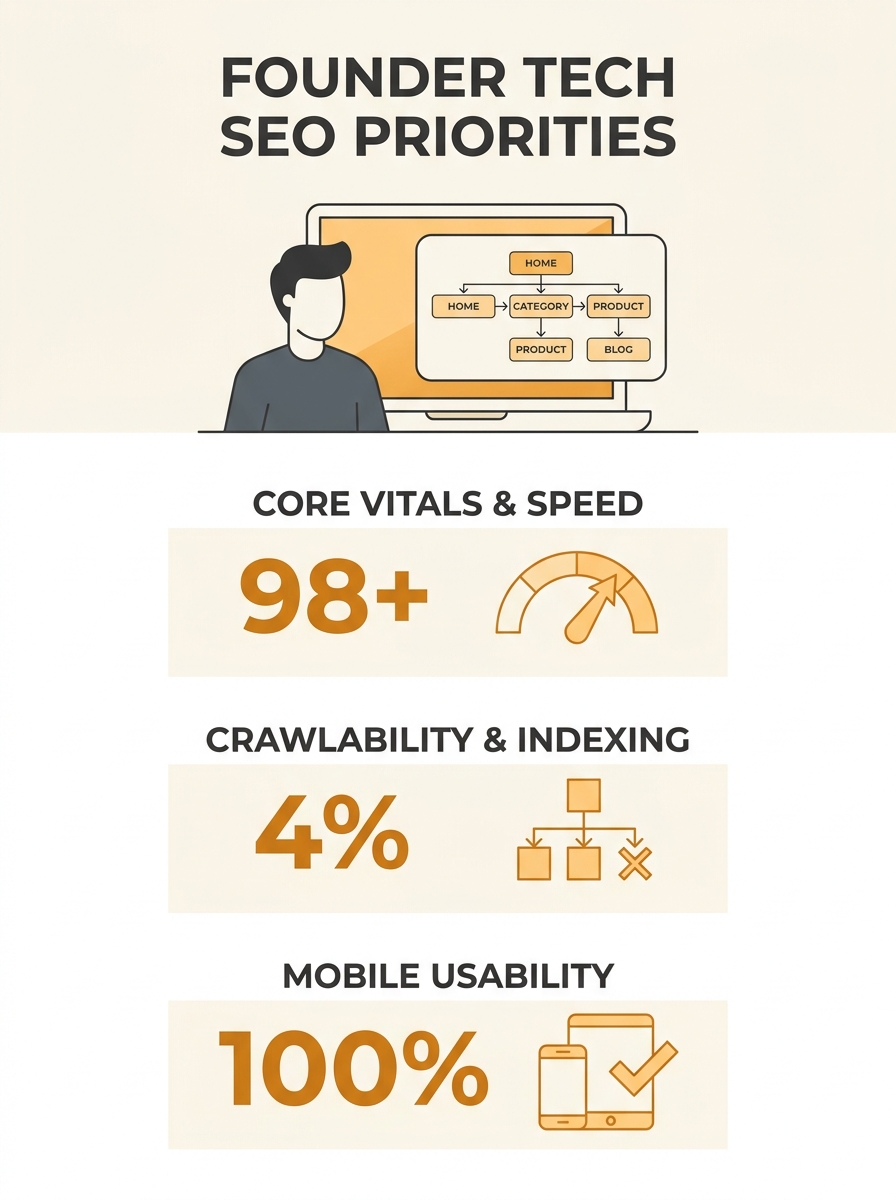
The guide establishes a five-tier priority sequence: site architecture and internal linking first, crawling and indexing control second, website speed and rendering third, mobile page quality fourth, and structured data fifth. The framework responds to research from Aira cited in the guide showing 67% of in-house SEO practitioners report non-SEO development work blocks website changes, and seoClarity data showing companies forfeit $35.9 million in potential annual revenue because technical SEO issues remain unresolved.
Why Architecture Ranks Ahead of Speed
Bonenkamp argues site architecture determines whether search authority flows between pages, whether topic clusters remain coherent, and whether important pages sit accessible within three clicks rather than buried five levels deep. The guide states architecture problems create “semantic noise” that prevents search engines and AI answer systems from interpreting what a site covers, even when individual pages load quickly.
The framework aligns with Bruce Clay’s March 2026 analysis on technical SEO focus areas cited in the guide, and incorporates priorities from DebugBear’s 2026 technical SEO checklist and Sitebulb’s 2026 SEO predictions. All three sources stress crawl access and indexing ahead of performance polish, according to the Mean.ceo piece.
Australian small businesses frequently prioritize page speed audits and Core Web Vitals optimization before confirming money pages are indexed correctly, a sequence the guide identifies as backwards. Bonenkamp writes that founders should “fix what blocks discovery before you polish what flatters vanity.”
The Five-Tier Technical SEO Sequence
The guide breaks the prioritization framework into five tiers ranked by business impact per unit of engineering effort:
Tier one—site architecture and internal linking: The guide prescribes cleaning URL structures, establishing topic clusters, reducing duplicate pages, and ensuring important pages sit within three clicks of the homepage. Site architecture audits expose structural problems that individual page fixes never reach, a principle the framework emphasizes.
Tier two—crawling and indexing control: The second tier addresses Search Console errors, XML sitemaps, canonical tags, robots.txt configuration, redirect chains, and JavaScript rendering problems that prevent money pages from being indexed. The guide notes this work directly affects discoverability across Google Search, Bing, and AI answer systems including ChatGPT and Perplexity.
Tier three—website speed and rendering: Page speed, Core Web Vitals, server response time, and script optimization move to tier three rather than tier one. The framework acknowledges speed affects user experience and conversion rates but argues speed optimization delivers minimal lift if architecture blocks crawlers from reaching key pages.
Tier four—mobile page quality: Mobile-specific issues including tap target spacing, font sizing, viewport configuration, and friction points that punish mobile visitors rank fourth in the sequence. The guide treats mobile quality as critical for conversion but secondary to structural discoverability.
Tier five—structured data and entity clarity: Schema markup, entity signals, and structured data implementations move to the final tier. The guide notes structured data helps search engines and AI systems interpret content but delivers limited value when foundational indexing and architecture problems persist.
2026 Technical SEO Extends Beyond Google Rankings
The guide argues technical SEO in 2026 determines visibility across traditional search engines and generative answer platforms simultaneously. Bonenkamp states sites that remain slow, fragmented, or architecturally unclear “lose twice—you lose classic rankings and you lose citation chances” in AI-generated answers.
The framework incorporates multi-platform discoverability as a core requirement rather than an add-on strategy. DebugBear’s 2026 checklist cited in the guide stresses crawl access and rendering across Google, Bing, and answer engines. Sitebulb’s 2026 predictions push entity-based strategy and presence in “moments of curiosity” when users query AI systems.
The Takeaway
The Mean.ceo framework gives Australian founders and small business owners a defensible decision tree when technical SEO backlogs exceed available engineering capacity. The five-tier sequence addresses a chronic resource allocation problem: businesses chase Core Web Vitals scores and page speed metrics while leaving indexing errors and fragmented architecture unresolved, forfeiting both traditional rankings and AI citation opportunities.
The prioritization logic—architecture first, indexing second, speed third—reverses the default sequence small businesses follow when confronting audit reports. For resource-constrained teams, the framework provides a testable hypothesis: fixing structural access delivers higher lift per engineering hour than polishing performance metrics on pages search systems cannot reach or interpret. Founders evaluating SEO debugging workflows or schema markup implementation can use the tier sequence to determine which projects move revenue and which projects consume budget without addressing discovery blockers.