
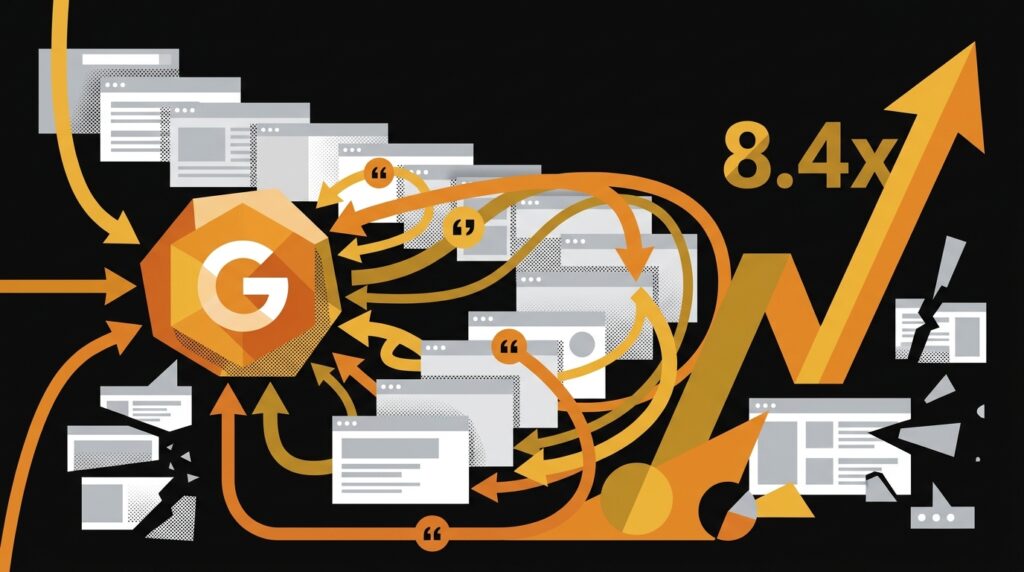
Citations from Google’s own domains—including google.com, Business Profiles, and Knowledge Panels—surged 8.4 times within AI Mode results between April 15 and June 30, 2026, according to an analysis by marketing research firm Profound. The study examined 1.44 billion citations displayed by AI Mode and found that Business Profiles and Knowledge Panels now appear as inline pop-up panels, allowing users to complete searches without clicking through to external websites.
TL;DR: Google’s AI Mode now prioritizes its own properties 8.4 times more frequently than three months ago, with click-through rates on traditional search results dropping to 8 percent when AI Overviews appear and organic traffic falling 10 to 30 percent across Taiwan-based businesses.
The shift represents an acceleration of the zero-click search trend, where users gather information directly from search results pages rather than visiting company websites. Profound characterized the change as “the early stages of a new Universal Commerce Protocol by Google,” suggesting the search engine is building a self-contained interface that handles product research, comparisons, and specifications without external links.
AI Overviews Cut Traditional Click-Through Rates in Half
Click-through rates on traditional search results fall to 8 percent when AI Overviews appear on a page, compared to 15 percent when AI Overviews are absent, according to U.S. market survey data cited in Profound’s analysis. The impact has materialized most sharply in Taiwan, where businesses across healthcare, beauty, e-commerce, and B2B sectors reported organic search traffic declines of 10 to 30 percent following the introduction of Chinese-language AI Overviews.
Data from research firm Growth Memo shows 75 percent of users who enter AI Mode remain within it and do not switch back to standard web search. Cloud infrastructure provider Cloudflare reported in July that more than 50 percent of internet traffic now originates from non-human sources, raising questions about the sustainability of advertising-supported web business models as human traffic from Google Search diminishes.
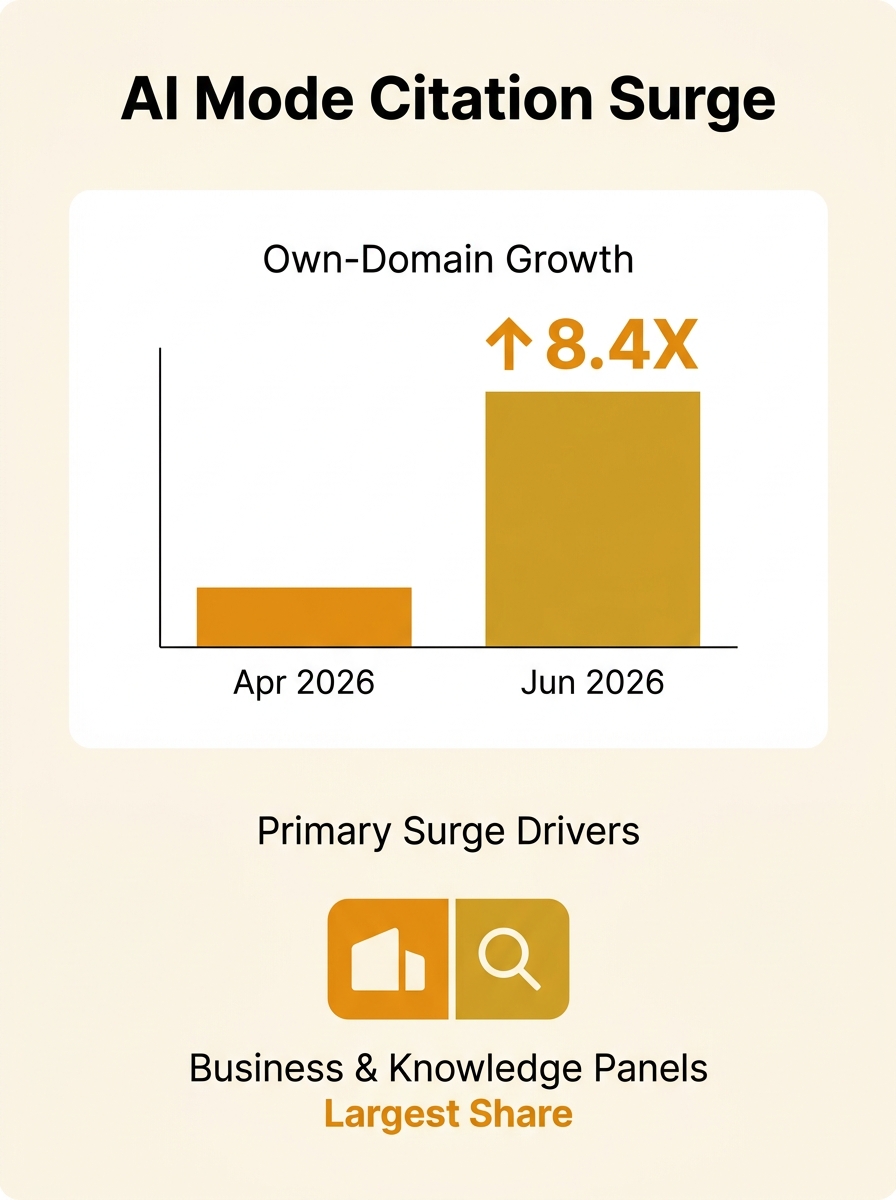
Profound’s research identified five sectors experiencing the most pronounced zero-click behavior: hospitality and travel, home services, restaurants and dining, real estate, and healthcare. The analysis examined more than 32 million Google Business Profiles across these industries and found users increasingly complete information-gathering tasks on search results pages, bypassing company homepages entirely.
E-E-A-T and RAG Architecture Drive Citation Selection
AI Mode uses Retrieval-Augmented Generation technology to select webpage snippets for inclusion in generated answers, with selection criteria weighted toward content carrying E-E-A-T signals—Experience, Expertise, Authoritativeness, and Trustworthiness—according to analysis from Taiwan-based digital marketing firm Jiangneng Digital Marketing. The firm stated that “if the content a company publishes lacks E-E-A-T signals, it will be difficult for AI to cite it as a trustworthy source.”
The architectural shift mirrors patterns documented in earlier research on AI search measurement tools, which found platforms optimizing for citation volume rather than recommendation share. Profound recommended businesses fill out Business Profiles in complete detail and actively manage reviews and ratings to maintain visibility as AI Mode prioritizes Google’s own properties over third-party websites.
The citation behavior contrasts with Reddit’s growing share of AI search citations, which reached one in five off-page citations through mid-2026. Where Reddit benefits from user-generated discussion threads that carry implicit authority signals, individual business websites face higher barriers to AI Mode inclusion unless they demonstrate clear E-E-A-T markers through schema markup and structured data implementation.
Google Pushes Back on Methodology, Users Report Misinformation
Google disputed aspects of Profound’s research methodology, though specific objections were not detailed in the analysis. Users have reported instances of misinformation within AI Mode results, echoing earlier findings that AI search tools deliver incorrect business information in a majority of UK retailer tests conducted in July 2026.
The prioritization of Google’s own domains within AI Mode aligns with the company’s June 2026 integration of AI-generated images into search overviews, which allowed the search engine to create custom visuals from text prompts without linking to external image sources. Both features reduce the likelihood that users will exit Google’s ecosystem during a search session.
Cloudflare’s finding that non-human traffic now exceeds human traffic across the internet raises questions about measurement accuracy in organic search analytics. The infrastructure provider’s July report did not break out bot traffic by source but noted the figure represents “more than 50 percent of internet traffic,” a threshold that complicates efforts to assess actual user engagement with traditional search results versus AI Mode interfaces.
The Takeaway
Australian small and medium businesses operating in hospitality, home services, real estate, healthcare, or restaurant sectors face immediate visibility risk from the 8.4x citation shift toward Google’s own properties. The 8 percent click-through rate when AI Overviews appear means seven out of eight users who see a generated answer will not visit an external website, making Business Profile completeness and review management operational priorities rather than optional marketing tasks.
The structural change demands technical SEO configurations that prioritize machine-readable schema markup over aesthetic website design, since AI Mode citations draw from structured data fields rather than page layouts. Businesses that have not implemented Organization, LocalBusiness, Product, or Review schema face systematic exclusion from AI-generated answers, regardless of actual content quality or E-E-A-T signals in prose form.
The 10 to 30 percent organic traffic decline documented across Taiwan-based businesses provides a leading indicator for Australian markets, where Chinese-language AI Overviews rolled out ahead of English-language equivalents. Marketing managers evaluating 2026 third-quarter budgets should model for continued traffic contraction from Google Search and prioritize alternative discovery channels—direct traffic, email, paid social, industry directories—that bypass AI Mode’s citation filtering entirely.