
Only 11.3 percent of high-volume AI search categories have a clear brand owner, leaving 89.3 percent of estimated AI search demand open for businesses that establish topical authority before competitors lock down category leadership, according to an analysis of six months of ChatGPT citation data published July 20, 2026, by marketing consultant Kevin Indig.
TL;DR: Indig analyzed 1,094 US categories, more than 50,000 brands, and over 600,000 ChatGPT citations from January through June 2026 and found that brands with clear category ownership hold their position in 90.4 percent of month-over-month comparisons, but most valuable categories remain unclaimed.
Indig accessed the dataset through Semrush, covering five prompt types per category—definition questions, comparisons, alternatives lists, use cases, and buying decisions—and published the findings in his Growth Memo Substack newsletter, according to the analysis. The research tracked which brands ChatGPT mentioned and cited most frequently when answering category-level queries.
The data settles a question Australian businesses evaluating AI search measurement strategies have faced since AI Overviews launched: whether topical authority built for traditional search transfers to generative AI platforms or whether AI search represents a blank-slate opportunity for any brand.
The Ownership Vacuum in High-Volume Categories
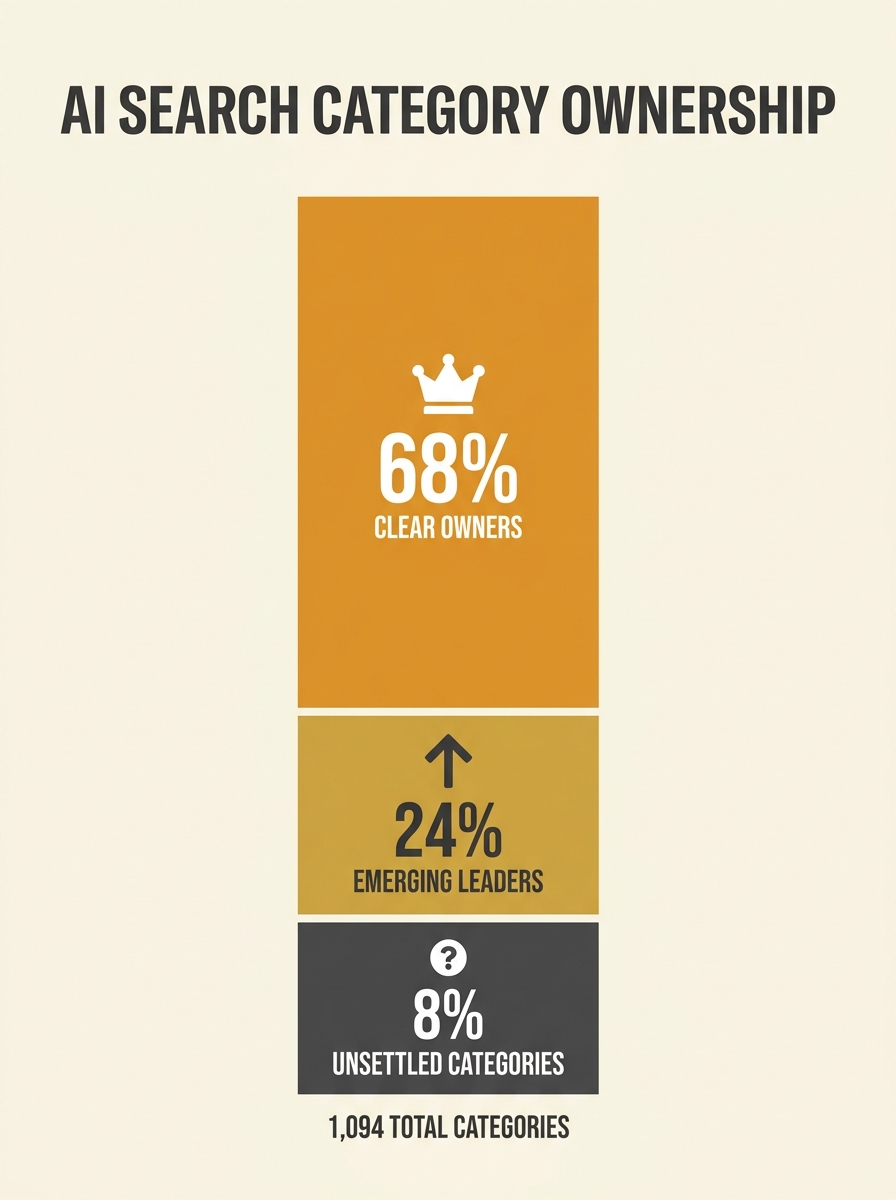
Indig defined three ownership tiers. A category has a clear owner when one brand appears in at least four of five test prompts and beats the runner-up by five percentage points or more. An emerging leader is a brand that leads at least three prompts without that margin. Everything else counts as unsettled.
Across all 1,094 categories, 15.2 percent had clear owners in June 2026. The majority, 53.7 percent, remained open fields with multiple contenders and no brand close to locking category leadership.
Indig then split the dataset by estimated AI search volume. The higher-volume half accounts for 98 percent of total AI search demand in the sample but has an ownership rate of only 11.3 percent, compared to 19 percent for lower-volume categories. The categories driving the most search traffic are the least settled.
“The categories worth the most money to occupy are, right now, the least decided,” Indig wrote in the analysis.
The finding gives Australian small and medium businesses a clear window to establish topical authority in AI search before larger competitors consolidate category ownership. Businesses that treat category focus as optional are conceding high-value categories to competitors willing to cover all five prompt variations consistently.
Owner Durability Depends on Lead Size, Not Growth Trajectory
Clear category owners held first place in 90.4 percent of month-over-month leadership comparisons between January and June 2026, according to the dataset. The switches that occurred concentrated in categories where the lead was already narrow.
Categories where leadership changed hands had a median lead of just 1.3 percentage points before the switch. Categories where the leader held position had a median lead of 2.9 points—more than double. Growth momentum alone predicted almost nothing; Indig showed three examples where a leading brand trended upward month over month but still lost position because a competitor grew faster.
“A one- or two-point lead is not a lead worth defending yet, and a brand sitting in that range should assume it’s still in a fight,” Indig wrote.
The data undercuts assumptions about how brands build AI search ownership. Citations and brand mentions showed a weak negative correlation of -0.229. The most frequently cited domain matched the most frequently mentioned brand only 20.8 percent of the time. However, the most mentioned brand received at least one citation 69.9 percent of the time.
Clear owners shared some characteristics compared to runner-up brands: 55.7 percent had higher branded search volume, 48.4 percent had higher organic traffic, and 52.5 percent scored higher on Semrush Authority Score. Indig described these as correlations rather than a formula, noting that brands earn default-answer status by being the source ChatGPT’s training and retrieval systems consistently select across all prompt variations.
Citations Alone Do Not Build Ownership
The weak correlation between citations and mentions means businesses cannot build category ownership by optimizing for citation volume alone. The most cited domain in a category rarely becomes the default brand ChatGPT names when answering questions.
Indig’s framework suggests businesses should track five prompt types for each target category—definition, comparison, alternatives, use case, and buying question—rather than monitoring branded mentions in isolation. Australian businesses adapting content marketing services strategies for AI search need coverage across all five question formats to close prompt gaps in contested categories.
Categories where a brand leads by fewer than three percentage points remain vulnerable to turnover. Businesses should prioritize closing remaining prompt gaps in those categories rather than defending established leads above the three-point threshold.
The analysis also challenges the assumption that traditional SEO metrics directly translate to AI search outcomes. A brand with strong organic rankings and high domain authority does not automatically become the default answer in ChatGPT unless that authority spans the full range of question types users ask about the category.
The Takeaway
Australian businesses have a limited window to claim category ownership in AI search before competitors establish durable leads. The 89.3 percent of high-volume demand sitting in unsettled categories represents a structural opportunity that will close as brands build the 3-point leads Indig’s data shows are difficult to overturn.
The strategic work is not creative—it requires identifying the 10 to 20 categories where a business needs to be the default answer, tracking all five prompt variations per category, and systematically closing gaps where competitors currently lead. Businesses with existing site hierarchy and topical clustering frameworks can adapt those structures to cover the full prompt range rather than building AI search strategy from scratch.
The citation-mention disconnect means businesses optimizing only for link acquisition or citation volume will lose categories to competitors that prioritize consistent, authoritative presence across definition, comparison, alternatives, use case, and buying-decision prompts. The window for claiming unowned categories likely closes faster than the 18-month cycles Australian SMEs typically associate with traditional SEO authority building.