
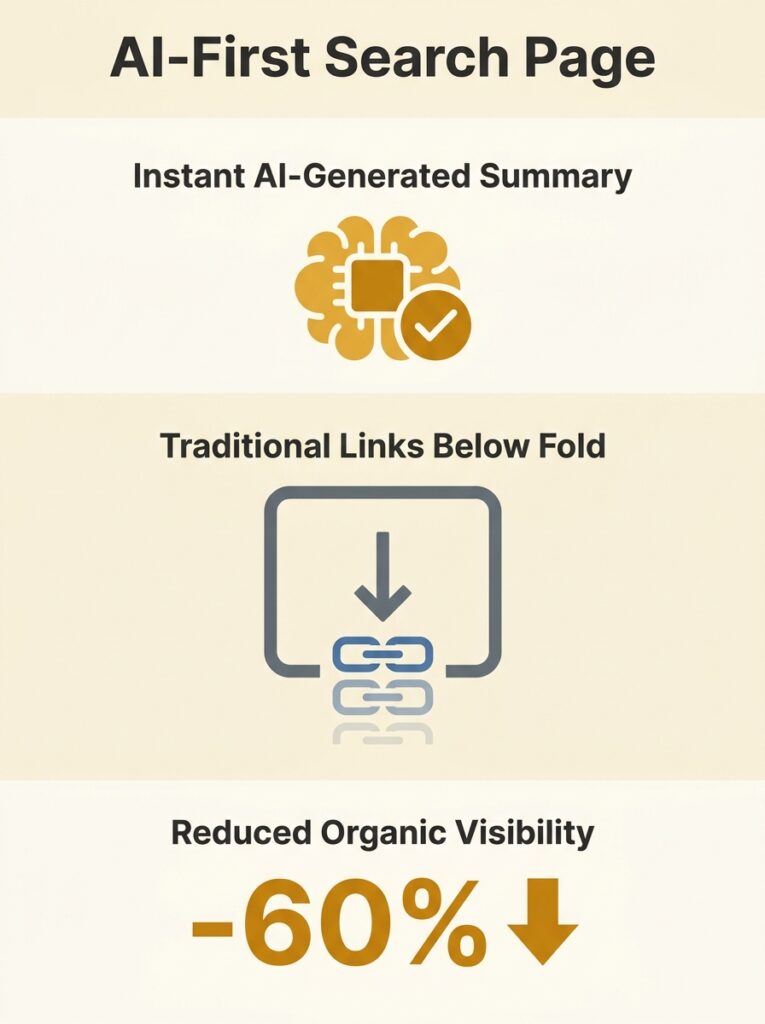
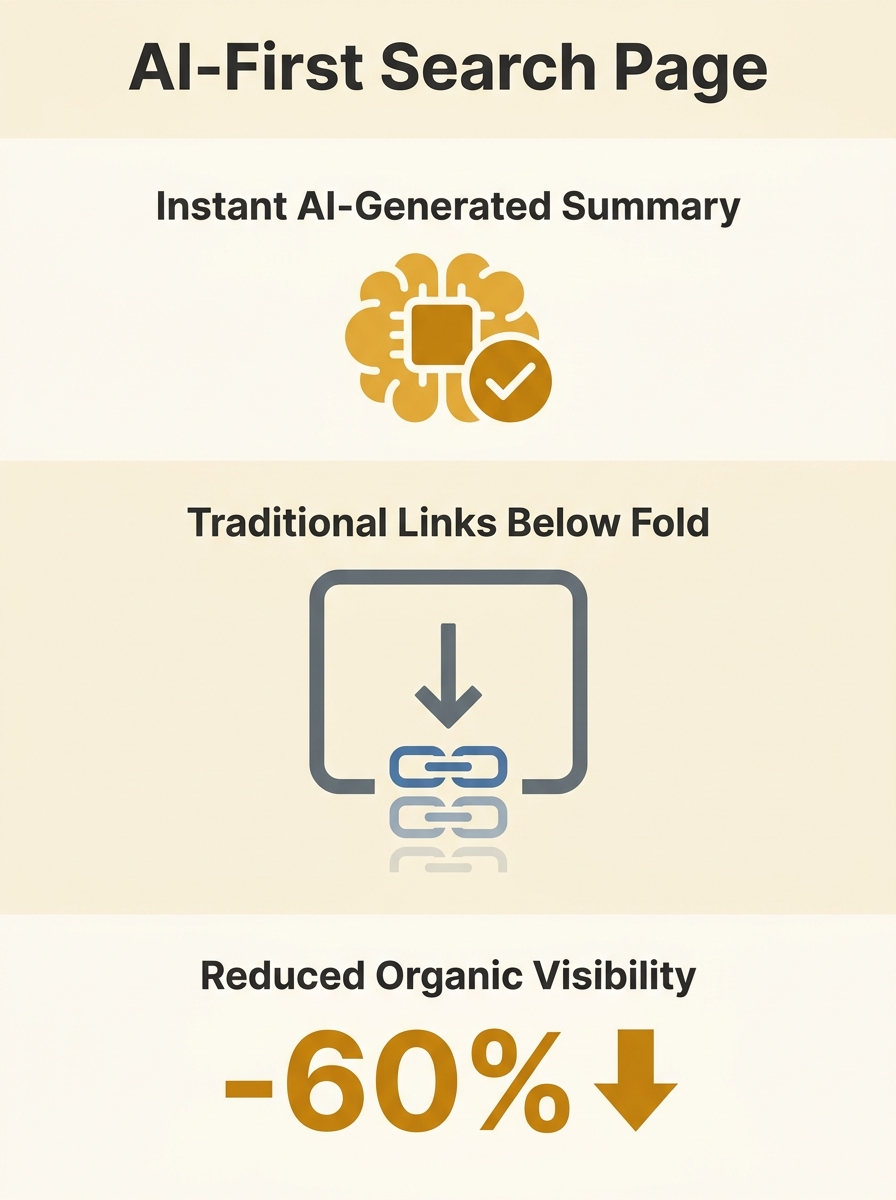
AI-generated summaries now appear in 86.8% of Google search queries, according to research from Authoritas published this week, pushing traditional organic results further down the page and fundamentally altering what constitutes effective search optimisation for Australian businesses still building strategies around conventional rankings.
The finding, reported by DMNews, marks a measurable shift in how Google presents information to searchers. Search Generative Experience (SGE) became active internationally in 2023 and expanded across European markets through 2024 and 2025. The technology places AI-written summaries at the top of results pages before a single traditional blue link appears, changing the visibility equation for sites that previously relied on first-page rankings to drive traffic.
Traditional Top-10 Rankings No Longer Guarantee Visibility
The research identified a second structural change: SGE summaries source citations from domains that never ranked in the top ten organic results for a given query. Sites that spent years climbing the ranking ladder can now be bypassed entirely by competitors appearing in the AI-generated summary, according to analysis from Search Engine Journal cited in the report.
Laurence O’Toole, chief executive of Authoritas, noted that brands face new exposure on their own terms. “These new types of generative results introduce more opportunities for third-party sites and even competitors to rank for your brand terms and related brand and product terms that you care about,” O’Toole stated in the report.
The implication reverses a core assumption of search strategy: achieving a top-three organic position no longer guarantees visibility if the AI summary addresses the query without requiring a click. For Australian businesses running Sydney SEO or Melbourne SEO campaigns built around traditional ranking metrics, the data suggests those frameworks may be measuring the wrong outcomes.
12-to-18-Month Response Lag Identified in Platform Shifts
The report identified a pattern in how organisations respond to search platform changes. Analysis of consumer behaviour data shows most businesses adapt to major platform shifts 12 to 18 months after user expectations have already changed. That delay window is where market share shifts occur, according to the findings.
The timeline matters for Australian businesses evaluating their current organic growth strategies. Google’s SGE expansion happened across 2023 through 2025. Businesses still optimising for pre-SGE search mechanics are now operating 18 to 24 months behind the platform’s actual behaviour, working from frameworks that assume searchers still click through to websites at previous rates.
The shift affects resource allocation. Marketing budgets directed toward improving traditional organic rankings—keyword density optimisation, backlink acquisition, technical site speed improvements—still produce measurable outcomes in those specific metrics. Those metrics no longer correlate as directly with visibility or traffic when the AI summary answers the query before the searcher reaches the organic results section.
Citation Authority Replaces Ranking Position
The report framed the strategic shift as moving from ranking optimisation to citation authority. The question changes from “How do we rank first for this keyword?” to “Why would an AI model cite our content as a source for this query?”
That reframing creates different content and authority requirements. Sites need depth, specificity, and demonstrated subject-matter authority that generative models identify as quotable. The report did not specify exact criteria AI models use when selecting citations, but noted that E-E-A-T (Experience, Expertise, Authoritativeness, Trustworthiness) principles remain relevant in this context.
The competitive landscape also shifts. A business that never ranked on page one for a given search term can now appear as a cited source in the AI summary for that term, gaining visibility without climbing the traditional ranking hierarchy. Conversely, a site holding the number-one organic position may receive zero visibility if the AI summary synthesises information from multiple sources without citing that top-ranked page.
Reading Between the Lines
Australian businesses need to audit whether their SEO agencies and internal teams are still building campaigns around 2023 assumptions in a 2026 environment. The 87% SGE appearance rate isn’t a forecast—it’s current behaviour affecting visibility and traffic today.
The practical question is whether your content demonstrates the kind of authority an AI model would cite when synthesising an answer. That’s a different content brief than writing for keyword density or featured snippet optimisation. It requires primary research, original data, subject-matter depth, and credentialed expertise documented on the page.
The shift also changes how to evaluate SEO performance. Traffic from branded searches may hold steady while unbranded informational queries—the discovery engine for new customers—decline as AI summaries satisfy those queries without clicks. Businesses measuring success purely on overall organic traffic numbers will miss the compositional change until the revenue impact becomes visible months later.