

Google’s SpamBrain system began processing the June 2026 spam update at 09:03 PDT on June 24, targeting scaled content abuse, cloaking, and doorway pages across every language and region. For Australian businesses running email campaigns to templated landing pages, those destination URLs are now under direct algorithmic scrutiny, and early reports show templated location-page networks already losing rankings.
TL;DR: The Google spam update 2026 (June cycle) targets thin and templated content, doorway pages, and cloaking. Email marketers who drive campaign traffic to auto-generated or location-swapped landing pages face ranking losses on those exact URLs. Recovery takes months, link spam penalties are permanent, and a spam detection audit of your email funnel’s landing pages should start before the rollout finishes.
How SpamBrain Classifies Content During a Spam Update
SpamBrain is Google’s machine-learning spam detection system. It runs continuously, but a formal spam update represents a significant recalibration: new training data, updated pattern recognition models, and adjusted confidence thresholds applied across the entire index. As Search Engine Journal reported on the announcement, Google’s guidance states that “improvements can take months for Google’s systems to reassess,” meaning quick recovery isn’t the expectation even for sites that fix violations immediately.
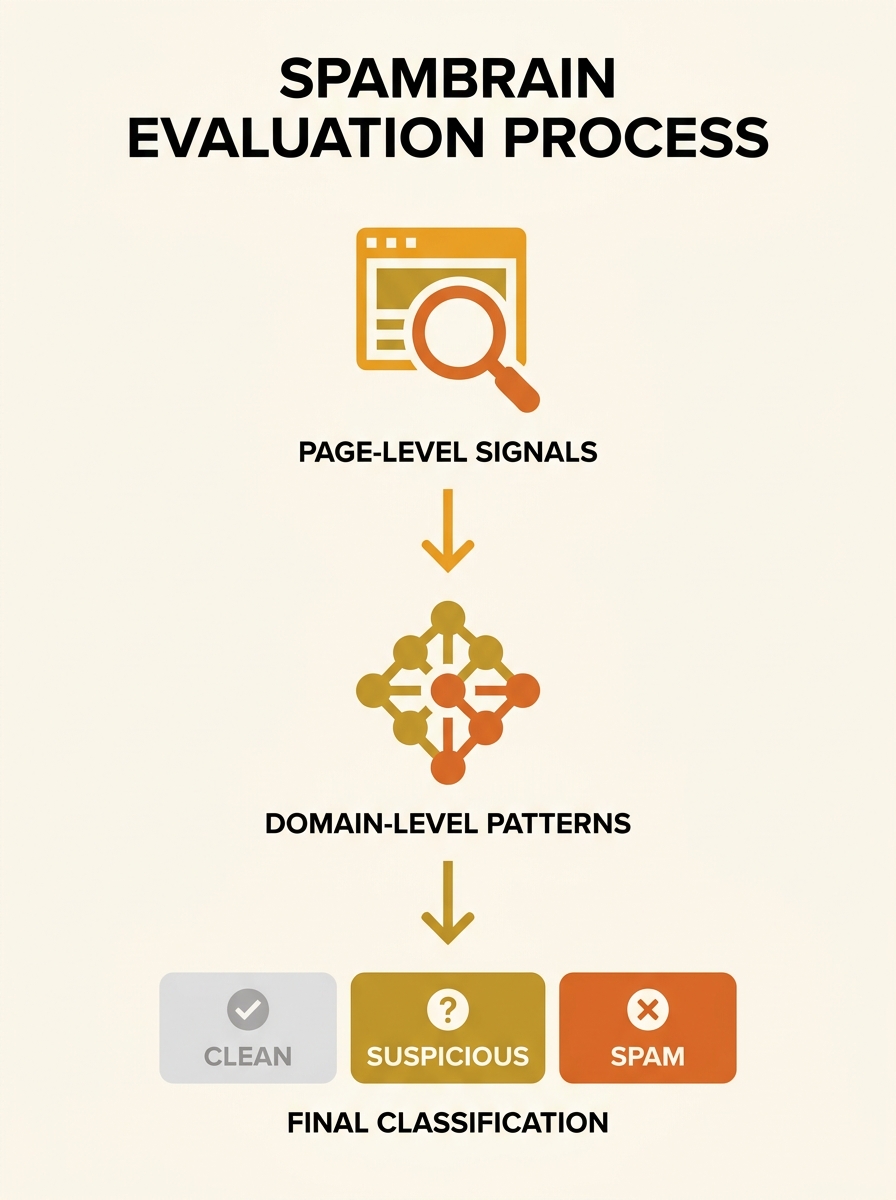
The mechanism works in layers. SpamBrain first evaluates individual pages for signals of manipulation: keyword stuffing, hidden text, cloaking scripts that serve different content to Googlebot than to human visitors. It then evaluates patterns across a domain. Are there hundreds of near-identical pages differing only by suburb name? That pattern triggers scaled content abuse classification.
For email marketers, this matters because SpamBrain evaluates the pages your subscribers land on. If your email campaign sends 15,000 subscribers to a landing page Google now classifies as spam, those subscribers hit a page that’s either deindexed or buried in results. Your click-through rate holds steady while your conversion path breaks underneath it.
Scaled Content Abuse Hits Email Landing Pages Hard
The March 2026 spam update already targeted AI-generated content abuse, with some domains losing 90%+ visibility according to GSC tracking analysis published by SEO Vendor. The June update continues that enforcement arc, with early Australian signals showing templated location-page networks as the primary casualty.
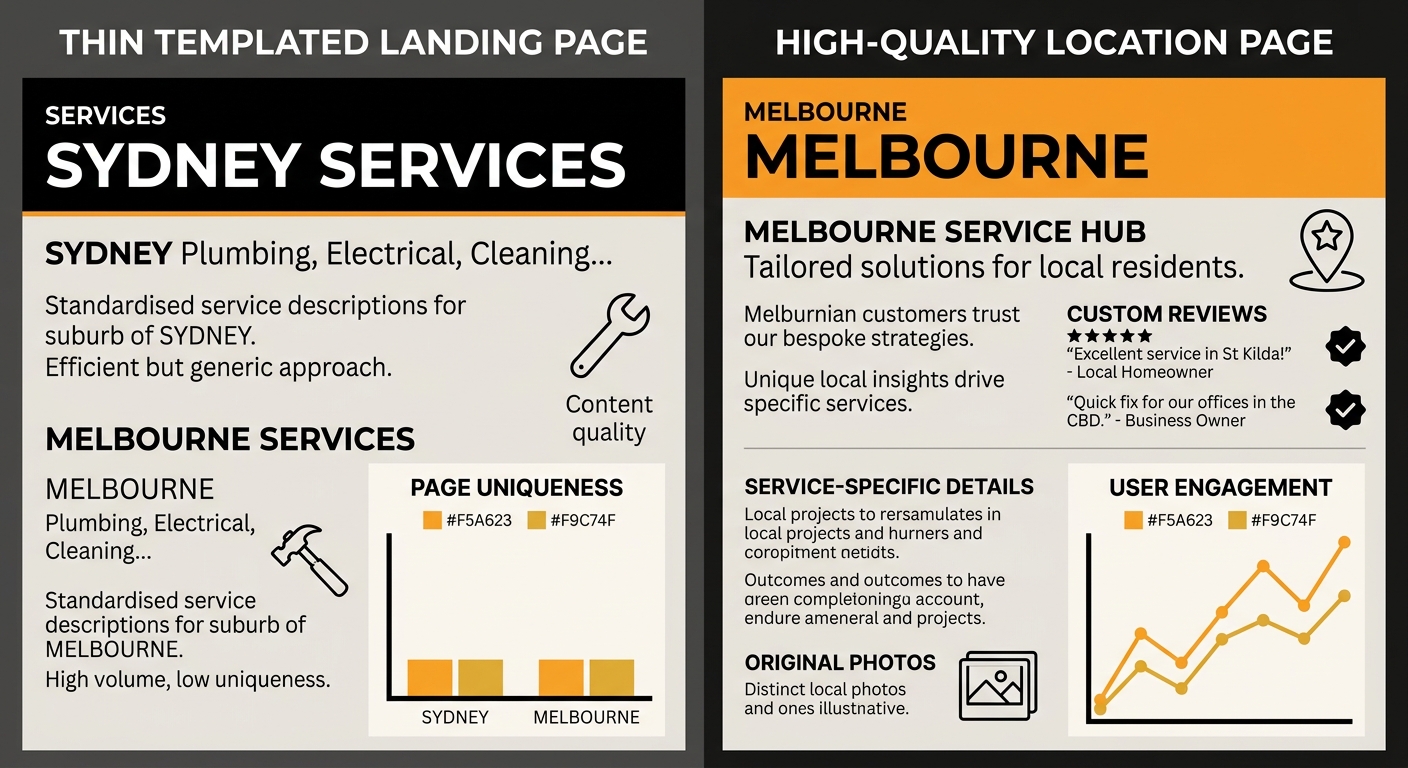
Here’s the specific pattern SpamBrain catches: a business creates landing pages for “plumber in Parramatta,” “plumber in Penrith,” “plumber in Blacktown,” and 47 other suburbs. Each page uses the same template with the suburb name swapped in. The content offers no unique local information, no genuine case studies, no suburb-specific data. SpamBrain classifies this as doorway page abuse.
Analysis published by Lucid Media found that “NZ and Australian sites that lean into local case studies, local data, and locally relevant examples saw less impact than US-style generic content” during earlier 2026 updates. The distinction is concrete: a page about plumbing in Parramatta that references local water pressure regulations, names a specific job site, or includes original photography counts as genuinely local content. A page that swaps “Parramatta” for “Penrith” and changes nothing else is a doorway page.
Many email marketers build these exact pages as campaign destinations. Geographic segmentation is standard practice: segment your list by area, point each segment to a location-specific landing page. The page itself has to carry genuine value for that location, though, or SpamBrain flags the entire pattern across your domain.
Warning: If your email campaigns point to location-segmented landing pages, audit every destination URL against Google’s doorway page policy before the rollout finishes. Pages that differ only by location name insertion are the primary Australian target of this update.
Link Spam Penalties Carry Permanent Consequences
One mechanism in this update deserves separate attention because its effects cannot be reversed. As PPC Land’s analysis confirmed, link spam violations carry a permanent consequence:
“Any ranking benefit previously generated by spammy links cannot be recovered even after the links are removed.”
If your site benefited from purchased links, link exchange schemes, or automated link building, and this update identifies those links as spam, the ranking benefit they provided is gone permanently. Disavowing the links stops further negative impact but does not restore the lost benefit.
For email marketing, this creates a compounding problem. Your landing pages lose organic visibility from the link penalty, which means they depend even more heavily on email traffic for conversions. But the pages themselves might also be flagged for content spam if they’re thin or templated. You lose both traffic channels on the same URL.
Technical SEO compliance in Australia requires a structured backlink audit as part of any spam detection audit. Google Search Console includes a Disavow tool, but it should be reserved for clearly toxic links. Aggressive disavowing removes legitimate link equity you’ve actually earned. If you’ve been working through a link building programme without a PR budget, the last thing you want is to accidentally disavow those hard-won links during a panic audit.
Disavowing spammy links stops further damage but does not restore the ranking benefit those links previously generated. The benefit is gone permanently.
Four GSC Signals for a Spam Detection Audit
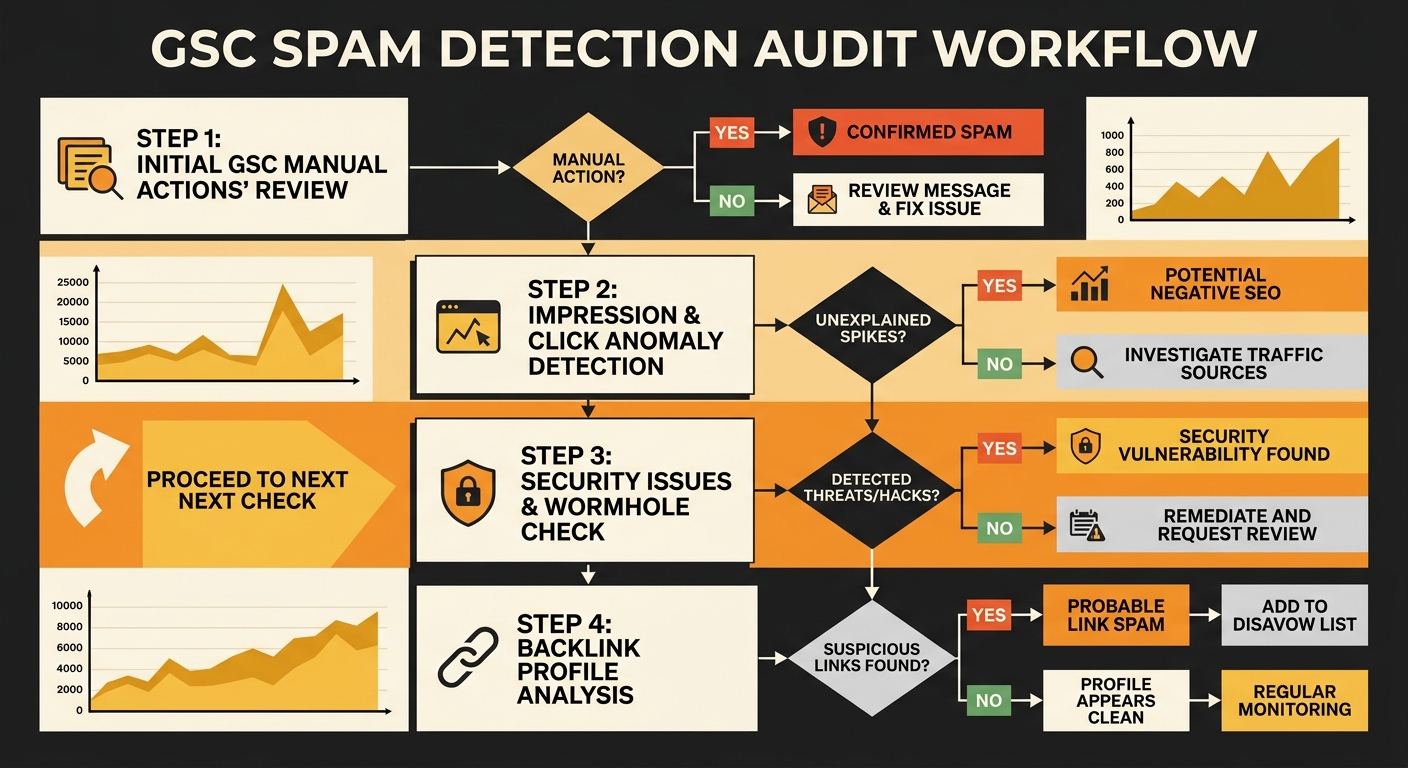
Google Search Console provides four specific checks that separate spam-related drops from normal fluctuation. Email marketers should filter these checks by the exact URLs receiving campaign traffic.
Compare 7-day against 28-day performance by page and query. Broad drops across many pages suggest update impact. Drops isolated to specific URLs receiving email traffic point to page-level classification issues. Run this comparison first, filtered to your campaign landing pages.
Match lost pages to weak Core Web Vitals signals. The March 2026 update introduced a composite performance score combining LCP, INP, and CLS. Pages with poor scores are more vulnerable to spam reclassification because Google’s systems treat poor user experience as a compounding quality signal. If you’ve already been troubleshooting crawling and freshness signals, this adds another layer of technical debt to resolve.
Review pages published at scale with thin copy. If you generated 50 blog posts or landing pages using AI tools with minimal editing, those pages are in the crosshairs. The March 2026 spam rollout already hit AI content abuse hard, and domains that lost 90%+ visibility hadn’t recovered before this June update landed.
Check the Security & Manual Actions panel. Algorithmic spam demotions don’t generate manual action notices, but sometimes Google applies both. A manual action requires a reconsideration request after fixing the violation, while algorithmic recovery happens automatically once changes are detected.
| Audit Check | What It Reveals | Email Landing Page Priority |
|---|---|---|
| 7-day vs 28-day comparison | Timing of drop relative to update | High (filter to campaign URLs) |
| CWV composite score match | Performance-compounded spam risk | Medium |
| Thin/scaled content review | Doorway or auto-generated classification | Critical |
| Manual action check | Whether Google applied an explicit penalty | High |
This ranking recovery checklist should run weekly during active rollout periods. Google stated the June 2026 update should finish within “a few days,” but reassessment of fixed pages takes months, not days.
Recovery Timelines and the Reassessment Window
Small businesses that recovered from the December 2025 core update did so by improving E-E-A-T signals, fixing Core Web Vitals, and restructuring content around complete topic coverage, according to recovery case data from SEO Services Australia. That recovery pattern applies to spam updates too, with a critical difference: spam recovery takes longer because the reassessment happens during subsequent SpamBrain recrawls or future spam updates, not on a rolling basis.
You don’t submit a reconsideration request for algorithmic spam demotions. That’s only for manual actions. You fix the violation, wait, and monitor.
For Australian businesses with email campaigns running to affected pages, this creates a practical problem. Your email calendar doesn’t pause for three months while Google reassesses your landing pages. You need interim landing pages that comply with Google’s spam policies from day one: original content, genuine local relevance if you’re targeting geographic segments, and no cloaking or hidden redirects. The technical baseline for compliance in Australia sits at HTTPS (above 91% industry adoption), accurate title tags (99% compliance baseline), and well-configured robots.txt files, according to 2026 visibility benchmarks from DesignBox.
If your site went through a migration recently, the complexity multiplies. Redirect chains, orphaned URLs, and canonical conflicts can mask spam signals or create false positives. A recently migrated site that inherits spam signals from its predecessor domain faces the worst-case recovery timeline.
Where This Mechanism Breaks Down
SpamBrain’s classification system has blind spots. The most significant: it cannot reliably distinguish between thin content created with manipulative intent and thin content created through legitimate business constraints. A small Australian business with five employees doesn’t have the resources to write 2,000 words of original content for every service area page. Their 200-word Parramatta page is thin, but it’s genuine.
The update treats pattern similarity as a proxy for manipulation. If 30 of your pages share 85% identical content, SpamBrain flags the pattern regardless of your intent. The mechanism optimises for precision at scale, accepting some false positives on individual small-business sites.
Another limitation: the update’s interaction with email marketing infrastructure is indirect. SpamBrain evaluates web pages, not email sending reputation. Google controls both Search and Gmail, and domain-level trust signals influence both systems. A domain flagged for web spam doesn’t automatically get worse Gmail deliverability. But the same domain hygiene problems that trigger SpamBrain (bought links, cloaking, deceptive redirects) also correlate with Gmail’s abuse detection patterns, and businesses running email campaigns through their primary domain carry that risk on a single asset.
The Google spam update 2026 cycle, March and now June, represents an accelerating enforcement cadence. Two spam updates in four months, plus core updates in March, April, and May, means Australian businesses can’t treat algorithm recovery as a one-time project. The sites surviving this environment maintain continuous audit practices rather than reacting after each update lands. For email marketers, that means every landing page in every active campaign needs to meet current spam policy standards before the next update arrives, whenever that turns out to be.