
AI search engines break complex queries into sub-questions and synthesise answers from multiple passages across a site, using a technique called query fan-out. Sites built with clear topical clustering structure and shallow site hierarchy SEO get cited in AI-generated responses. Flat or disorganised sites get skipped.
TL;DR: Restructure your site around pillar-cluster architecture, keep crawl depth under three clicks, and write each section so AI systems can extract a direct answer from the opening sentences. These six rules cover the structural work that earns citations in ChatGPT, Perplexity, and Google AI Overviews for Australian businesses.
The rules below apply whether you’re running a 50-page service site or a 5,000-page e-commerce catalogue. They’re ordered by impact: get the first three right and the rest follow naturally. With 83% of AI-powered searches now producing zero-click outcomes, your on-page structure is often the only thing standing between your content and invisibility.
Map your topic clusters before restructuring a single page
Every website reorganisation SEO project should start with an audit of existing content, not a redesign of the navigation. According to Semrush’s topic cluster guide, “an effective topic cluster strategy that involves publishing quality content on relevant topics builds topical authority that helps with search engine optimization (SEO) and generative engine optimization (GEO).” That dual benefit across traditional rankings and AI citations is why mapping comes first.
Pull every indexed URL into a spreadsheet. Group pages by the broad topic they address. Flag pages that target the same intent as cannibalisation risks. Per Sedestral’s topical authority guide, you should prioritise keywords with “clear commercial value but manageable difficulty scores” to avoid competing against your own pages during the restructure.
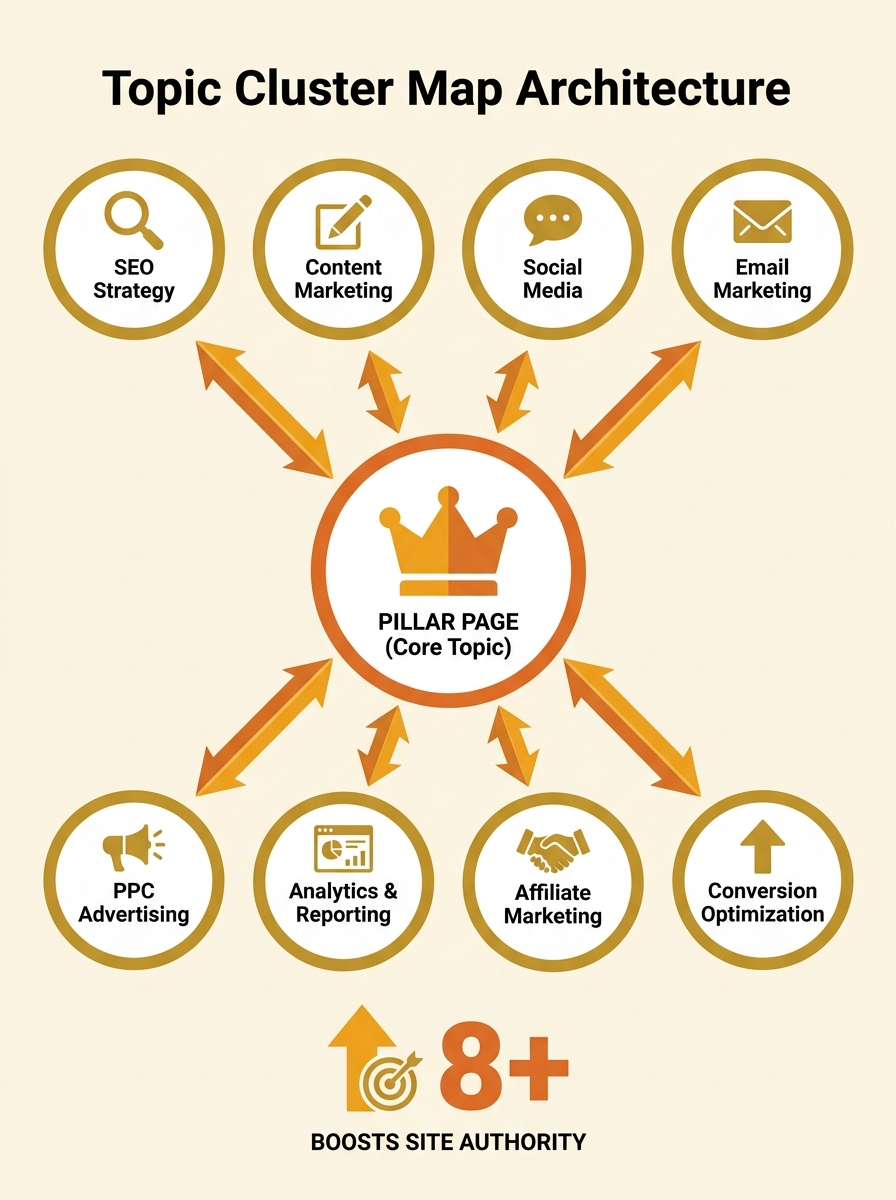
The output of this mapping exercise should be a set of 5 to 15 topic clusters (depending on site size), each with one pillar topic and 4 to 12 supporting subtopics. Current best practice calls for pillar pages of 2,500 to 4,000 words covering the broad subject, with cluster pages of 800 to 1,500 words each handling specific subtopics or user intents. If you’ve already got pages that overlap, consolidate them with 301 redirects before building the cluster.
If your site carries technical SEO debt from conflicting crawling rules, resolve those conflicts during the mapping phase. Restructuring on top of broken directives compounds the problem.
Keep every page within three clicks of the homepage
Crawl depth directly affects whether search engines and AI indexers find and prioritise your pages. Moz’s internal linking guide describes the optimal internal linking architecture as a pyramid, noting that “this structure has the minimum amount of links possible between the homepage and any given page. Crawl depth is a number indicates a page’s distance from the home page. A higher crawl depth could affect a page’s crawlability.”
According to Search Engine Land’s topic cluster guide, the pillar-cluster approach “adds hierarchy for massive topics while keeping crawl depth shallow and user journeys linear. Every page stays within a few clicks of the homepage.”
For Australian businesses with fewer than 500 pages, three clicks from homepage to deepest page is achievable with a straightforward structure: homepage links to category or pillar pages, pillar pages link to cluster content. For larger sites dealing with pagination and crawl budget problems, you’ll need to add hub pages or faceted navigation that prevents cluster pages from being buried at depth 4 or 5.
This rule breaks when you have genuinely deep content hierarchies like legal databases or product catalogues with thousands of SKUs. In those cases, aim for four clicks maximum and use XML sitemaps to supplement the internal link graph.
Write pillar pages that resolve the broad question in the first two sentences
AI search indexing in Australia and globally follows a consistent pattern: AI systems extract answers from the opening sentences of sections, not from conclusions buried at the bottom. Research shows 44.2% of LLM citations come from the first 30% of each content chunk, and pages with tight ledes see approximately 3 times higher citation rates than those that delay the answer.
Google’s Search Central documentation on AI features states you should apply “the same foundational SEO best practices for AI features as you do for Google Search overall,” including “creating helpful, reliable, people-first content.” The page also confirms that to appear as a supporting link in AI Overviews or AI Mode, a page must be indexable.
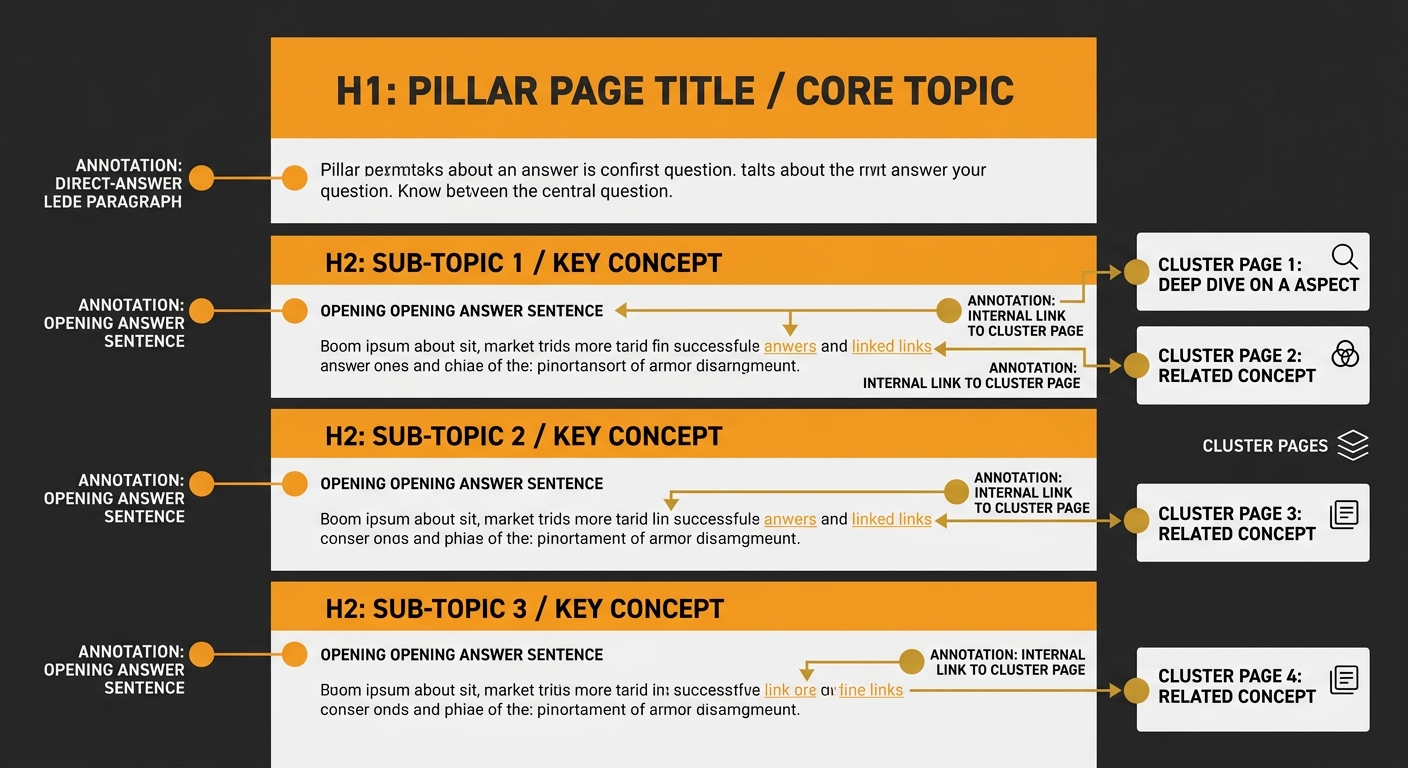
In practice, your pillar page’s opening paragraph should answer the core question in 40 to 60 words. Each H2 section within the pillar does the same for its sub-question. Keep paragraphs under 80 words so AI parsers can extract clean answer blocks. Use question-format headings where they fit naturally, because AI systems performing query fan-out match user sub-questions against your headings directly.
With 83% of AI-powered searches producing zero-click outcomes, the answer you provide on-page is often the only interaction a user has with your content.
According to Mailchimp’s topical authority research, “rather than focusing on building general domain authority, successful websites now need to demonstrate deep expertise in specific subject areas to earn a prominent position in search results.” The pillar page is where you demonstrate that depth, and the structure of every sentence within it determines whether AI systems can actually extract and cite your expertise.
Link bidirectionally between every pillar and its clusters
Your internal linking architecture is the structural backbone of topical clustering. Every cluster page links back to its parent pillar, and every pillar links out to each of its cluster pages. The links run in both directions, always. This bidirectional pattern distributes link equity from the pillar (which typically attracts more external links) to the cluster pages that need ranking support. It also signals to both traditional crawlers and AI indexers that these pages belong to a coherent topic group.
A 2024 Princeton and Georgia Tech study on generative engine optimisation measured that pages with clear source citations and internal references earned 27.7% higher citation rates in LLM-generated answers. The same study found quotation addition lifted citation rates by 42.6% and statistics addition by 32.8%, reinforcing that well-linked, evidence-rich pages outperform thin ones in AI search.
Descriptive anchor text matters more than many site owners realise. Don’t link every cluster page with generic “read more” or “click here” text. Use anchors that tell both users and AI systems what the target page covers. If you’re working through a topic cluster internal linking implementation, verify that every link’s anchor text includes a meaningful description of the destination.
One common mistake during restructuring: linking clusters to each other without routing through the pillar. Horizontal cluster-to-cluster links are fine as supplements, but they shouldn’t replace the vertical pillar connection. If you remove the pillar from the link graph, the topical signal weakens significantly even if the individual cluster pages still make sense on their own.
Target one distinct intent per cluster page
Keyword cannibalisation is the silent killer of topical clustering structure. When two pages on your site target the same search intent, they compete against each other in both traditional rankings and AI citation selection. AI systems using query fan-out will pull from whichever page gives the clearest answer, and if two pages provide overlapping content, neither gets cited reliably.
Each cluster page should address a single, specific user intent. If your pillar page covers “commercial cleaning services in Melbourne,” your cluster pages might target “office cleaning frequency standards,” “commercial cleaning cost per square metre,” and “green cleaning products for commercial spaces.” Each page owns its intent exclusively.
For Australian businesses working with search engine optimisation services on site hierarchy SEO, this means mapping keywords to pages in your cluster spreadsheet and checking for overlap before any page goes live. Your content strategy and production workflow should include a cannibalisation check as a standard gate before publishing.
Warning: If your audit reveals two or more existing pages targeting the same intent, don’t publish a new cluster page for that intent. Consolidate the existing pages first, redirect the weaker URL to the stronger one, and then build out remaining gaps in the cluster.
Audit for freshness signals on a fixed schedule
AI search systems apply recency filters when selecting content for citations. News-related queries filter for content published within 7 days. General informational queries typically favour content updated within the past 30 to 365 days. Stale content with outdated statistics or superseded regulatory references gets deprioritised regardless of how well-structured it is.
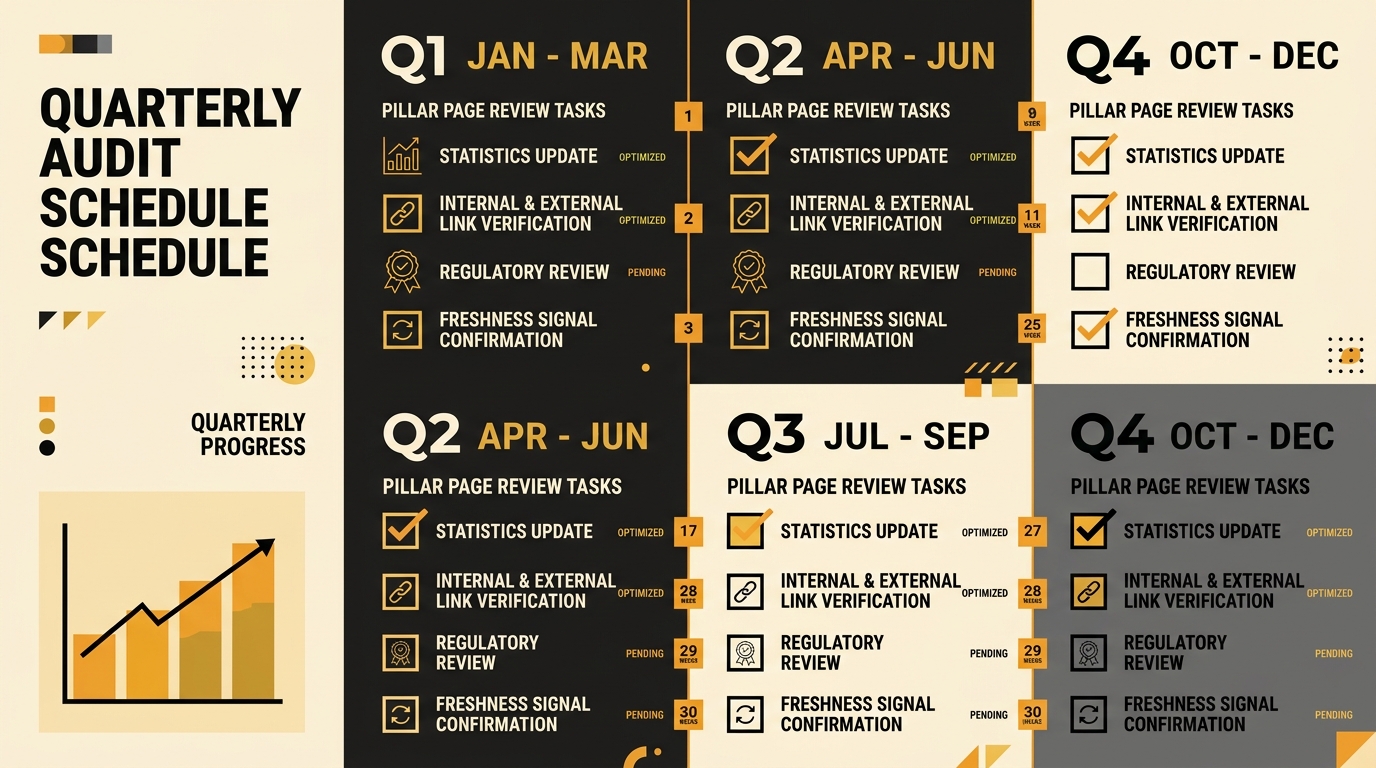
Set a quarterly review schedule for pillar pages and a biannual schedule for cluster pages. Update statistics, check that external links still resolve, and confirm any regulatory or industry-specific information reflects current Australian requirements. Without scheduled refreshes, you’ll see citation rates decline within 6 to 12 months of publication, even if the structural work was sound when you launched.
This is particularly relevant for industries where Australian regulations change frequently: financial services, healthcare, construction. A pillar page on workplace safety compliance that references superseded Safe Work Australia codes won’t earn AI citations, even if the rest of the content is excellent.
Pages that address site architecture issues blocking AI search indexing should be reviewed whenever Google releases a core update, as indexing criteria shift with each algorithm change.
When These Rules Collapse
These six rules assume your site has clean technical foundations. If your robots.txt blocks critical pages, if your canonical tags contradict each other, or if your site loads too slowly for crawlers to process efficiently, the topical clustering structure you build on top will underperform. Fix the plumbing before rearranging the furniture.
The rules also assume you have enough content to fill out each cluster meaningfully. A cluster with a pillar page and only one or two supporting pages sends a weak topical signal. If you can’t write at least four substantive cluster pages for a topic, that topic probably belongs as a section within a larger pillar rather than its own standalone cluster.
And for very small sites (under 20 pages), formal pillar-cluster architecture adds complexity without proportional benefit. A clear, shallow hierarchy with descriptive internal links between related pages will serve you better than forcing content into a clustering framework it doesn’t need yet. The core principles here, clear topical grouping, shallow depth, bidirectional links, direct-answer formatting, apply at every scale. The formal structure becomes necessary as you grow past 30 to 40 pages and need AI systems to understand which pages represent your deepest expertise on a given subject.