

Affiliate sites that can’t appear in standard Google search snippets are automatically excluded from AI Overviews and AI Mode. Google’s documentation confirms this requirement: a page must be indexed and snippet-eligible before any AI feature can reference it. Architecture mistakes — orphaned review pages, broken canonicals, deep click paths — eliminate affiliate content from AI-generated answers at the crawl stage.
TL;DR: Six architecture rules determine whether your affiliate content can appear in Google’s AI search features. Every rule maps to a specific crawl or indexing failure that blocks AI visibility. Fix the structure first; content quality improvements won’t matter if Google can’t reach or understand your pages.
Affiliate marketers pour effort into review depth, comparison tables, and product expertise. But the site holding all that content operates under architectural constraints that Google’s AI systems use to decide what gets indexed, what gets a snippet, and what gets cited in an AI Overview. According to Google’s AI features documentation, there are no additional requirements to appear in AI Overviews beyond standard search eligibility. That sounds simple. In practice, it means every technical SEO site hierarchy problem you’ve been ignoring is now also an AI visibility problem.
These six rules form an audit framework. Each one targets a specific architecture failure that blocks Google AI Overview indexing for affiliate content.
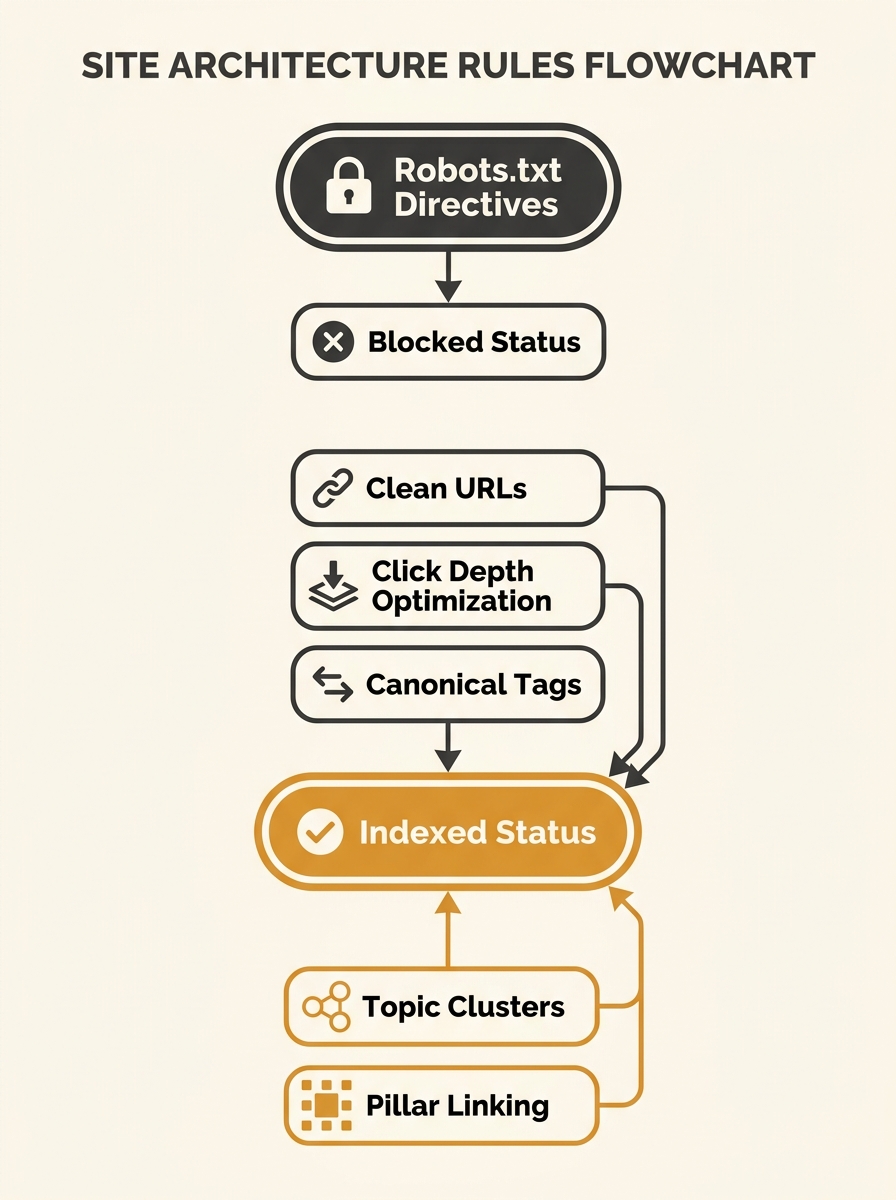
Flatten your click depth to three levels or fewer
No critical affiliate page — product review, comparison post, buying guide — should sit more than 3 clicks from your homepage. AI crawlers and ranking models use site structure as a signal of what is important, and a shallow, well-linked hierarchy outperforms a deep, sparsely linked one for both crawl efficiency and topical authority signals.
The standard failure pattern on affiliate sites looks like this: homepage → category → subcategory → brand → product review. That’s 4 clicks minimum. Add a filtered comparison page sitting behind a subcategory, and you’re at 5. Google’s crawl budget for a typical affiliate site with 500–2,000 pages is finite. Pages buried at depth 4 or 5 get crawled less frequently, indexed more slowly, and are far less likely to carry the freshness signals AI Overviews prefer.
The fix involves restructuring your navigation so that high-value review and comparison pages link directly from category-level pages, or from the homepage itself for your top 10–20 money pages. If you’ve been carrying hidden technical SEO debt in your site architecture, click depth is usually the first place it shows up.
Tip: Run a crawl with Screaming Frog or Sitebulb and filter by crawl depth. Export every page at depth 4+. If any of those pages target commercial affiliate keywords, restructure the internal linking to bring them within 3 clicks.
Organise content into topic clusters around your money pages
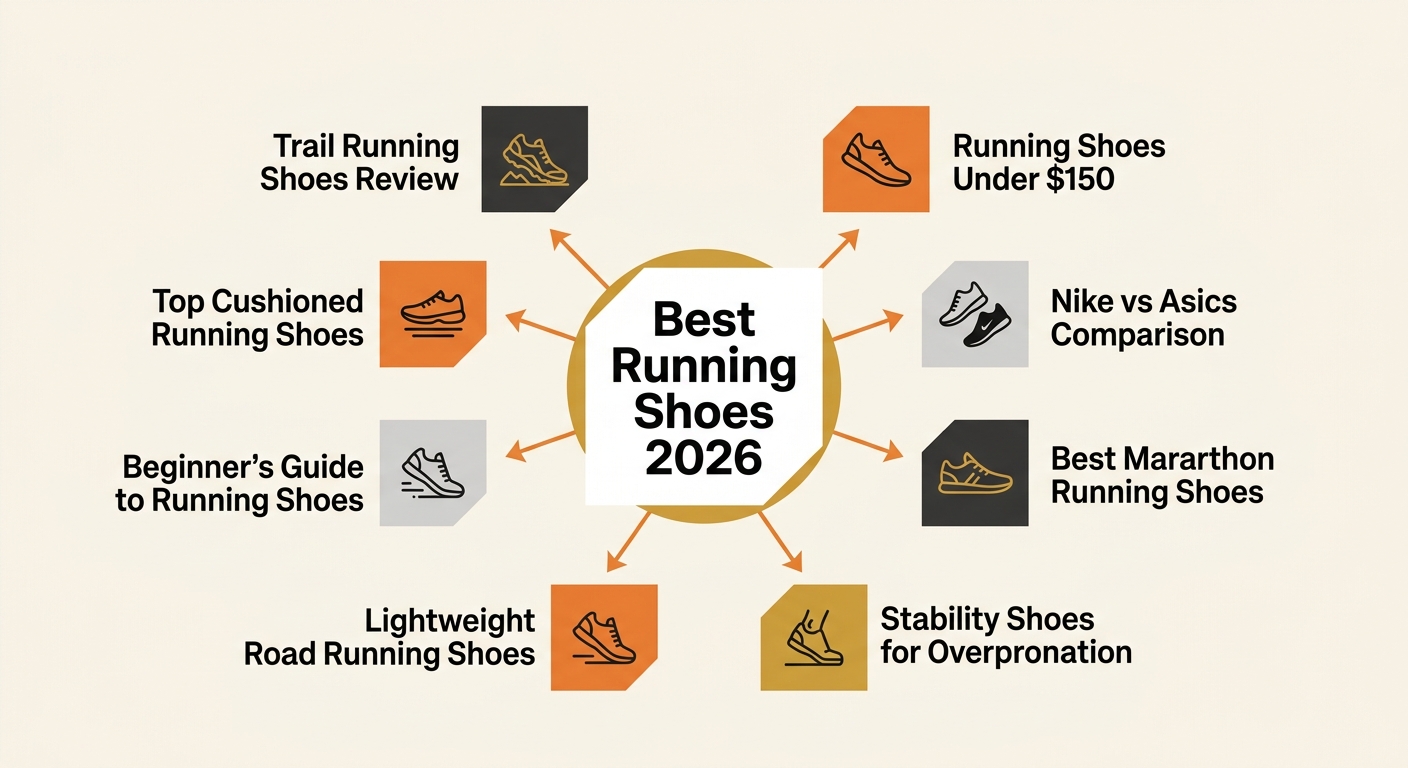
Content clustering for AI works differently than the old keyword-silo model. A topic cluster connects a pillar page (your main buying guide or category review) to 8–15 cluster pages (individual product reviews, how-to guides, comparison posts) through intentional bidirectional links. According to Search Engine Land’s guide on topic clusters, this model requires clean subfolders (e.g., /best-laptops/, /best-laptops/budget/, /best-laptops/vs-chromebooks/), consistent breadcrumbs, and zero reliance on query-string parameters for core content.
Why does this matter for AI indexing specifically? Google’s AI Overviews pull from indexable content that is easy to parse, as Digital Strike’s research on AI Overview visibility confirms. A cluster architecture makes the relationship between your content pieces explicit at the URL, navigation, and link level. When an AI system encounters a well-structured cluster, it can map your topical coverage and identify which page to cite for a specific query.
Affiliate sites often fail here because they build content by keyword opportunity rather than by topic coverage. You end up with 30 product reviews that don’t link to each other, no pillar page tying them together, and no subfolder structure that signals the relationship. Google’s AI sees 30 disconnected pages rather than an authoritative topic node. Sites using documented content strategies show 2x the effectiveness rate compared to ad-hoc publishing for exactly this reason.
Use clean subfolder paths for every revenue page
Query-string URLs like /products?category=headphones&sort=price&page=2 create three problems for site architecture AI search visibility: they generate near-infinite crawl paths, they produce duplicate content at scale, and they obscure your site’s topical hierarchy from both traditional and AI indexing systems.
The fix is static, descriptive subfolder paths. /headphones/noise-cancelling/sony-wh1000xm6-review/ tells Google’s systems exactly where this page sits in your content hierarchy. The path itself communicates the parent topic (headphones), the subtopic (noise cancelling), and the specific entity (Sony WH-1000XM6). AI crawlers parsing your site for topical authority can follow this hierarchy cleanly.
For affiliate sites running on WordPress with WooCommerce or similar platforms, default URL structures often inject query strings for filtering, sorting, and pagination. Each of those parameterised URLs risks being crawled and indexed as separate pages, diluting the authority of your actual review content. Set canonical tags to the clean version, block parameterised variants in robots.txt, or better yet, generate static category pages at clean URLs.
Audit your robots.txt for AI crawler conflicts
Your robots.txt file might be blocking the exact crawlers that feed content into AI-generated answers. GPTBot (OpenAI), Google-Extended (Gemini), and CCBot (Common Crawl, which feeds many LLM training sets) each respect robots.txt directives independently. If you’ve added blanket disallow rules — or if a plugin added them without your knowledge — you’ve opted out of AI search visibility entirely.
The more common affiliate-site problem is subtler: robots.txt and meta robots directives that conflict with each other. A robots.txt file that allows crawling of /reviews/ but a meta robots noindex tag on individual review pages within that folder creates a situation where crawlers access the pages but indexing systems ignore them. Google’s own guidance states that a page must be indexed and eligible to appear with a snippet — a noindex tag anywhere in the chain breaks that eligibility for both standard search and AI features.
Warning: Check your robots.txt right now for Disallow directives targeting GPTBot, Google-Extended, or CCBot. If you want your affiliate content cited in AI-generated answers from ChatGPT, Google AI Overviews, or Perplexity, those crawlers need explicit access to your content directories.
Every architecture mistake that blocks normal indexing now also blocks your content from AI-generated answers. Google confirmed it: no index, no snippet, no AI Overview.
Fix canonical mismatches before they multiply
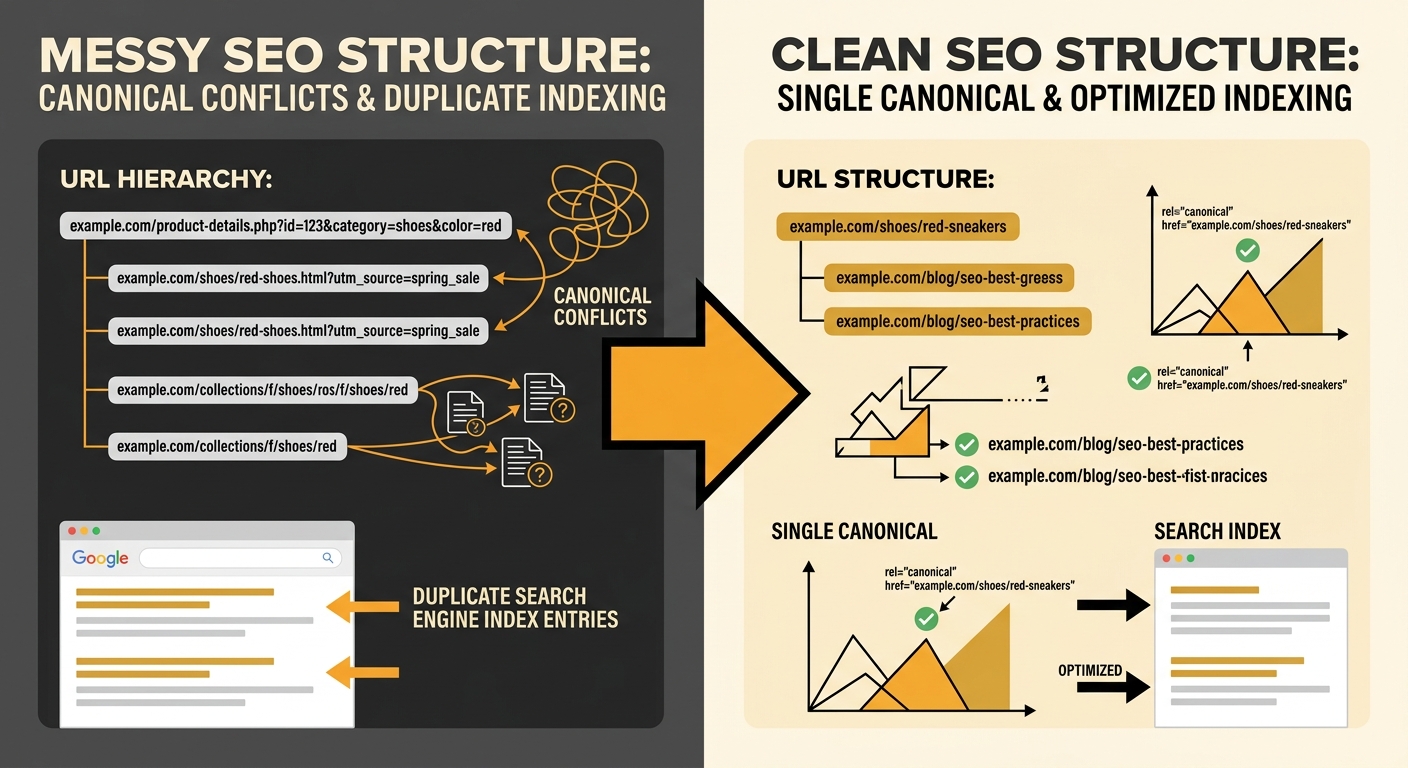
Canonical tag errors are among the most damaging architecture problems for affiliate sites because they compound silently. A single product review page accessible at 3 different URLs (with and without trailing slash, with and without www, with a UTM parameter appended) creates 3 indexable versions unless your canonical tags consistently point to one. Google’s AI systems consolidate these signals, but when canonicals conflict — one page claims /review-page/ while another claims /review-page/?ref=sidebar — the system either picks the wrong one or ignores both.
Affiliate sites are especially vulnerable because internal tracking links, affiliate network click-tracking redirects, and CMS-generated pagination all produce URL variants. A 500-page affiliate site can easily have 1,500+ indexable URL variants if canonical tags aren’t configured correctly. That fragmentation doesn’t just waste crawl budget. It dilutes the page-level authority signals that determine whether Google’s AI features cite your content or a competitor’s.
Run a crawl, export every page with a canonical tag that doesn’t match its own URL, and fix each mismatch. Then verify that your CMS isn’t generating new mismatches every time you publish.
Link every cluster page back to its pillar — and verify the reverse
Bidirectional linking between pillar and cluster pages is the mechanism that makes topic clusters work for AI search. Each cluster page links back to the pillar, and the pillar links to each cluster. According to Siteimprove’s research on pillar and cluster strategy, this creates a tightly connected internal structure that signals topical authority and distributes link equity across the cluster.
Affiliate sites break this pattern in two predictable ways. First, cluster pages link to the pillar but the pillar never links back — the pillar page was written first and nobody updated it when new reviews were published. Second, cluster pages link to each other but skip the pillar entirely, creating a web without a hub. Both patterns weaken the topical authority signal that Google’s AI systems use to determine which site deserves citation for a broad query like “best wireless headphones 2026.”
The audit step is mechanical: crawl your site, map every internal link between pages within a cluster, and flag any page where the link relationship is one-directional. Google’s AI optimisation guide confirms that standard SEO best practices remain the foundation for AI feature eligibility. Internal linking structure is one of the oldest and most reliable of those practices. If you’ve been treating AI search optimisation as something separate from SEO, this is where the two disciplines converge directly.
When These Rules Break
These six rules assume a content-driven affiliate site with 200–2,000 pages, a WordPress or similar CMS, and a primary revenue model based on organic search traffic to review and comparison content. They break in specific situations.
JavaScript-heavy single-page applications need server-side rendering or dynamic rendering before any of these rules apply — if Google can’t render your pages, architecture improvements won’t help. Sites above 50,000 pages face crawl budget constraints that demand more aggressive pruning (noindexing thin tag pages, removing outdated product reviews) before restructuring helps. And sites with programmatic affiliate pages generated from product feeds often have deeper problems: thin content that fails Google’s quality filters regardless of architecture.
The one rule that never breaks is the first one in Google’s own documentation: your page must be indexed and eligible for a snippet. Everything in this framework serves that single requirement. If your affiliate content passes that bar, Google’s AI features can find it. If it doesn’t, no amount of structured data, schema markup, or content optimisation will compensate. Google has been explicit that structured data isn’t required for generative AI search — and that overfocusing on it is a documented mistake. Get the architecture right, and the AI visibility follows the same path your organic rankings already travel.