

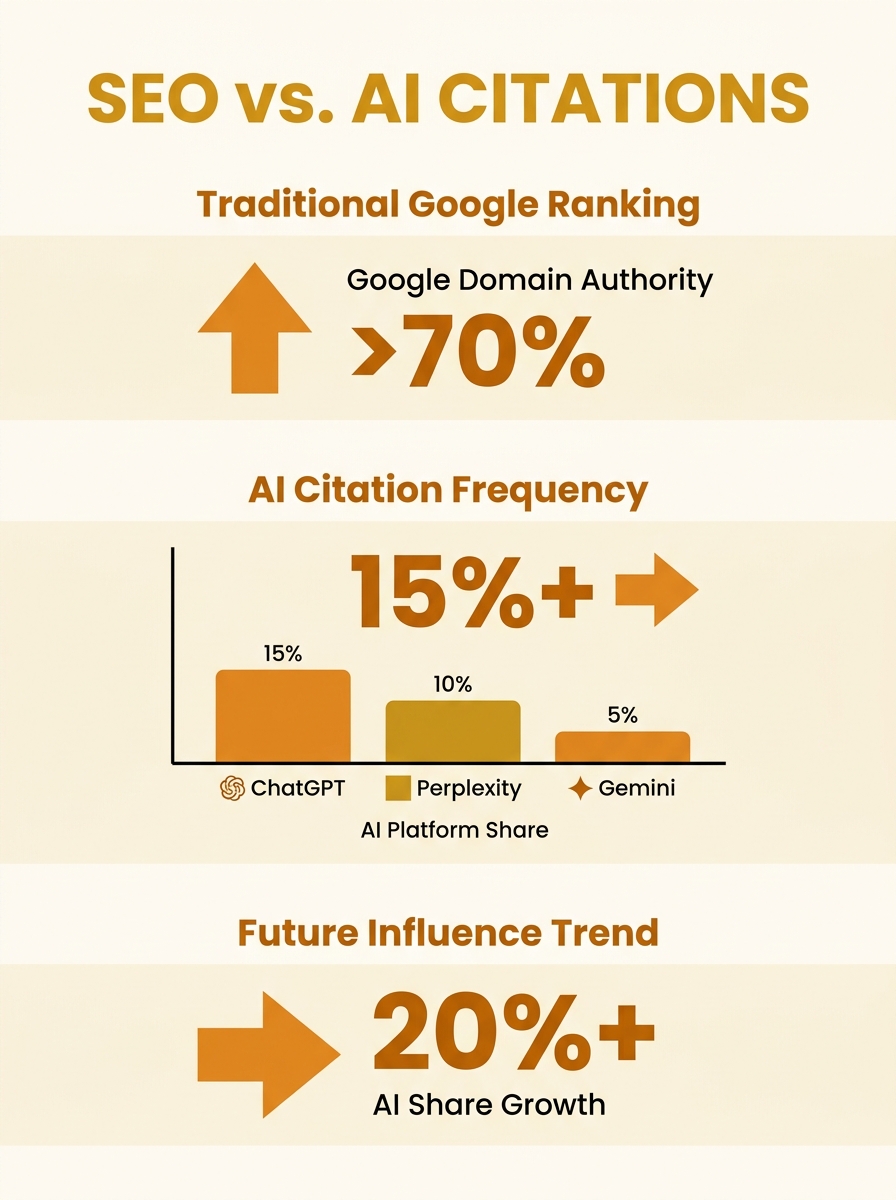
Brands holding top-five Google rankings appeared in AI-generated search responses only 31% of the time when tested across 4,308 prompts in March 2026, according to research published today by NP Digital. The digital agency tested 100 commercial keywords across five industries, identifying the top-ranked businesses on Google and then querying ChatGPT, Perplexity, and other AI platforms with variation-based questions from the same categories. More than two-thirds of the time, the brands that dominated traditional search rankings received no mention in AI outputs.
TL;DR: Brands ranking first through fifth on Google were cited in AI-generated search responses only 31% of the time across 4,308 test prompts, NP Digital research shows, marking a fundamental break between traditional ranking performance and AI search visibility.
The findings arrive as Google Marketing Live 2026 confirmed that traditional search has been replaced by AI-based search as the platform’s primary interface, NP Digital APAC managing director Dan Kalinski wrote in the analysis. The experiment used prompt suggestions from Ubersuggest and AnswerThePublic to generate longer-tail, conversational queries typical of how consumers interact with large language models.
Zero-Click Search Dominates Consumer Journeys
Zero-click activity already accounts for 65% of consumer searches, with most purchase decisions shaped before a brand’s website enters consideration, according to a Bain & Company report cited by Kalinski. NP Digital’s client data shows the consumer journey collapsing from more than 20 touchpoints over several weeks to a single AI conversation in five minutes. “The old measurement framework, using rankings, traffic and CTR, is assessing the wrong thing entirely,” Kalinski stated in the analysis.
The shift eliminates the relevance of surface-level metrics that have anchored SEO reporting for two decades. Brands still optimising for keyword rankings face structural invisibility in AI-mediated discovery, the research suggests. Australian businesses dependent on organic search visibility now operate in an environment where traditional search performance has decoupled from consumer visibility.
Southeast Asia Leapfrogging AI Adoption
Southeast Asia has accelerated past Western markets in AI-led discovery, mirroring the region’s earlier shift to chat-native commerce platforms, according to the NP Digital analysis. Platforms including Lazada, Shopee, and Grab conditioned consumers to expect instant, personalised answers, creating a behavioural foundation that now drives faster AI search adoption. The trend carries direct implications for Australian businesses competing in regional markets or targeting audiences influenced by Southeast Asian consumer behaviours.
Kalinski framed the shift as a zero-margin environment where misallocated attention produces immediate penalties. “No digital environment punishes misallocated attention more brutally than the current one,” he wrote.
NP Digital’s 30-Day Adjustment Framework
The agency outlined a five-step framework for brands to improve AI visibility within 30 days, starting with an AI share-of-voice audit. The protocol calls for querying brand and category terms on ChatGPT, Perplexity, Gemini, and other major AI platforms to identify whether the business appears in responses and how frequently competitors surface. The audit replaces traditional search engine ranking checks.
Measurement priorities shift from rankings and traffic to brand mention frequency in AI outputs, citation counts, and share of AI recommendations by category, the framework prescribes. Review volume and quality now outweigh keyword density as ranking signals, with AI agents surfacing brands based on third-party citations rather than on-page copy optimisation, according to the analysis.
Content strategy recommendations include adopting an encyclopaedic tone over promotional messaging. AI Overviews pull disproportionately from content containing facts, comparisons, and statistics, Kalinski noted, while sales-oriented copy gets overlooked by large language models. Cross-channel messaging consistency carries new technical importance because AI agents cross-reference signals from Google, YouTube, Reddit, review platforms, and social media. Inconsistent messaging creates conflicting signals that suppress AI recommendations.
The framework aligns with emerging AI visibility audit methodologies and the shift toward outcome-based measurement documented in recent technical SEO research.
Context and Outlook
The NP Digital experiment quantifies a structural break between traditional search optimisation and AI search visibility that Australian small and medium businesses must now account for in organic growth planning. The 31% citation rate for top-ranked brands indicates that existing SEO performance offers limited predictive value for visibility in ChatGPT, Perplexity, and Google’s AI-powered interfaces. For businesses that built content strategies around keyword rankings and domain authority, the findings confirm that historical investments no longer translate to discovery.
The 30-day adjustment timeline Kalinski proposes suggests rapid repositioning remains viable for businesses willing to shift measurement frameworks and content production priorities. Australian businesses operating on compressed marketing budgets face a choice between reallocating resources toward AI-native optimisation or accepting invisibility in a discovery layer that now mediates 65% of search activity. The research does not address whether traditional SEO retains residual value for brand-direct searches or transactional queries where consumers bypass AI interfaces entirely.
NP Digital’s focus on Southeast Asian adoption patterns highlights a second-order risk for Australian businesses: regional competitors may establish AI search dominance while local brands continue optimising for deprecated ranking signals. The chat-commerce parallel Kalinski cited, where Southeast Asia leapfrogged Western markets, offers a precedent for market-structure shifts that happen faster than incumbents adjust. Whether Australian SMEs adopt the prescribed audit-and-realignment framework or develop alternative approaches, the underlying visibility gap the experiment documented requires a strategic response.