

Passing Google’s Rich Results Test proves your JSON-LD syntax is correct. It proves nothing about whether Google will display rich results for your pages. The gap between valid schema markup and actual rich result display involves three separate filtering systems, and Australian sites overwhelmingly fail at the second or third.
TL;DR: Schema validation confirms syntax. Google’s decision to show rich results depends on type support, rendering accessibility, and page-level authority signals — three distinct gates that most sites audit as if they were one. Fix all three or rich results won’t appear regardless of how clean your JSON-LD looks.
The confusion is understandable. Google’s own tooling reinforces it. You paste your URL into the Rich Results Test, see green checkmarks, and assume the work is done. But the test evaluates markup structure, not Google’s willingness to display enhanced listings for your domain, your content, or your topic. These are governed by a completely different set of rules — what I’ll call the Three-Gate Schema Audit: the Syntax Gate, the Render Gate, and the Authority Gate. Clearing gate one is where 90% of schema tutorials stop. Gates two and three are where rich results actually get decided.
The Syntax Gate Is Where Everyone Stops — and It’s the Easiest One
Google supports a fraction of schema.org’s full vocabulary for rich result display. The schema.org specification defines hundreds of types. Google’s Rich Results Test evaluates only the subset Google has explicitly committed to rendering in search results. When your structured data not showing up triggers an investigation, the first question should be whether the schema type you’re using is one Google actually supports.
This distinction widened in mid-2025 when Google removed support for 7 schema types, including PracticeProblem and CourseInfo. If you’re marking up pages with these deprecated types, the schema.org validator will report valid markup while Google’s Rich Results Test returns “no items detected.” Both tools are telling the truth. They’re evaluating against different rule sets.
The fix here is straightforward: check Google’s current supported types documentation before writing a single line of JSON-LD. Each schema type has specific required and recommended properties. Article schema, for instance, requires an image property and an author property. Product schema requires a name and at least one of offers, review, or aggregateRating. Miss a required property and the syntax gate rejects your markup silently — no error, no warning, no rich result.
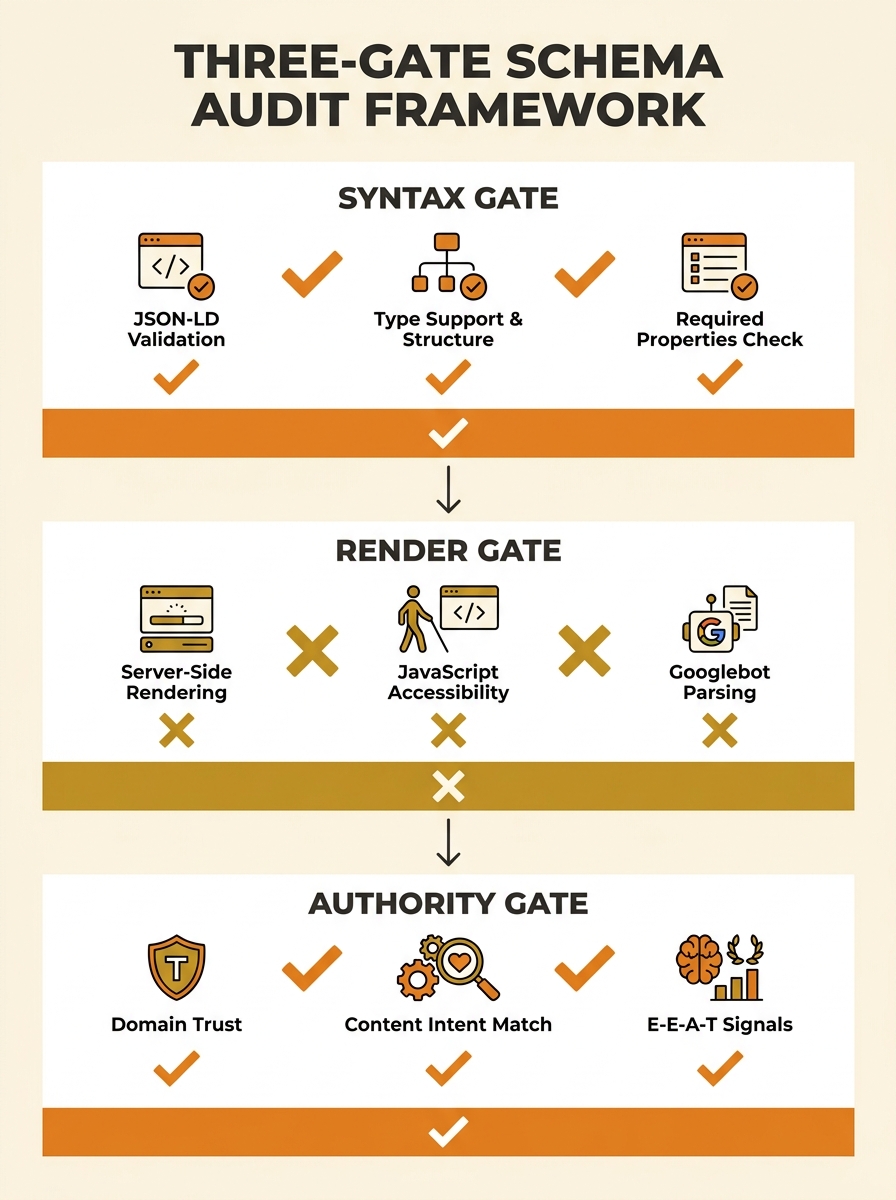
The Render Gate Filters Out Markup Googlebot Never Sees
Valid schema that Googlebot can’t read produces the same outcome as no schema at all. This is the gate that catches modern JavaScript-heavy sites, single-page applications, and CMS configurations that inject JSON-LD on the client side rather than including it in the initial HTML response.
According to structured data monitoring research from Webalert, 30% of articles silently ship with a missing image or missing author field in their schema — fields that are technically present in the CMS but fail to render into the final HTML that Googlebot processes. Search Console reports “Missing field ‘image'” errors for these pages, but unless someone is actively checking the structured data report, the failures accumulate unnoticed.
The core problem is timing. Googlebot renders JavaScript, but the rendering pipeline is separate from the initial crawl, runs on its own schedule, and can time out on complex pages. If your JSON-LD depends on a JavaScript framework to inject it into the DOM, Googlebot’s renderer might never process it. This is a well-documented issue — our coverage of why JavaScript crawling doesn’t match indexing results walks through the specifics. The solution involves server-side rendering your schema markup so it’s present in the raw HTML response, visible to every crawler on the first request.
Warning: A common single-page application anti-pattern: JSON-LD injected by a client-side framework after initial page load. Googlebot’s JavaScript rendering may never execute it. Always validate by fetching your page’s source HTML directly and confirming the JSON-LD block appears without JavaScript execution.
There are simpler rendering failures too. Unclosed HTML tags on the page can corrupt how Google’s parser reads schema nesting, as Search Engine Journal has documented. Duplicate aggregateRating properties from conflicting CMS plugins create ambiguous signals. Relative URLs in image fields instead of absolute URLs cause silent validation failures. Each of these passes a syntax check while failing the render gate because the markup Googlebot actually processes doesn’t match what you see in your development environment.
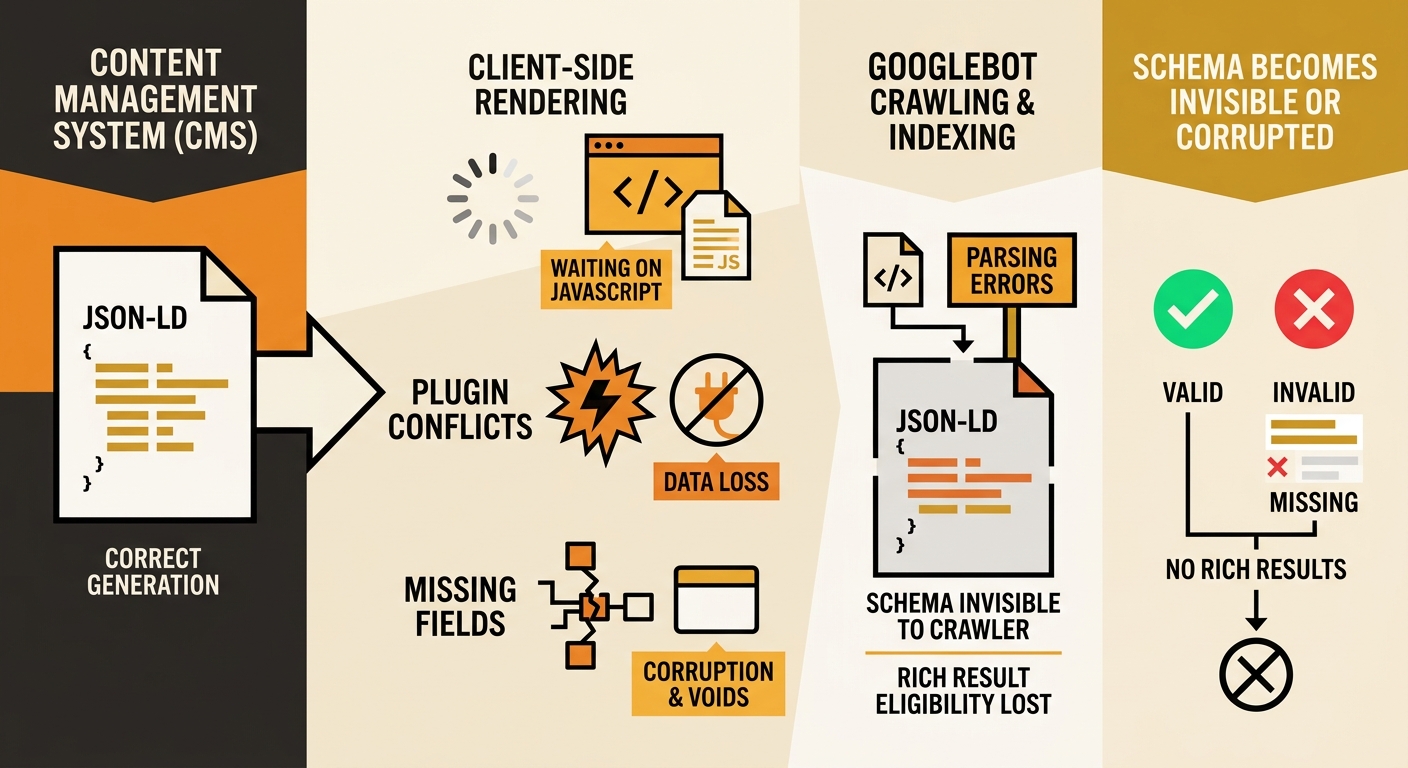
Thirty percent of articles ship with schema fields missing from the rendered HTML. The CMS has the data. Googlebot doesn’t see it.
Webalert’s research recommends required-field validation at the CMS layer, not the rendering layer. Authors should be unable to save content that would produce invalid schema. This moves the quality control upstream, where the fix costs minutes instead of hours of debugging after the fact.
Google’s Authority Filter Decides Whether Valid, Visible Markup Earns Display
Google’s own structured data documentation states the principle plainly: “Using structured data enables a feature to be present, it does not guarantee that it will be present.” The algorithm “tailors search results to create what it thinks is the best search experience for a user, depending on many variables.” Those variables include domain authority, content depth, user engagement signals, and content intent alignment — none of which have anything to do with whether your JSON-LD validates.
This is the gate that frustrates technically competent developers the most. Your schema is valid, your rendering is correct, and Google still won’t show your rich snippets. The March 2026 core update made this gate dramatically harder to clear. Tracked sites saw a 47% drop in FAQ rich result impressions as Google shifted structured data from a display trigger to an AI trust and entity verification signal. FAQ and How-To schema on pages where the FAQ isn’t the primary content purpose are now algorithmically demoted or removed entirely from desktop results.
Intent mismatch is the pattern behind most authority gate failures for Australian business sites. A services page with FAQ schema tacked on as a conversion device — questions like “Why choose us?” and “What makes us different?” — reads as promotional content to Google’s classifiers. Google filters out schema where questions are written in a sales-pitch tone rather than an educational one. The content on the page needs to genuinely match the schema type. FAQ schema belongs on pages where the FAQ is the actual content, not a marketing afterthought.
Entity authority plays an increasingly significant role. Sites with clean Organisation and Person schema — including sameAs identifiers linking to verified profiles on LinkedIn, Wikidata, and industry directories — see improved citation rates in Google’s AI Mode. This connects directly to how Google evaluates expertise and trust signals for Australian business sites. The structured data validates the entity; the entity’s reputation determines whether Google trusts the structured data enough to display it prominently.
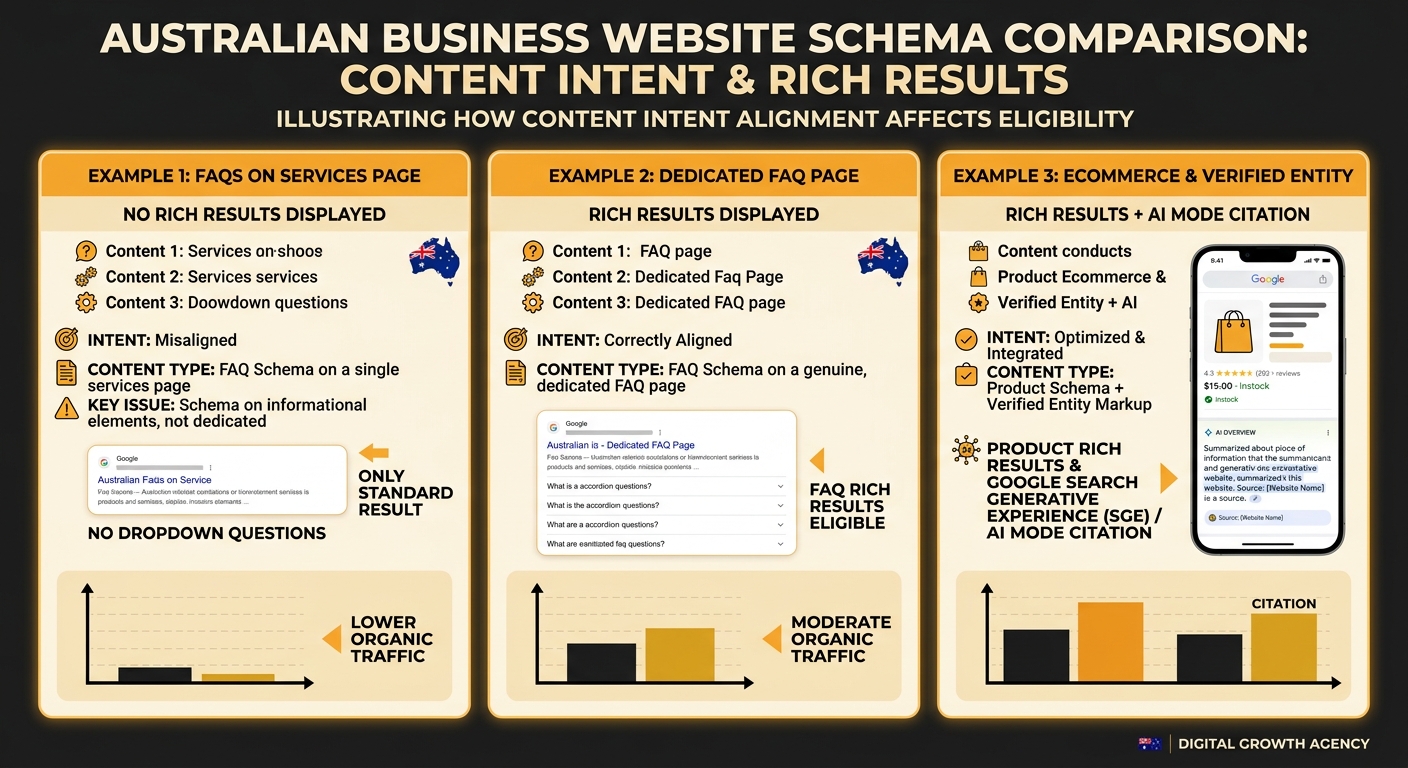
Common reasons competitors show rich snippets while you can’t include four factors documented by schema testing guides: lower domain authority relative to the query’s competitive set, thinner page content that doesn’t warrant enhanced display, undetected schema validation errors in the rendered HTML, and server-side rendering issues preventing Googlebot from processing the markup at all. Diagnosing which factor applies to your pages requires checking all four systematically using Search Console’s structured data report and the Rich Results Test against your live URLs, not your source code.
Where Valid Schema Actually Gets You
The thesis holds. Technical validity is the minimum viable prerequisite for schema markup rich results — the equivalent of having a driver’s licence without knowing whether any roads lead where you want to go. The Three-Gate Schema Audit provides a diagnostic sequence that matches how Google actually processes and decides on structured data display:
Gate 1 — Syntax: Does the markup validate, use a Google-supported type, and include all required properties? Test with both the Rich Results Test and the schema.org validator. They check different things.
Gate 2 — Render: Does the markup appear in the raw HTML that Googlebot receives on first request? Confirm through Search Console’s URL Inspection tool, not your browser’s developer console. If your site runs heavy JavaScript, this gate is where your JSON-LD implementation issues will surface.
Gate 3 — Authority: Does your domain, your page content, and your entity reputation warrant rich result display for this specific query? This gate has no tool. It’s determined by the same E-E-A-T and authority signals that govern organic rankings broadly.
Australian businesses investing in structured data should recognise that Google rich snippets Australia-wide follow the same authority patterns as organic search itself. A perfectly marked-up page on a low-authority domain competing against established players for competitive queries won’t earn rich results until the underlying site authority catches up. Treating schema as an AI visibility signal rather than a display trigger aligns your expectations with how Google’s systems actually work in 2026 — and produces a structured data strategy that serves both traditional search and the emerging generative search interfaces where entity verification matters even more.