
A top-ranked Google search result now receives 58 percent fewer clicks when an AI Overview appears above it, according to analysis published July 9 by Gravitate, a Vancouver-based digital marketing agency. The firm compiled data from Ahrefs, Pew Research Center, SparkToro, and Press Gazette showing that businesses achieving strong organic rankings are watching website traffic decline despite maintaining visibility.
TL;DR: Google’s AI Overviews correlate with a 58 percent drop in click-through rates for first-position search results, with 68 percent of all U.S. searches now ending without any click to an external website.
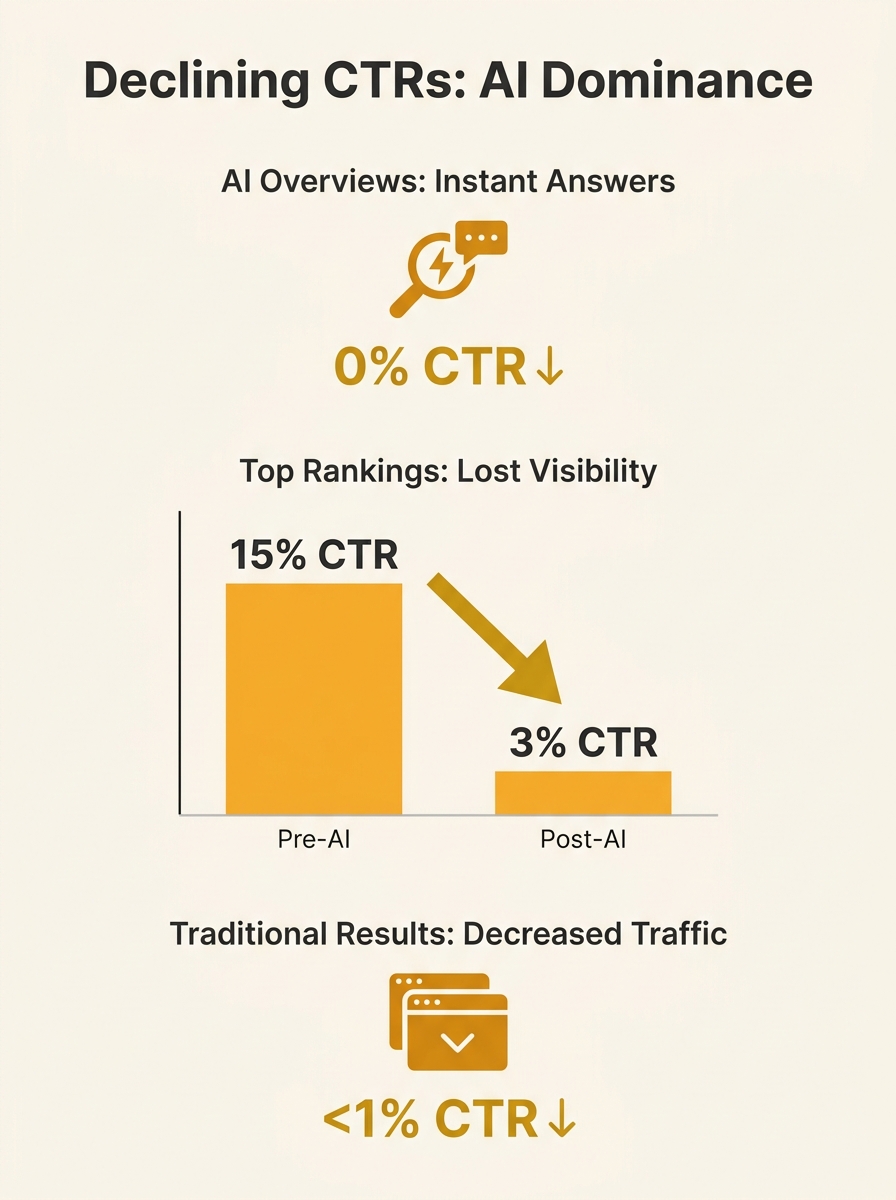
The Ahrefs study analyzed 300,000 keywords using averaged Google Search Console data from December 2025. When AI Overviews appear on a search results page, the traditional result sitting in position one directly beneath it loses 58 percent of its baseline click-through rate. Ahrefs reported the effect had worsened from a 34.5 percent drop measured in April 2025, signaling the impact intensified as Google expanded AI Overview deployment across more query types.
Gravitate’s 26-year-old agency compiled the analysis to address what it described as “one of the most perplexing issues in the current digital marketing landscape”—businesses paying for SEO services, achieving strong rankings, yet experiencing continued traffic declines. The finding: visibility no longer reliably translates into visitors.
Zero-Click Searches Reach Record High
A 2026 SparkToro study conducted with Similarweb determined that 68 percent of all Google searches in the United States conclude without a click, up from approximately 60.45 percent two years earlier and an estimated 45 percent a decade ago. For every 1,000 searches on Google, fewer than 320 now direct users to external websites, according to the SparkToro data.
Pew Research Center’s March 2025 behavioral study tracked 900 U.S. adults navigating 68,879 Google searches. On queries that surfaced an AI Overview, only 8 percent of search sessions resulted in a user clicking a traditional link, compared with 15 percent on searches without an AI Overview—a 47 percent drop in click probability. Links embedded inside AI Overviews themselves captured just 1 percent of all clicks.
The pattern predates AI search. A 2024 SparkToro study using Datos clickstream panel data showed 58.5 percent of U.S. Google searches ended without a click, and 59.7 percent in Europe. Google had already been reducing clicks over time; AI Overviews accelerated an existing trend rather than creating it.
Publisher Traffic Losses Mount Across Major Sites
Total publisher referral traffic via Google search dropped roughly 33 percent globally in 2025, according to data from Press Gazette, Chartbeat, and the Society of News Editors compiled in the Gravitate analysis. U.S. referrals declined 38 percent; European referrals fell 17 percent.
Business Insider lost 55 percent of its Google referral traffic in 2025, the analysis shows. Forbes and HuffPost each lost approximately 50 percent of referral traffic from Google. Gravitate noted these publishers operate established sites with strong domain authority, indicating the losses stem from Google answering more queries within its own platform rather than from content-quality penalties.
“They did not see the decline because they operate weak content sites that get caught up in spam and abuse policies,” the Gravitate analysis stated. “Their losses are the result of Google’s attempt to satisfy more of the search queries, without users having to leave the Google ecosystem.”
March 2024 Core Update Adds Confounding Factor
Google’s March 2024 core update removed what the company considered low-value content from search results by 45 percent, the analysis noted. The update represented one of Google’s largest ranking changes in recent years, with many websites losing rankings or seeing pages deindexed overnight.
Gravitate cautioned that combining algorithmic changes with AI Overview deployment complicates attribution. Businesses experiencing traffic declines may incorrectly identify AI Overviews as the sole cause when multiple factors contributed to the drop. The analysis did not quantify how much of the observed traffic decline stemmed from algorithmic penalties versus AI Overview displacement.
What This Means for Australian Small
Australian small and medium businesses investing in organic search face a new calculus: ranking well no longer guarantees proportional traffic returns. The 58 percent CTR drop for top-ranked results when AI Overviews appear means SEO strategies focused solely on position improvement will deliver diminishing returns. Businesses need to measure actual traffic and conversions from search, not just keyword rankings.
The shift intensifies the importance of content quality and direct answers. If AI Overviews extract information without sending clicks, businesses must create content valuable enough that users seek the full version. Product pages, service descriptions with implementation details, and proprietary data become more defensible than generic informational content that AI can summarize completely.
E-commerce operators should particularly note the publisher traffic data. If major editorial sites with strong authority lost 50-55 percent of Google referrals, e-commerce SEO strategies relying on organic discovery face similar headwinds. Diversifying traffic sources—email lists, direct traffic, social channels—becomes essential rather than optional for revenue stability.