

Between a stale Google Business Profile listing the wrong phone number and a website with zero suburb-specific pages, a Melbourne concreting business was functionally invisible in local search. Six months of fixing those fundamentals, with no ad spend, produced a 140% increase in organic leads and consistent Map Pack visibility across 12 target suburbs.
The Google Business Profile Was Technically “Live” But Functionally Dead
The Map Pack now captures the majority of local clicks before anyone scrolls to organic listings, and for trades businesses, that placement gap often comes down to profile completeness rather than domain authority or backlinks. This concreting crew had claimed their listing back in 2021, verified it, and then forgotten it existed. The phone number redirected to a disconnected line. The primary category read “Home Services” instead of the far more precise “Concrete Contractor.” And the last Google Business Profile post was dated March 2023.
As Leadhub’s guide for trades businesses puts it, “ensuring your information is accurate and up-to-date will help you rank higher in search results and attract more customers.” That sounds obvious. But the gap between knowing this and actually doing it is where most tradie SEO results stall. The fix here was methodical rather than clever: correct the phone number, swap the category from generic to specific, upload 28 jobsite photos taken over two weeks, add operating hours, and begin posting weekly project updates. Weekly activity signals to Google’s algorithm that the profile belongs to an active, trustworthy business, and the local ranking factors around photo libraries and review volume are well documented by now.
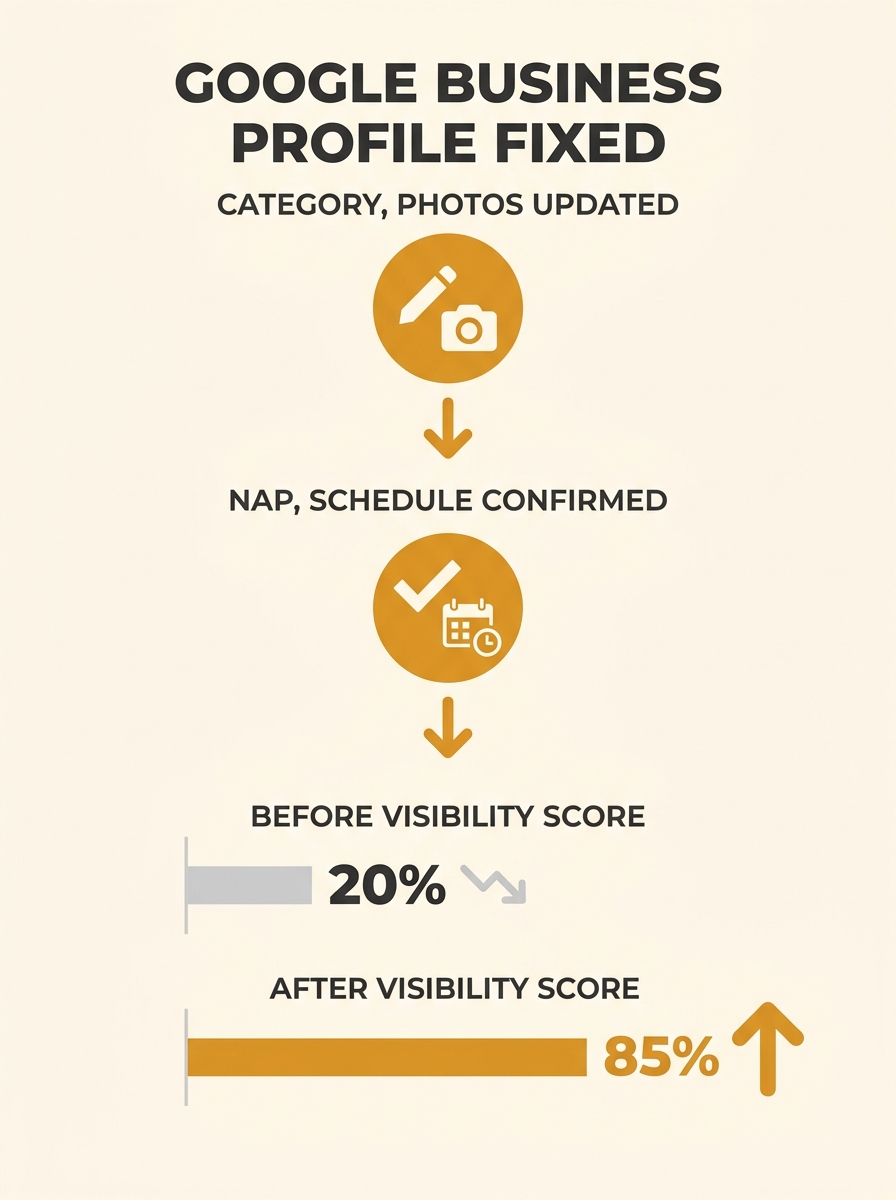
Within eight weeks, the profile appeared in Map Pack results for 9 of the 12 target suburb queries. The concreting crew’s Google Business Profile results went from zero impressions per week to an average of 340, with 22% of those converting to either a phone call or a direction request. What changed wasn’t the algorithm. The algorithm had been waiting for this profile to give it something to work with.
Suburb Pages That Earned Rankings Because They Earned Attention
The second piece of this Melbourne local SEO project targeted the website itself, which had five pages: Home, About, Services, Gallery, Contact. For a business servicing suburbs from Werribee to Footscray to Sunshine, there was no content addressing any of those areas individually. The site ranked for nothing because it targeted nothing.
The team built 12 suburb-specific service pages, one for each target area, following a structure backed by current local SEO best practice. Each page carried 400 to 600 words of genuine content addressing local context (soil types affecting concrete pours in Werribee’s growth corridors, heritage overlay requirements in Footscray, popular driveway finishes across Sunshine’s newer estates). Title tags stayed under 60 characters and meta descriptions between 145 and 155 characters, each including the suburb name, the service type, and a clear value proposition. Every page also carried LocalBusiness schema markup with consistent NAP (Name, Address, Phone) details matching the Google Business Profile, Yellow Pages, True Local, and hipages listings.
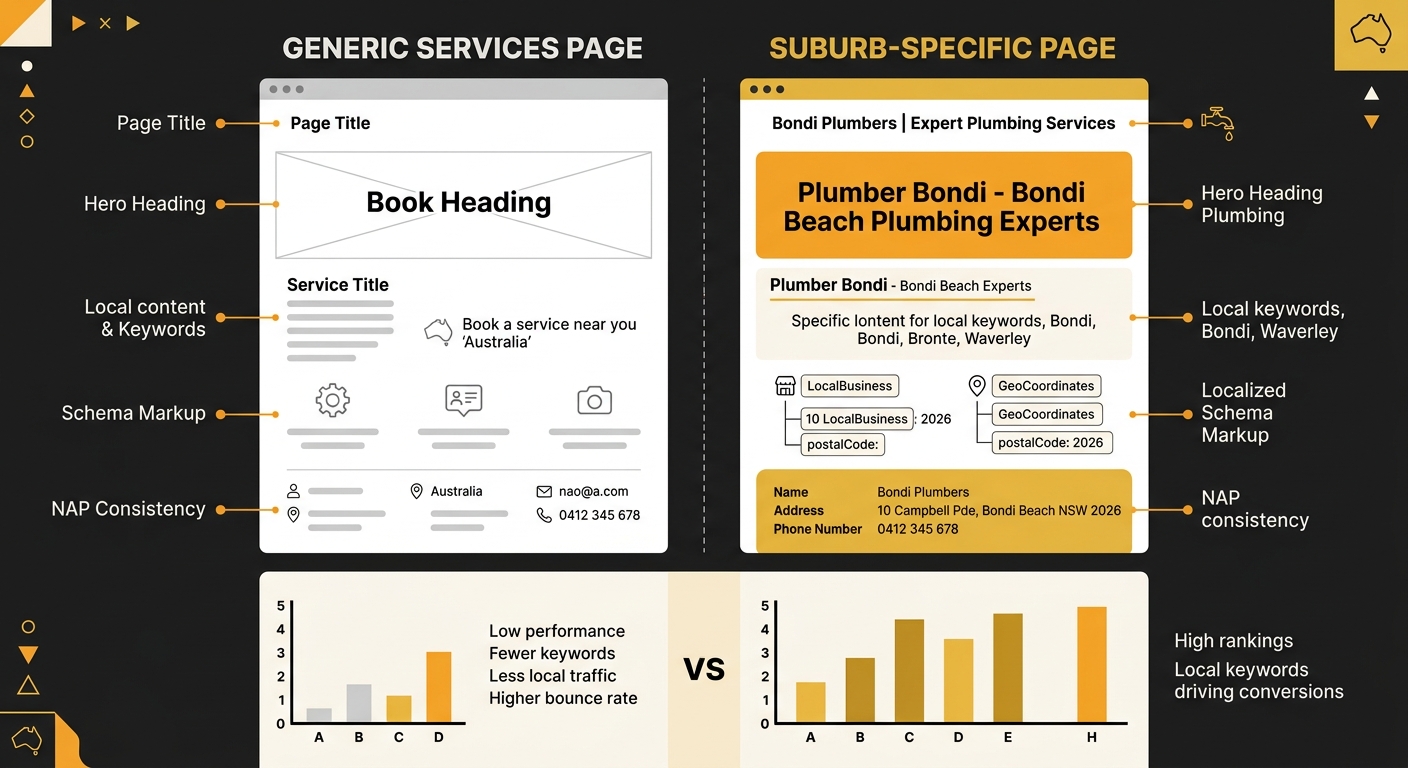
This wasn’t about stuffing suburb names into boilerplate paragraphs. Google’s thin-content penalties hit duplicate suburb pages hard, and the self-inflicted content problems that cause most Australian SME ranking drops frequently trace back to exactly this kind of lazy templating. Each page needed to say something real about the area, the kind of work done there, and the specific questions homeowners in that suburb ask before hiring. SEO Summer’s tradie case study documents first-position rankings achieved within two months for targeted keywords by following a similar location-specific content approach, and the Melbourne crew’s experience tracked closely with that timeline. By month three, 7 of the 12 suburb pages ranked on page one for their target terms.
The cost of building these pages was effectively time. CJCO’s 2026 small business SEO guide makes the point clearly: “Google Search Console and Google Business Profile are both free and together provide most of what a DIY operator needs.” Paid tools like Ahrefs or Semrush help with competitor keyword gap analysis, but in the first six months, the free stack handled everything this business required. The total financial outlay for the first phase was $0 in ad spend, $0 in paid tools, and roughly 40 hours of content creation spread across two people.
The Review Engine That Turned Customers Into Ranking Signals
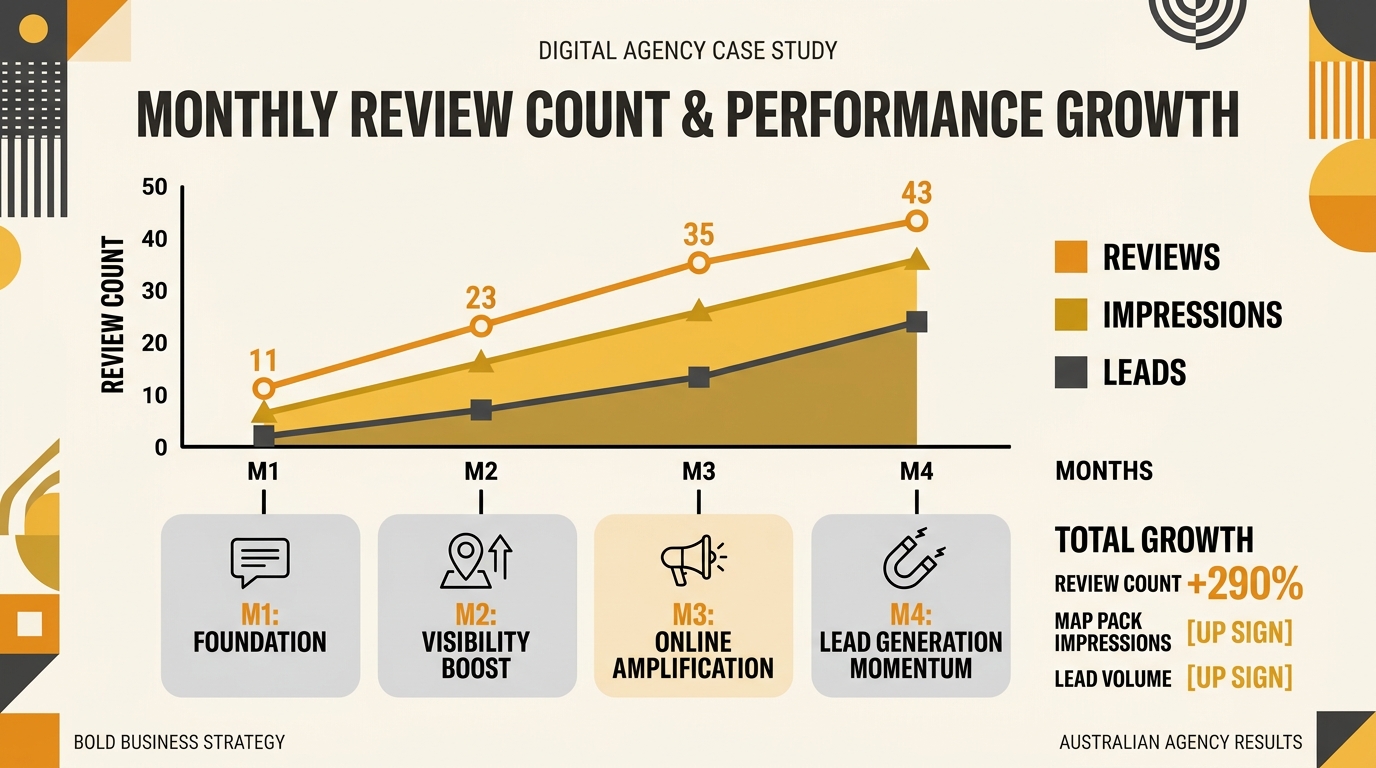
Reviews were the third and arguably most consequential fix. The business had 11 Google reviews, accumulated over four years, with an average rating of 4.2 stars. Several competitors in the same suburbs carried 50 to 80 reviews each. In local pack rankings, review volume and recency function as a primary trust signal and ranking tiebreaker. Industry data shows 97% of consumers read reviews for local businesses before making contact, and tradies with consistent, positive Google reviews tend to dominate local search results in their service areas.
The team implemented a two-tap SMS review request sent to every customer within 24 hours of job completion. The target wasn’t volume spikes but consistency: 5 reviews per month, every month. They also committed to responding to every review within 72 hours, positive or negative, with personalised replies that mentioned the suburb and the type of work completed. This approach treats review management as an ongoing operational process rather than a one-off campaign, and the effect on organic leads for this trades business was significant. Within four months, the review count climbed from 11 to 43, the average rating rose to 4.7 stars, and the profile’s click-through rate from Map Pack results doubled.
The compounding nature of this work matters. ServiceTitan’s analysis of organic lead generation for trades businesses describes these leads as “slower to build but more sustainable over time”, contrasting them with paid leads that disappear the moment ad budgets pause. Every review earned, every suburb page indexed, and every weekly GBP post published adds to a base of visibility that compounds rather than resets. That’s the fundamental economic argument for this kind of local SEO case study in Australia, and it’s particularly relevant for trades businesses operating on tight margins where $2,000 to $5,000 per month in Google Ads spend feels risky.
The overlap between building a Google Business Profile that ranks in Map Pack results and earning the trust signals that convert those impressions into phone calls is where the real work happens. A profile can rank and still underperform if the path from the listing to a booking action is cluttered or unclear. The concreting crew simplified theirs: one prominent “Get a Quote” link, one phone number, and a website URL pointing to the relevant suburb page rather than a generic homepage. Conversion rate from Map Pack impressions to leads rose from 4% to 9.2% after that single change.
The Part of This Story That Doesn’t Generalise
The 140% figure is real, and the methods are replicable. But the context carries caveats that any honest local SEO case study in Australia should acknowledge. Melbourne’s western suburbs represent a growth corridor where new housing developments create consistent demand for concreting work. The competition, while present, included several businesses with equally neglected profiles and websites. A tradie operating in a saturated inner-city market with 30 well-optimised competitors would face a steeper climb using the same playbook.
There’s also the question of sustainability. The review engine requires ongoing effort. The suburb pages need periodic updates as content decay on ageing pages can erode rankings over 12 to 18 months. Weekly GBP posts demand someone’s time every week. None of this is hard, but all of it is persistent, and trades businesses run by small teams often lose momentum once the initial results plateau. The difference between businesses that sustain tradie SEO results and those that backslide is almost always operational discipline rather than technical knowledge.
What remains genuinely uncertain is how Google’s evolving AI search features will reshape local pack visibility over the coming years. We’ve already seen AI Overviews change how clicks distribute in Australian search results, and the interaction between traditional Map Pack rankings and generative search answers is still unstable. The fundamentals documented here, accurate profiles, useful content, genuine reviews, are likely to remain relevant regardless of interface changes. But the specific mechanics of how they translate into leads will shift, and anyone treating a six-month case study as a permanent blueprint is going to be surprised eventually. The work doesn’t finish. It adapts, or it decays.