
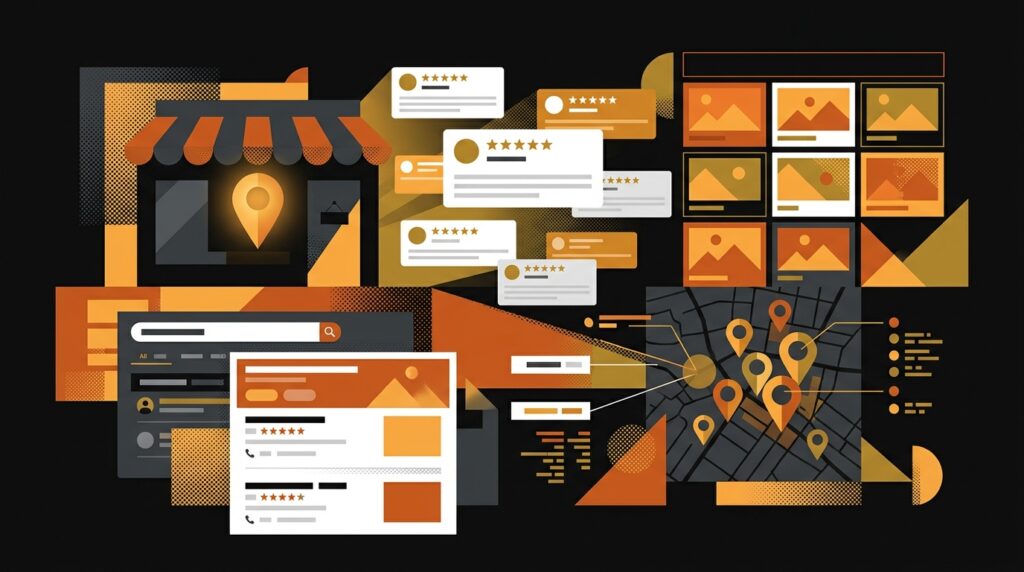
Everything-PR published a local SEO playbook on June 5 identifying five foundational Google Business Profile failures that recur across business categories, with insufficient photo libraries and abandoned review strategies appearing as the most common visibility gaps. According to the guide, businesses with under 10 photos consistently underperform those maintaining 30 to 50 images of exteriors, interiors, products, and team members, while brands failing to reach 50-plus Google reviews forfeit prominence signals across local search surfaces.
TL;DR: A local search guide published June 5 identifies photo volume and review accumulation as the two most consistently neglected ranking factors for Australian businesses competing in Google Map Pack results.
The playbook frames local SEO as a four-surface discipline in 2026, spanning Google Map Pack results, Google AI Overviews, Apple Business Connect across 1.5 billion active devices, and review platforms including Yelp and industry-specific directories. The guide emphasizes that fundamentals, Google Business Profile maintenance, review acquisition, local content, and citation consistency, remain the foundation, with AI-assisted discovery platforms boosting rather than replacing those core signals.
Map Pack Position Concentration Creates Winner-Take-Most Dynamic
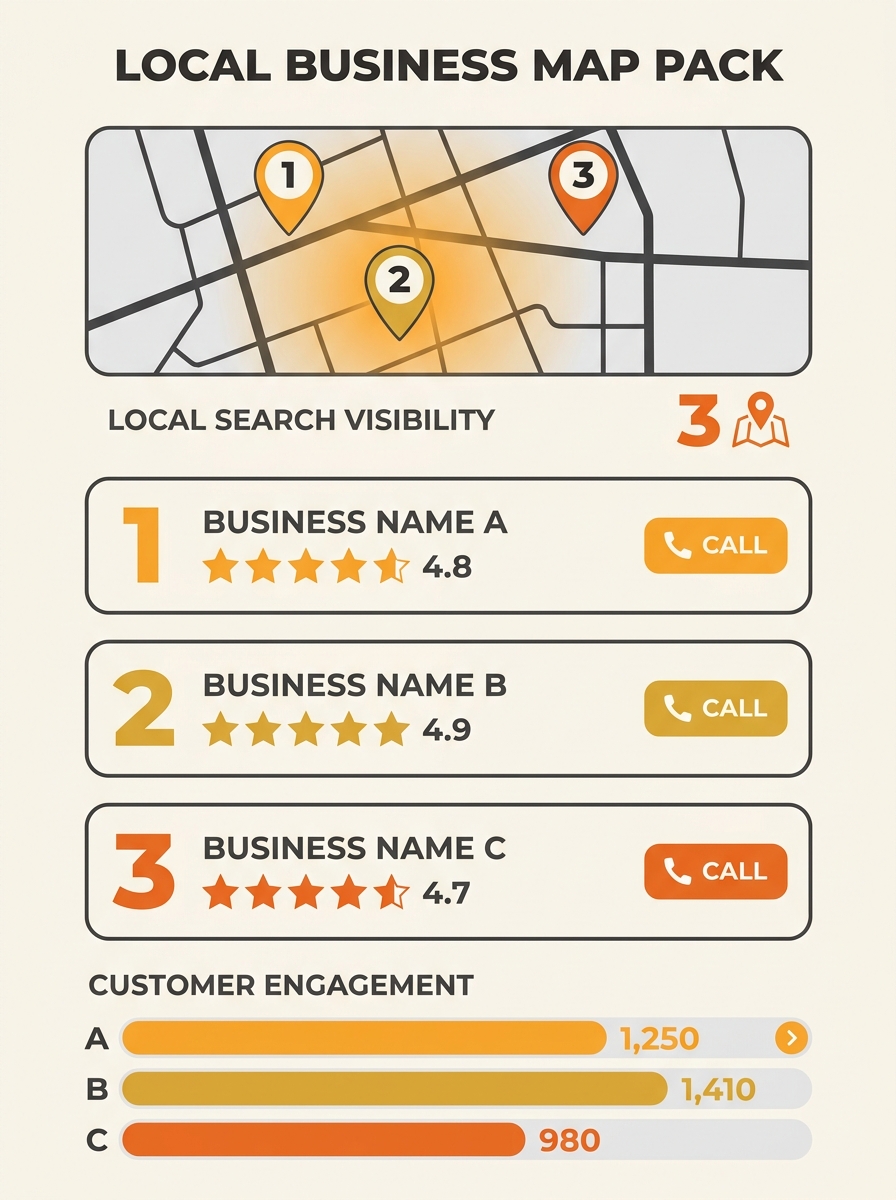
The guide cites industry studies from BrightLocal and STAT showing that Map Pack position one captures 30 to 45 percent of local clicks for a given query. Approximately 44 percent of local-intent searches in the United States produce a Map Pack interaction, according to the analysis.
The playbook describes the competitive gap between position three and position four as “a cliff” rather than an incremental decline. Businesses ranking fourth or lower sit beneath the fold and rarely earn meaningful traffic without an explicit “more places” click from the searcher, the guide states.
Map Pack ranking factors as of 2026 include proximity to the searcher, Google Business Profile completeness and active feature usage, review volume and recency, review keyword content, category selection accuracy, name-address-phone consistency across the citation graph, and prominence signals from inbound links and brand mentions, the guide outlines.
Five Recurring GBP Failures Identified Across Categories
The playbook identifies five Google Business Profile errors that appear consistently in audits regardless of business type. Using overly broad categories, “Restaurant” instead of “Italian Restaurant” or “Lawyer” instead of “Personal Injury Attorney”, leaves relevance signals uncaptured, the guide notes. Profiles maintaining fewer than 10 photos consistently underperform those with 30 to 50 images across multiple categories, the analysis states.
Outdated or incorrect operating hours drive one-star reviews when customers arrive at closed businesses, according to the guide. Abandoned question-and-answer sections broadcast inactivity, while static profile photos from years prior fail to reflect current operations, the playbook warns.
The guide recommends that businesses verify their primary category matches the most specific available option, upload comprehensive photo libraries covering exteriors, interiors, products, and team members, maintain current holiday and seasonal hours, respond to customer questions in the Q&A section, and refresh profile imagery to reflect recent operations.
Apple Business Connect Gains Recommendation for iOS-Heavy Markets
The guide positions Apple Business Connect as a recommended local SEO surface for markets with concentrated iOS usage. Apple Business Connect powers Apple Maps, Siri, Spotlight, and Apple Intelligence across 1.5 billion active devices, the playbook states.
The analysis describes local search as “the SEO discipline closest to the buying decision,” noting that searchers looking for dentists, restaurants, contractors, or lawyers are rarely conducting research and instead intend to act immediately. Brands appearing in local results convert at rates substantially higher than other digital marketing channels, while businesses absent from local search results remain “functionally invisible at the moment of demand,” the guide states.
Google’s local algorithm weighs three primary signals: proximity, or how close the business is to the searcher; relevance, or how well the business matches the query; and prominence, or how well-known and well-reviewed the business is, the playbook outlines. Businesses control relevance through category selection, business descriptions, and service listings, while prominence derives from review accumulation, citation consistency, and broader web authority signals, the guide explains.
Review Accumulation Positioned as Compounding Signal
The guide identifies reviews as “the most undervalued local SEO asset,” describing review signals as factors that compound across every local search surface. The 2026 baseline target is more than 50 reviews on Google for any actively competitive local market, the playbook states.
Review volume, recency, keyword content within review text, and response rates from the business all contribute to local prominence signals, the analysis notes. The guide describes review acquisition as a discipline requiring systematic post-transaction request processes rather than passive accumulation.
Australian small and medium businesses seeking to compete in local search should prioritize Google Business Profile optimization and review accumulation over advanced technical tactics, the playbook suggests. The guide positions citation consistency and local SEO content strategies as secondary priorities after GBP foundations are secured.
What Happens Next
The playbook’s emphasis on photo volume and review density as consistently neglected factors aligns with the broader shift toward visual content in local search rankings. Australian businesses competing for Map Pack visibility will need to audit their Google Business Profile photo libraries and establish review request workflows that target the 50-review threshold the guide identifies as a 2026 baseline.
The four-surface local search model the guide outlines, Google Map Pack, AI Overviews, Apple Business Connect, and review platforms, creates optimization requirements beyond Google Business Profile alone. Businesses operating in iOS-heavy demographics should add Apple Business Connect to their local SEO stack, while those targeting informational local queries will need to consider how AI Overviews surface local recommendations.
The winner-take-most Map Pack dynamic the playbook describes means that businesses ranking fourth or fifth face minimal traffic gain from incremental improvements. Firms seeking professional SEO services to close the gap between position four and position three should prioritize review accumulation, category precision, and photo library depth over technical site optimizations, based on the ranking factors the guide surfaces.