

Technical SEO infrastructure requirements expanded beyond crawlability and indexing basics according to a framework published September 16, 2026 by Analytics Insight, which positioned site architecture, canonicalization and internal linking as systems that determine whether AI-driven search platforms can interpret website content coherently.
TL;DR: Analytics Insight published a technical SEO framework September 16 arguing that infrastructure issues—not content gaps—now prevent AI search systems from indexing and interpreting business websites correctly.
The framework shifts technical SEO from specialist checklist work to digital infrastructure planning, according to the publication. The analysis argues that websites with strong content still lose visibility when search systems cannot crawl pages efficiently, understand URL hierarchies, or resolve duplicate signals across growing site architectures.
Search Systems Require Architectural Clarity Before Evaluating Content Quality
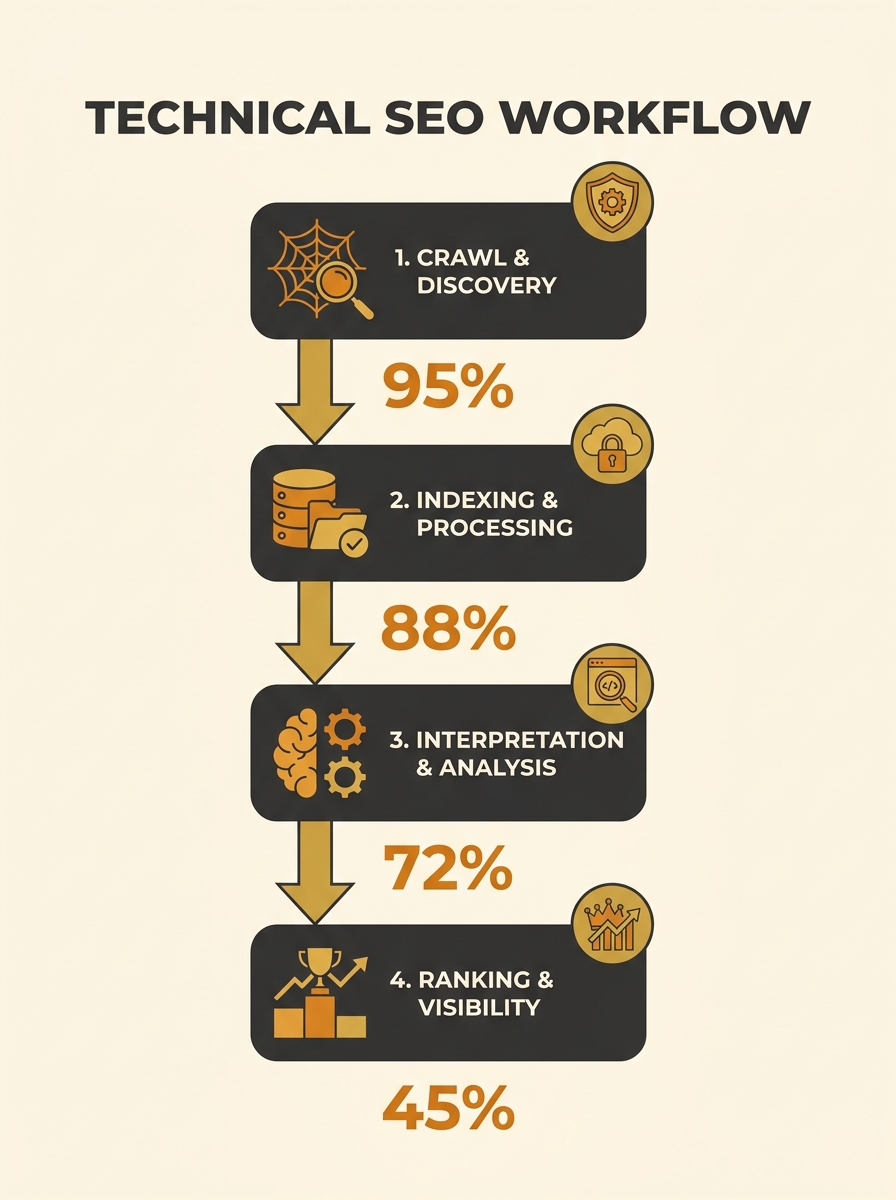
AI-driven search platforms must complete four infrastructure steps before content quality matters, the framework states. Search systems discover pages, access them, interpret relationships to other site sections, and decide whether pages belong in the index. Problems at any stage make content invisible regardless of writing quality.
“A page may be well written but buried behind weak internal linking,” the publication stated. “A canonical tag may point to the wrong URL. A redirect chain may waste crawl resources. JavaScript may prevent important content from being rendered consistently.”
The analysis separates crawlability from indexation as distinct technical problems. A crawler reaching a URL does not guarantee indexing, and indexed pages may not rank if search engines cannot determine which version represents the canonical destination. Technical audits should verify server status codes, indexing permissions, canonical tags, unique page value and internal link placement from meaningful site sections, according to the framework.
Site Architecture Should Map to Search Intent Categories
Websites should clarify which page serves each major search intent through architectural decisions, not just metadata, the publication argued. A service page, pricing page, comparison page and educational guide may cover related vocabulary but answer different user questions. Architecture that fails to distinguish these roles causes internal competition for rankings.
Parent-child relationships, predictable URL patterns, deliberate internal links and topic clusters help search systems understand hierarchy and context, the framework states. Clear architecture also improves navigation for human visitors.
The analysis recommends technical SEO audits examine crawlability, indexation, site structure, canonicalization, internal linking, structured data and the relationship between search intent and page purpose as interconnected systems rather than isolated issues.
Canonicalization Errors Multiply as Website Size Increases
Small websites survive inconsistent URL rules because limited page counts mask problems, according to the publication. As sites expand, duplicate paths, parameter URLs, outdated redirects, HTTP-HTTPS variants and inconsistent trailing-slash behavior create ambiguity for search systems.
Canonical tags indicate preferred versions but cannot substitute for clean architecture, the framework states. When internal links point to non-canonical URLs or redirects contradict canonical signals, websites send mixed messages. Strong technical foundations require consistency: internal links, sitemaps, canonicals, redirects and navigation should reinforce identical preferred URLs.
The analysis positions structured data as entity definition rather than ranking guarantee. Schema markup helps machines interpret entities, page types, organizations, products, articles and relationships more clearly in environments where AI search systems synthesize answers instead of returning page lists.
“Clear entity signals can make it easier to understand who published the content, what the content is about, and how it relates to the rest of the website,” the publication stated. The framework recommends using appropriate structured data consistently and ensuring markup reflects page-visible content.
Performance Bottlenecks Affect User Satisfaction and Crawl Efficiency
Page performance impacts user satisfaction and search crawling simultaneously, the analysis argues. Slow loading, unstable layouts, heavy scripts and delayed interaction reduce satisfaction even when content quality remains high.
Performance work should target real bottlenecks rather than perfect scores, according to the framework. Image delivery, script execution, caching, server response, font loading and third-party tools require review based on actual effects on users and crawling.
Internal linking represents a technical system rather than content-editing detail, the publication stated. Important pages should not depend on search engines discovering them through sitemaps alone—they need contextual links from related pages and navigation structures that communicate hierarchy and topical relationships clearly.
Businesses Implications
Australian businesses relying on content marketing services to drive organic growth face infrastructure requirements that determine whether AI search platforms surface their content at all. The September 16 framework confirms what site-level technical audits increasingly show: strong writing, keyword targeting and backlink profiles cannot compensate for websites that search systems struggle to crawl or interpret correctly.
Small and medium businesses should prioritize infrastructure audits over content volume expansion when organic visibility plateaus. Clear URL hierarchies, consistent canonicalization, deliberate internal linking and structured data implementation now function as prerequisites for AI-driven search visibility rather than optimization refinements. Companies that treat technical SEO as infrastructure planning—rather than periodic error fixing—position themselves to benefit from content investments that might otherwise remain invisible to generative search platforms.
The shift from page-level optimization to system-level architecture particularly affects e-commerce SEO implementations, where product pages, category hierarchies and filtered navigation create URL proliferation that requires architectural discipline. Businesses should verify that crawl budgets, canonical signals and internal link equity flow toward pages designed to capture commercial intent before scaling content production.