
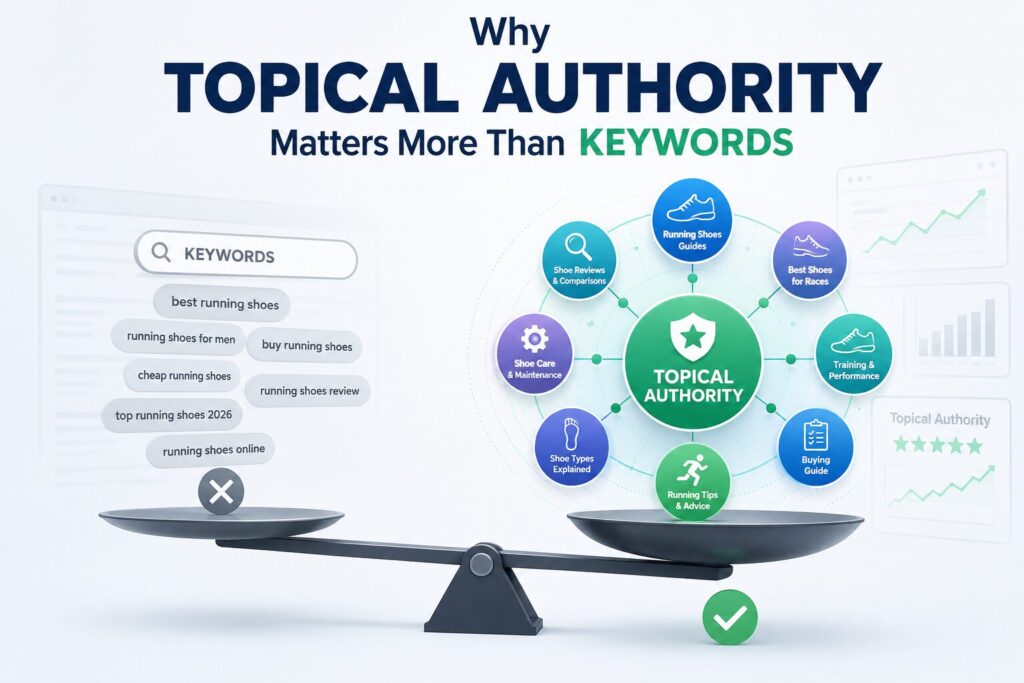
Do you want AI systems to cite you? Are you eager for Google to treat your website as an authoritative source on a topic? Then, you need to face the truth: today, keywords matter less than topical authority for both SEO and GEO.
Years ago, you could build a successful site by optimizing for random keywords. But today, Google pays a lot more attention to the breadth and depth of expertise your website shows on a specific subject. That’s why topical authority is so important. Let’s find out what it is exactly and why it matters so much these days.
What is topical authority?
Topical authority is the perceived subject-matter expertise of your site. Search engines and AI systems have complex algorithms to assess it. But generally speaking, they measure it via interconnection, content breadth, and content depth.
For example, among the factors that influence topical authority are:
- Clear content focus and the number of pages that cover related subtopics.
- The internal linking between these pages.
- Off-site brand signals and backlinks from niche-relevant websites.
- Deep content coverage with E-E-A-T signals.
- Update frequency and freshness of the content.
Overall, your main goal is to build consistent signals around your brand both on your own website and on other platforms. That’s why your content has to revolve around the same topic. Similarly, when it comes to backlinks, focus on niche-relevant websites, whether you’re doing your link building by yourself, using an Adsy platform, or any other service.
Over time, all this will help you build strong entity authority and get more visibility in traditional and AI search.
Topical authority vs. domain authority
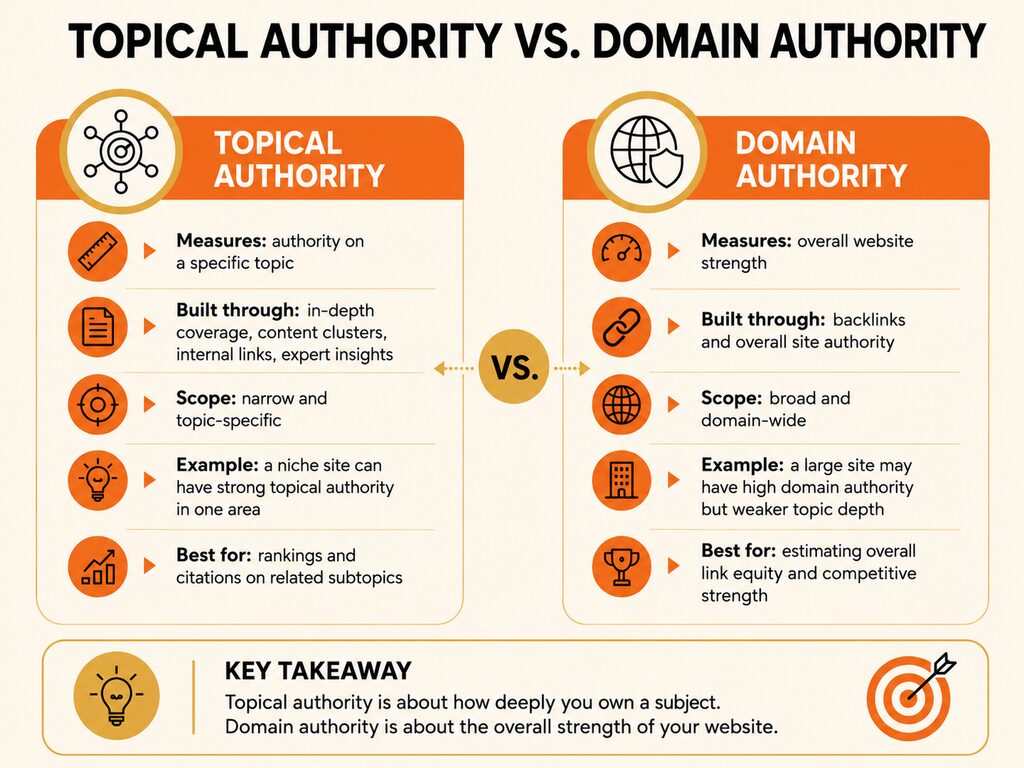
Domain authority and topical authority are not the same thing:
- Domain authority is a website-wide score. You can use DA/DR/AS third-party metrics to evaluate it. The foundation of domain authority mainly consists of the quality and quantity of backlinks that point to your domain.
- Topical authority is a more subject-specific term. Essentially, it comes down to focusing on a clear area of expertise for your website. For example, if you publish recipes, all your content has to be around cooking and culinary topics.
Why topical authority is more important than keywords
Nowadays, keywords do not dominate the GEO and SEO game anymore. Here are the main reasons why topical authority of the website came into play and is more important:
Google evaluates E-E-A-T, not just keywords
Long gone are those times when you could stuff your blog posts with keywords and rank in a matter of days. Google is much smarter and more elaborate these days. For years, its algorithms have been prioritizing E-E-A-T (experience, expertise, authoritativeness, and trustworthiness). So, no wonder that by relying on these four pillars, your topical authority improves as well.
Essentially, Google AI systems and LLMs consider your expertise when choosing citation sources. For instance, websites with comprehensive topic coverage are cited much more often than sites with isolated articles on the same topics. It means that your citation probability depends directly on the depth of your topical coverage.
AI systems cite sources with industry authority
AI is more likely to cite and mention brands with strong expertise and exposure in a specific niche. It evaluates whether your website comprehensively covers the industry-specific subject. On top of this, it assesses the external visibility of your business. That’s why if your website has many niche-relevant brand mentions and backlinks, AI systems will most likely prefer to cite it.
Semantic search isn’t purely keyword-based
Semantic search focuses on context rather than keywords. It aims to define the true meaning and search intent behind a given query. This type of search analyzes connections and context between the words you google. It aims to comprehend what you really mean to ensure you get the right answers. Therefore, pure keywords are not so important these days.
Niche expertise offers many SEO benefits
While it takes time to build good topical authority, it gives you many more advantages compared to basic keyword optimization:
- You are more resilient to algorithm updates. Google’s content updates usually have the greatest impact on broad and shallow content strategies. So, the websites with genuine topical depth are now more likely to keep their positions.
- You can compete with much bigger websites. Topical authority is about subject-matter expertise in a specific niche. So, even a small specialized website can outrank a much larger one when its topical authority is high.
- You rank for more keywords with minimal effort. The websites with strong topical authority tend to rank higher thanks to a wider range of related searches. That’s also because of the thousands of long-tail keywords they naturally include in their content.
How to improve topical authority on your website
Building topical authority is a process that requires a system of simple methods and steps. Let’s check the most effective ones that can help you with both traditional search and LLM optimization.
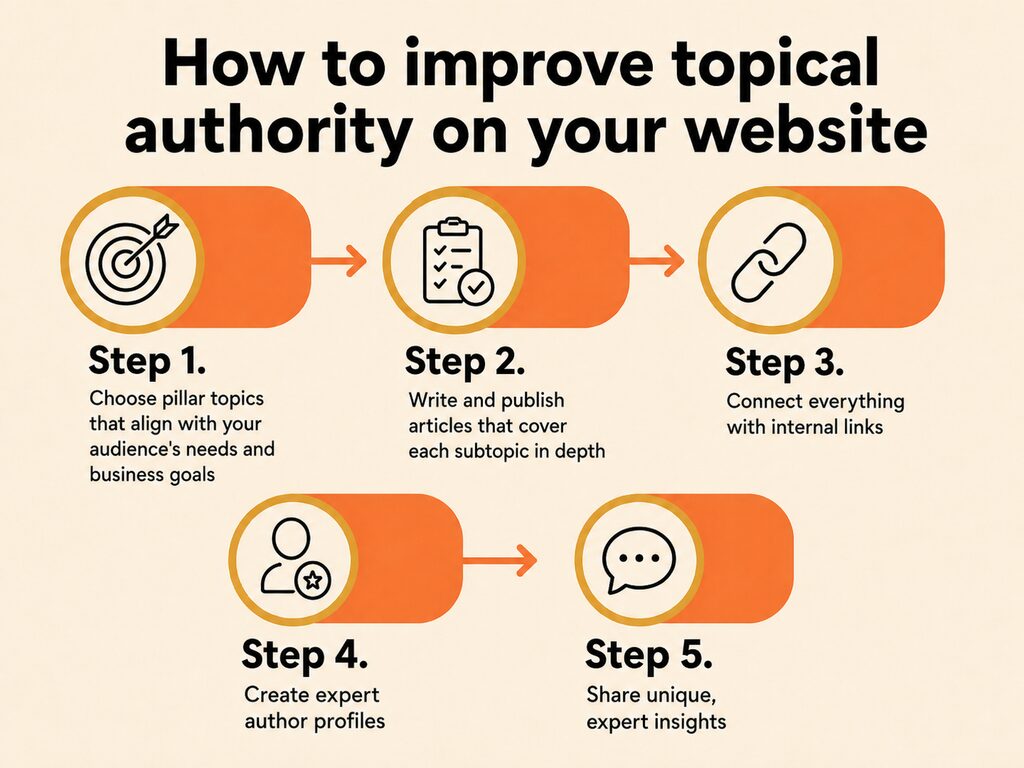
Step 1. Choose pillar topics that align with your audience’s needs and business goals
First, identify 3 to 5 pillar topics that align smoothly with your audience’s needs and your specific business goals. For example, imagine your website is about web development. Then, you may narrow down your content to topics such as “AI-powered web development,” “design systems for websites,” etc.
If you concentrate on just a few topics in your niche, you may gain better LLM visibility. Besides, this can also boost your rankings in traditional search. A clear topical focus is especially useful for new brands in competitive niches.
Step 2. Write and publish articles that cover each subtopic in depth
These are the things you should aim for in the content you publish:
- Cite verifiable statistics and credible sources.
- Add unique content (real-life examples, small case studies, personal experiences, and so on).
- Consider using answer blocks and clearer content structures for easier AI extraction.
- Make sure there are internal links to other articles in the same topic clusters.
- Incorporate long-tail keywords into your posts where they fit.
Keep in mind that your main target is semantic completeness. Meaning, you should cover every angle of the topic. Ideally, over time, your website has to answer every relevant query around the pillars you’ve picked. Because the deeper your articles are in terms of coverage, the more chances you have for AI systems to cite you.
Here is another important detail. When choosing keywords for your content, always prioritize relevance. Even if there are queries that have higher search volume, it’s much better to focus on topics closely related to your industry rather than chasing random clicks.
Step 3. Connect everything with internal links
Internal links help connect all your pages and show the depth of your topical coverage. So, make sure that each article links to at least a couple of related pages on your website. It’s also helpful to track your internal linking to make sure there are no orphan pages. This will help both search engines and AI systems discover your content more easily.
This is one of the smaller but still essential steps of the topical authority SEO strategy. That’s why make sure you do not skip it, no matter how tiny this seems.
Step 4. Create expert author profiles
When your website has author profiles with real people who have relevant experience and expertise, it brings more topical authority to your website. It’s especially trustworthy if you add links to their LinkedIn, X, Instagram, etc.
For example, if you write about personal finances, it’s much more credible when the author is a private consultant with 10+ years of experience. Search systems will treat such pages as more trustworthy than the articles published under the “our team” profile. Again, expertise and experience influence your LLM visibility and give your website visitors additional reassurance.
Step 5. Share unique, expert insights
Building topical authority requires consistent action. It is not a one-time project. That’s why you need to make sure your content stays fresh and unique over time. So, include original research, real-life experiences, case studies, etc. The more unique your content is, the more appealing it will be to Google and AI search systems.
Even if you don’t have the resources to run original surveys and studies, make sure your content still adds something new. There isn’t much sense in rewriting what’s already been said a million times. So, add some stories from your own experience, find relevant examples and analyze them, give unique perspectives, and so on.
Step 6. Build off-page authority
Building off-page authority is essential for every business to get more traffic, achieve long-term results, gain trust, and have higher rankings. Off-page authority isn’t just about backlinks. It also includes word-of-mouth recommendations, reviews about your services or products, UGC content, and any other mention of your brand.
That’s why it is critical to look at your link building outreach as a broader strategy. In addition to getting backlinks, implement digital PR techniques, get brand mentions, and show up on review platforms, YouTube, Reddit, Quora, etc.
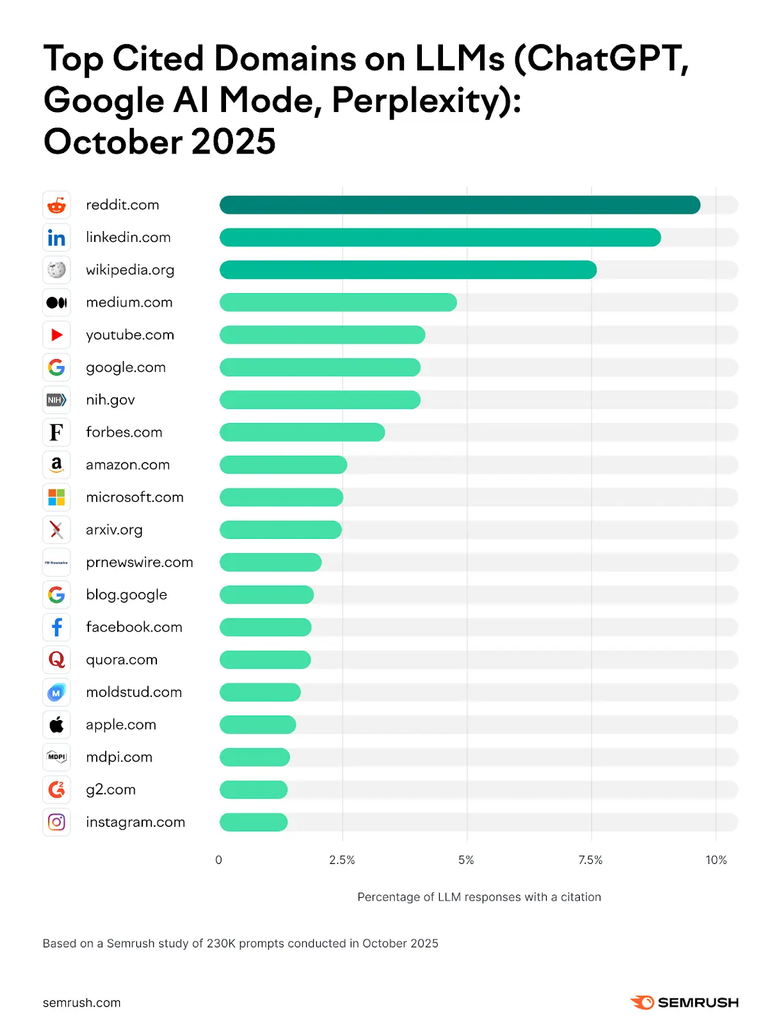
Just have a look at the graph below. These are the websites where you have to show up:
Source: Semrush
The more often your brand appears on the sites LLMs already cite, the better your chances of being cited as well. But the important part is that your business has to show up in the relevant context. This is how you complement the topical authority you’ve been creating on your own website.
Long story short, to become more visible, get more external mentions across platforms. Even if those are unlinked mentions on Reddit, Quora, LinkedIn, or YouTube, they still contribute to your brand exposure. Essentially, the more topically relevant footprints your business has online, the better your off-page authority will be.
So, do keywords still matter?
Yes, but they are just one of the components. They can help you understand what your audience wants to know and find the right angle for your content. But these days, visibility is more complex, so keyword optimization alone won’t work.
Search engines and LLMs don’t simply match keywords in the search query to the keywords you use in your content. They try to understand what the user wants and who can give them the most expert and credible answer. That’s exactly why topical authority matters more.