

Subscribing to an all-in-one SEO platform actively works against the interests of a typical Australian SME. The pitch sounds reasonable: one tool, one login, one monthly invoice, and you get keyword research, rank tracking, backlink analysis, site audits, and content optimisation all in one place. Semrush, Ahrefs, Moz Pro — they’re excellent products. But they’re built for agencies managing dozens of clients, or in-house teams at companies with six-figure marketing budgets. When a 20-page electrician’s website in Perth or a boutique retailer in Hobart subscribes at $129 to $249 per month, the maths stops working almost immediately.
This article defends a simple claim: for Australian SMEs with fewer than 100 pages and limited internal SEO expertise, a modular stack of cheaper (often free) tools will outperform an all-in-one platform on every metric that matters. Here are three reasons why.
The $200/Month Feature Graveyard
All-in-one platforms price their plans around feature volume. Semrush’s Pro plan at around USD $140/month includes site audits, position tracking, keyword research, backlink analytics, content marketing tools, social media scheduling, PPC analysis, and more. That’s roughly a dozen distinct toolsets.
An Australian SME running a local services business, say a physiotherapy clinic in Melbourne, will realistically use two or three of those. Keyword research, maybe a monthly site audit, and rank tracking for 20 to 50 local keywords. The remaining nine or ten toolsets sit untouched.
As a LinkedIn discussion on this exact trade-off noted, you may not need or use all the features, which can make it an expensive or unnecessary investment. This is a polite way of saying you’re subsidising features that enterprise clients use while your team doesn’t even know they exist.
The iBeam Consulting team puts the threshold bluntly: $200+ per month is where all-in-one platforms actually start to justify themselves, and even then, only for businesses with enough scale to exercise the full feature set. Below that threshold, you’re buying capability you can’t absorb.
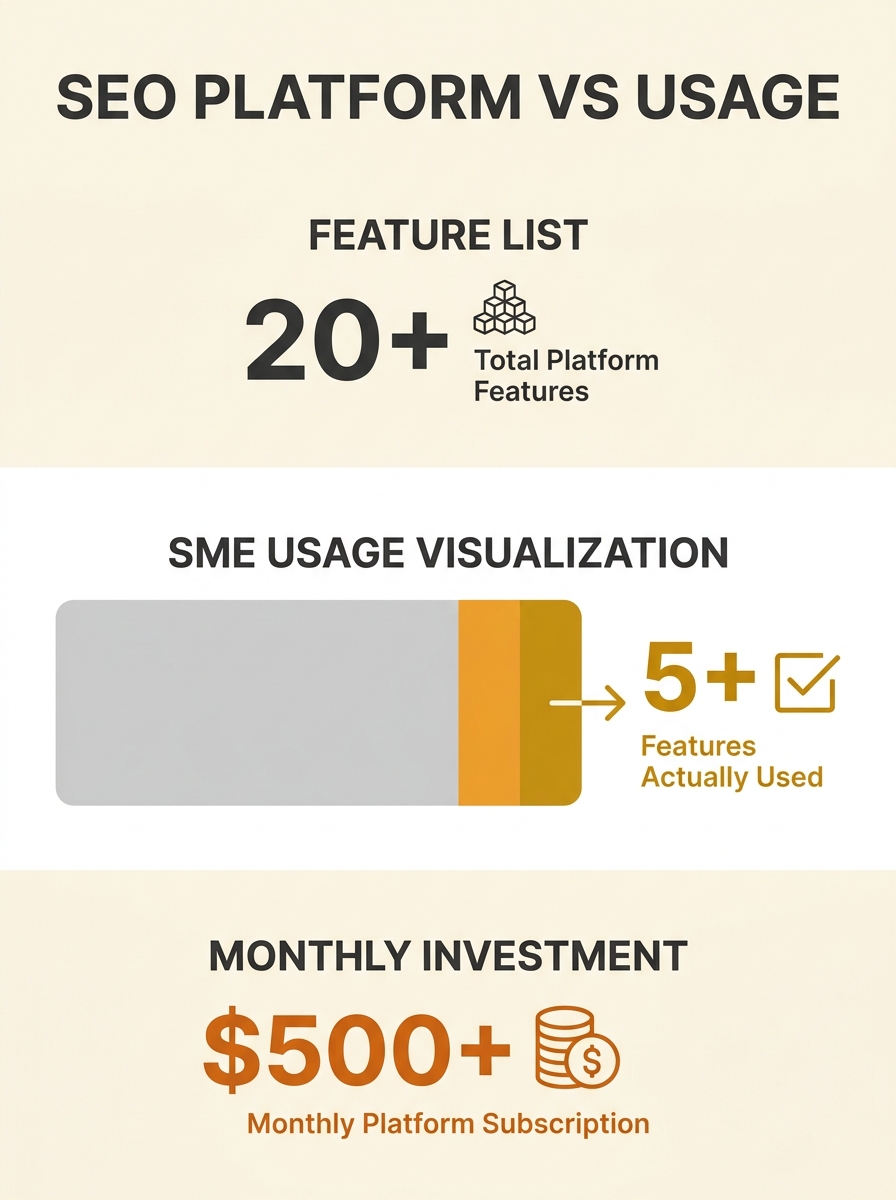
And there’s a subtler problem. When your audit tool is bundled into the same interface as your keyword tool and your content tool, the platform has an incentive to surface findings that keep you engaged across all modules. We’ve written about how SEO tools can generate a false sense of completeness when their dashboards prioritise green ticks over genuine insight. An all-in-one platform’s site audit module will flag plenty of issues, but it tends to prioritise the ones it can sell you adjacent solutions for. The issues that actually matter to your rankings — crawl inefficiencies, thin content, broken internal link chains — often require deeper investigation than a bundled module provides.
Australian Search Data Has Blind Spots in Every Major Platform
Here’s a problem specific to our market. The major all-in-one platforms source their keyword databases primarily from the United States. Their Australian keyword volumes are estimated, often extrapolated from US data and adjusted by population ratio. For high-volume commercial terms (“car insurance,” “mortgage broker”), the estimates are reasonable. For long-tail local queries (“emergency plumber Parramatta after hours,” “bulk landscape supplies Geelong”), the data can be wildly inaccurate or simply absent.
Ahrefs has stronger backlink data. Semrush tends to perform better for local Australian competitor analysis and PPC research. But neither platform provides the granularity that Google Search Console gives you for free, because GSC reports your actual impressions and clicks from actual Australian users searching on google.com.au. There’s no estimation involved.
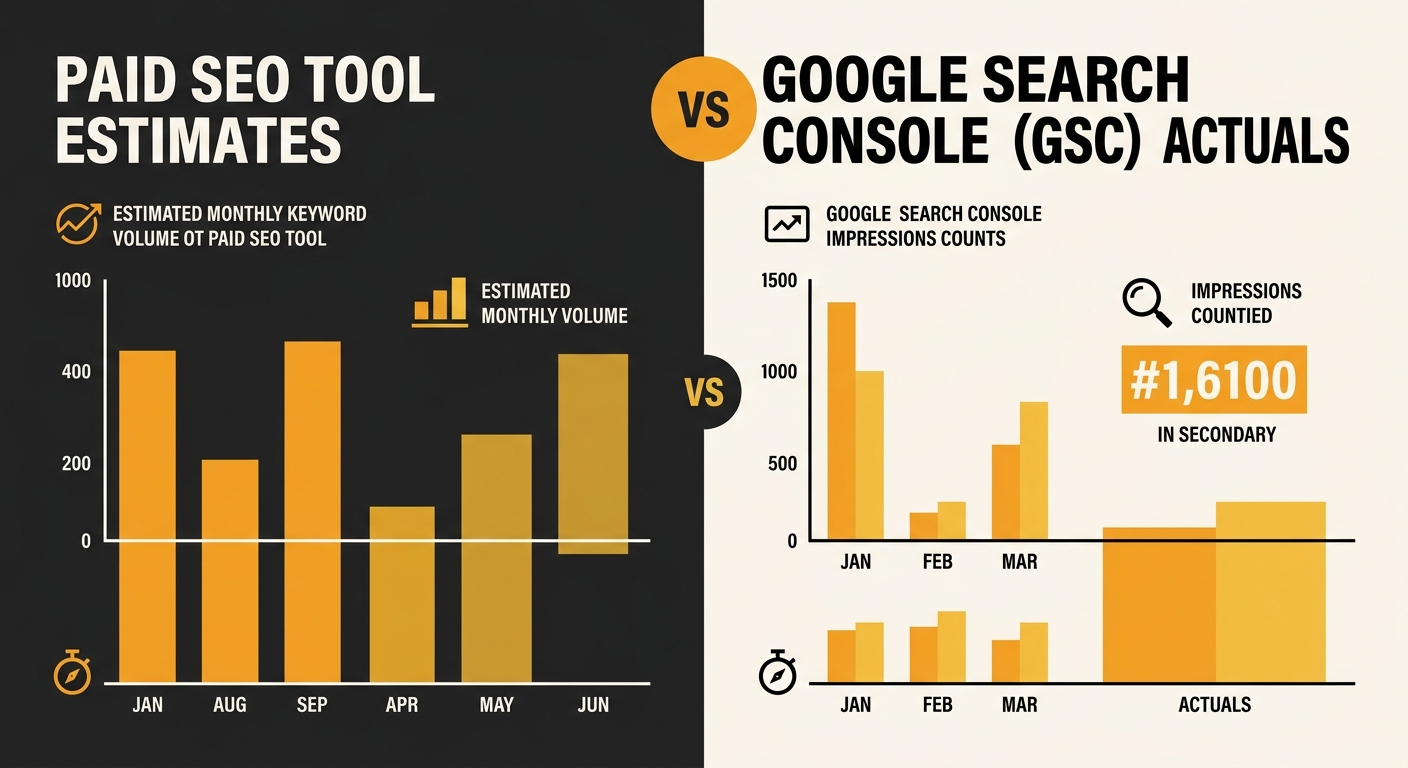
This data gap matters enormously for technical SEO tool selection at the SME level. When you’re trying to work out whether a page is underperforming, you need real numbers, not modelled approximations. GSC gives you those numbers. An all-in-one platform’s keyword module gives you a guess.
For businesses focused on local SEO services across multiple suburbs or regions, the gap is even wider. Local pack rankings, Google Business Profile insights, and map-based search visibility require tools built specifically for local search. The local features inside Semrush and Ahrefs exist, but they’re shallow compared to dedicated local SEO tools like BrightLocal or even the free data inside GBP’s own dashboard.
The same principle applies to technical audits. Screaming Frog’s free version crawls up to 500 URLs with deep configuration options for crawl behaviour, rendering, and extraction. The site audit modules inside all-in-one platforms offer less control and less transparency about what they’re actually checking. If you’re diagnosing technical SEO debt that’s accumulated over years, you need the tool that shows you everything, not the one that shows you a score out of 100.
Google Search Console reports actual impressions and clicks from actual Australian users. No paid platform matches that accuracy for your own site.
A Three-Tool Stack That Costs Under $60
The most effective approach for Australian SMEs, according to Devenup’s 2026 analysis, is to combine targeted platforms rather than relying on a single solution. Here’s what that looks like in practice.
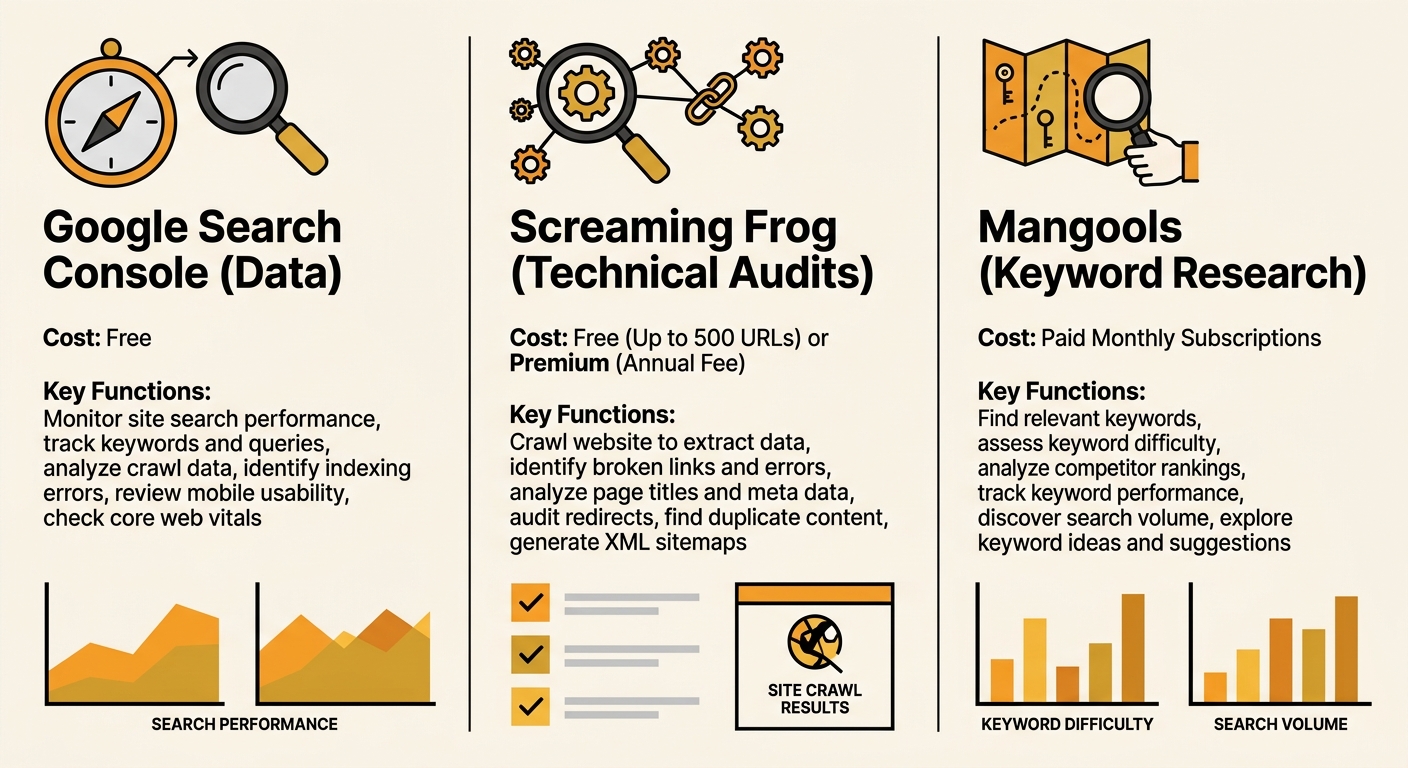
Google Search Console (free). This is your foundation. Real search data from real Australian users. Indexing status, crawl errors, Core Web Vitals, manual actions, and search performance broken down by query, page, country, and device. No SEO tool provides more accurate performance data for your own site. If you’re only going to use one tool, this is it.
Screaming Frog SEO Spider (free up to 500 URLs). For a site under 500 pages, this gives you a complete technical audit: broken links, redirect chains, duplicate content, missing metadata, orphan pages, and crawl depth analysis. The configuration depth is unmatched by any all-in-one platform’s audit module. You run it when you need it rather than paying a monthly subscription for always-on access you don’t require.
Mangools or Ubersuggest ($29–49/month). This covers keyword research, rank tracking, and basic backlink analysis. Mangools in particular offers a clean interface, reasonable Australian keyword data, and a price point that reflects what a small business actually needs. You’re paying for the features you use, and the annual plans bring the monthly cost down further.
Total monthly cost: $29 to $49, depending on which keyword tool you choose and whether you pay annually. Compare that to $129 to $249 for an all-in-one platform where you’d use a fraction of the features.
Tip: If you’re running a WordPress site, pair this stack with a free plugin like Yoast or Rank Math for on-page basics. Don’t pay for a premium SEO plugin until you’ve outgrown the free version. From what we’ve seen, most SMEs never do.
And when you outgrow this stack? That’s when you consider adding a dedicated tool for a specific gap. Maybe Surfer SEO for content optimisation once you’re publishing regularly. Maybe BrightLocal for local citation management once you’ve expanded to multiple locations. The point is that each addition solves a defined problem you’ve already identified, rather than being part of a bundle you subscribed to speculatively.
This modular approach also forces better discipline. When you have separate tools, you’re more likely to understand what each one is telling you and why. When everything lives inside one dashboard, it’s easy to mistake breadth of data for depth of understanding. We’ve explored this dynamic before when examining why green ticks in SEO tools miss what actually matters for Australian sites trying to rank in an increasingly AI-influenced search landscape.
The Claim, Pressure-Tested
There are legitimate counterarguments. If you’re an agency managing 15 clients, Semrush’s reporting and client management features justify the price on workflow efficiency alone. If you have an in-house SEO specialist who uses backlink gap analysis, content gap analysis, and position tracking across hundreds of keywords daily, an all-in-one platform earns its cost through density of use.
But those scenarios don’t describe the typical Australian SME. They describe agencies and mid-market companies. The typical SME has a business owner or a marketing generalist who logs into their SEO tool once or twice a month, runs a keyword search, maybe triggers an audit, and then goes back to running the actual business.
For that person, the all-in-one platform is a trap. It looks professional. It feels like the responsible choice. The onboarding email promises a “complete SEO solution.” Then the subscription renews month after month while the business extracts maybe $30 worth of functionality from a $200 tool.
The alternative is straightforward. Google Search Console for real data. Screaming Frog for technical audits. A focused keyword tool for research and tracking. Anything beyond that, you add when you have a specific reason. Your SEO tool stack strategy should reflect how your business actually operates, not how an enterprise software company structured its pricing tiers. For the vast majority of Australian SMEs, that means modular tools chosen deliberately, each one earning its place or getting replaced. The all-in-one pitch is compelling marketing. The reality, for a small business paying in Australian dollars with a small site and limited time, rarely matches it.