

BrightLocal, Whitespark, and Moz Local all flag the same category of problem more frequently than any other when practitioners run an Australian citation audit: duplicate listings the business owner didn’t know existed. According to Google’s own Business Profile Help documentation, a profile gets classified as a duplicate for four distinct reasons — an existing verified profile already covers the business, multiple profiles share the same address, different services have been split into separate listings, or a combination of these factors. And survey data cited across multiple SEO industry sources puts the trust cost in sharp relief: over 80% of customers lose confidence in a business when they encounter inconsistent information online. For a local business competing in Google Maps, where proximity and relevance get decided in fractions of a second, carrying two or three profiles that contradict each other is a ranking problem hiding in plain sight.
How Duplicate Google Business Profiles Get Created in Australia
The common assumption is that duplicates come from carelessness. The reality is more mundane and more systemic. Here’s how it typically happens.
A business moves premises. The owner creates a new Google Business Profile at the new address, assumes the old one will eventually disappear, and forgets about it. It doesn’t disappear. Google keeps it live, sometimes for years, with the old phone number and old opening hours still visible to anyone searching.
Or a staff member sets up a profile using their personal Gmail account. They leave the business. The new manager can’t access that profile, so they create a fresh one. Now two verified profiles exist for the same location, each with different contact details.
Franchises and multi-location businesses hit this problem at scale. As one industry guide on multi-location SEO notes, each location needs its own profile with accurate hours, categories, and contact information. But when head office and individual franchisees both create profiles independently, the duplication compounds. Three locations can easily turn into six or seven listings across Google Maps.
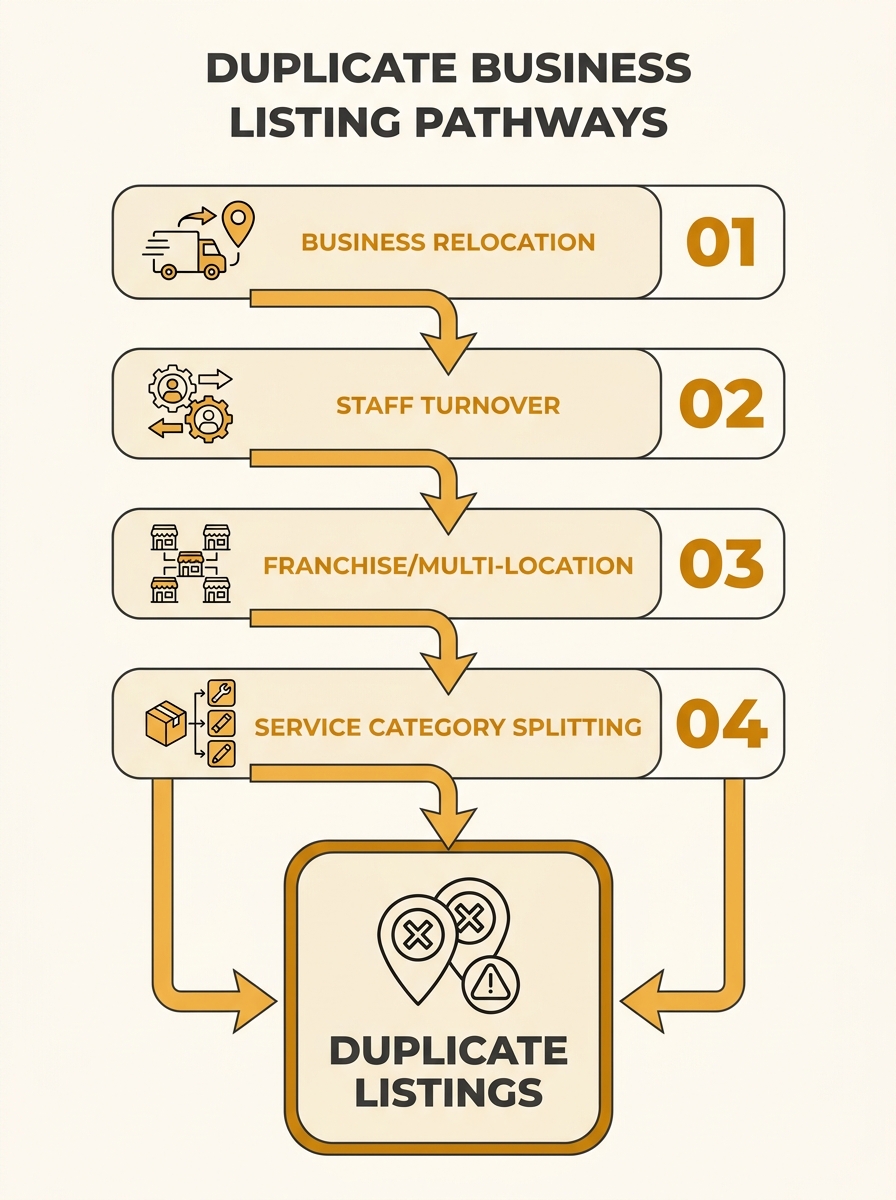
The service-splitting scenario is particularly common among trades and professional services in Australia. A plumber creates one profile for “Emergency Plumbing” and another for “Bathroom Renovations,” thinking this will capture more search traffic. Google’s guidelines explicitly prohibit this approach. The result can be suspension of both profiles, which is worse than having neither rank well.
The Ranking Damage When Multiple Business Profiles Compete
Google’s local ranking algorithm weighs three primary factors: relevance, distance, and prominence. When a business carries a duplicate Google Business Profile in Australia, it fractures the signals that feed all three.
Reviews split across two profiles instead of consolidating into one. A business with 45 reviews on its primary profile and 12 on a forgotten duplicate would rank better with all 57 reviews on a single listing. As one Australian SEO guide documents, moving from 5 to 30 reviews over two months typically produces a visible ranking shift within that same window. Spreading those reviews across duplicates dilutes the effect entirely.
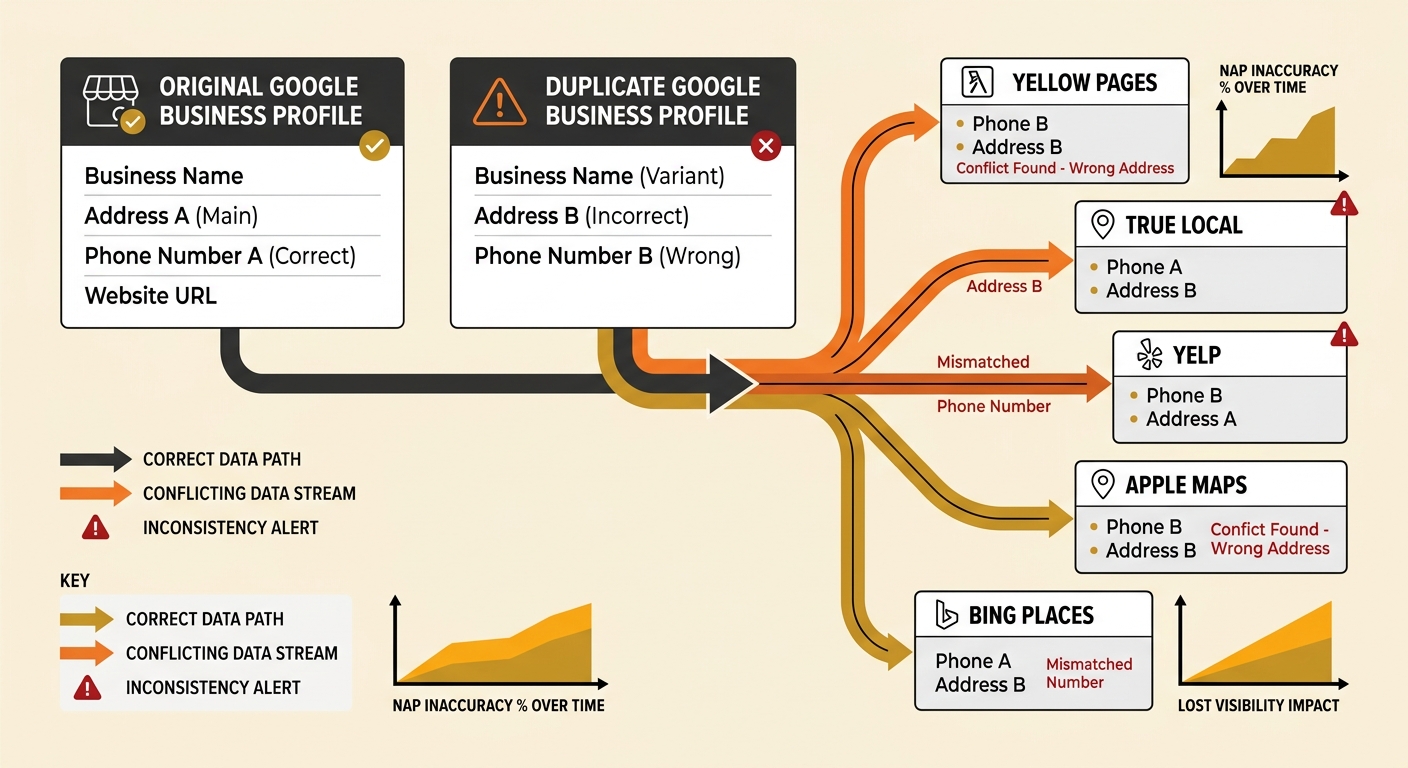
Citation signals get confused. When directory A lists your phone number as the one from your old profile, and directory B lists the number from your new profile, Google can’t confidently verify which data is correct. This uncertainty suppresses your prominence score, which directly affects where you appear in the local pack.
Having more than one profile for the same location confuses Google and can actually hurt your ranking.
That observation, from Creative Warrior’s Google Maps ranking guide, captures the core issue cleanly. The multiple business profiles rankings impact compounds over time because each additional month of conflicting data gives Google less reason to trust any single version of your business information.
We’ve covered the importance of citation consistency as a foundation for local SEO previously, and duplicate profiles are the single fastest way to undermine that foundation. Every duplicate creates a cascade of inconsistent Name, Address, and Phone number (NAP) data across the web, because aggregators pick up whichever version they find first and propagate it outward.
Finding Your Duplicates Before They Find Your Customers
Running an Australian citation audit doesn’t require expensive software, though tools make the process faster. Here’s the practical sequence.
Search Google Maps Directly
Search for your business name. Then search for your business name plus suburb. Then search for your phone number. Then search for your street address without the business name. Each of these searches can surface profiles you didn’t know existed. Pay attention to listings marked “Permanently closed” or showing outdated information — these still send conflicting signals to Google’s algorithm.
Use Citation Audit Tools
BrightLocal, Moz Local, and Whitespark all offer citation scanning that checks your business details across dozens of directories simultaneously. Citation Builder Pro runs manual audits and cross-references findings from multiple tools, which catches discrepancies that automated scans sometimes miss. If you’re managing more than two locations, automated scanning is worth the investment — manual checking across 50+ directories per location doesn’t scale.
Check Your Google Business Profile Dashboard
Log into Google Business Profile Manager. If you see more than one listing for a single location, you’ve found a duplicate within your own account. If a duplicate exists under a different Google account (created by a former employee, an agency, or a well-meaning family member), you won’t see it here, which is why the Maps search step matters.
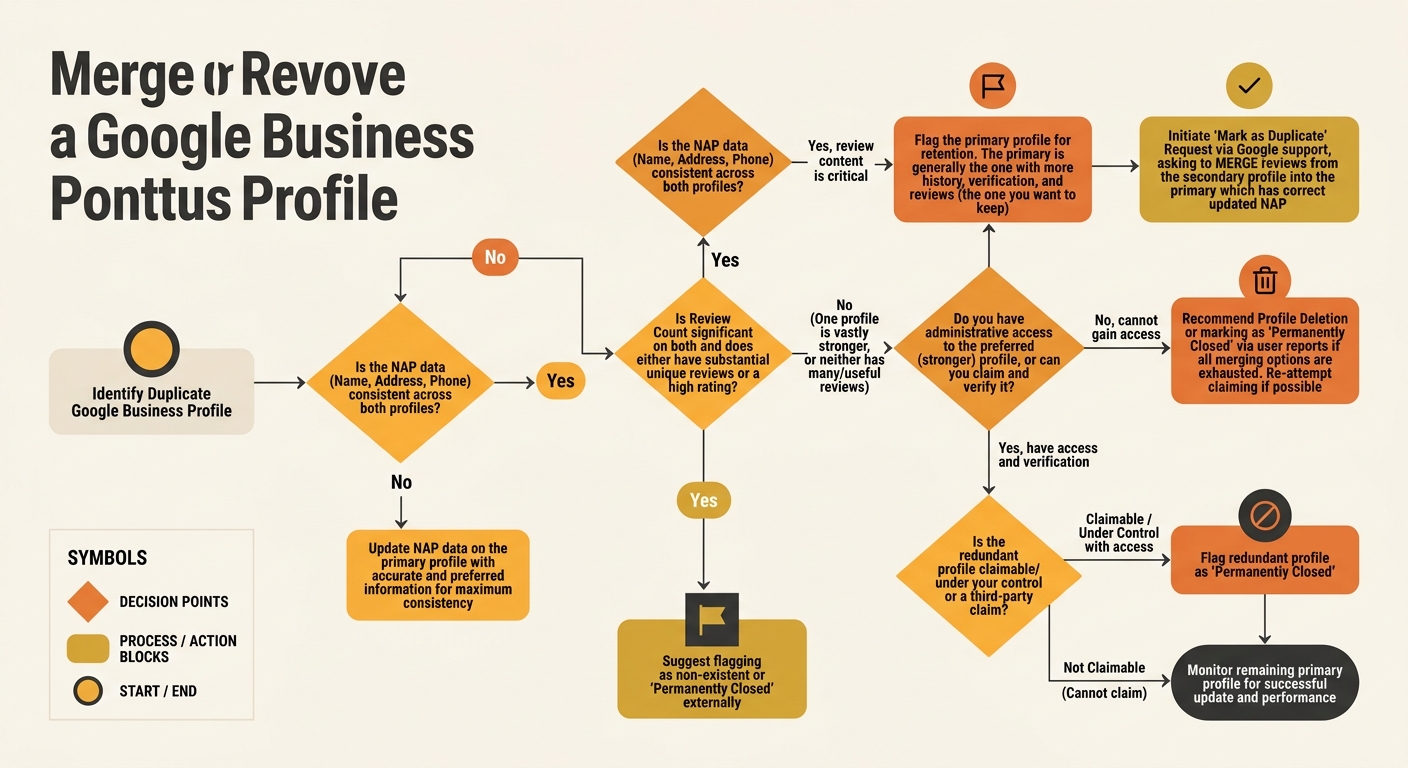
Warning: Never delete a profile that has accumulated reviews and ranking history. Deletion destroys that data permanently. Merging preserves it. Always merge first, delete second — and only delete after confirming the merge has completed.
Local SEO Listing Consolidation: Merge or Remove
Once you’ve identified duplicates, you have two paths. The right choice depends on which profile holds the most value.
If one profile has reviews and the other doesn’t, report the empty duplicate through Google Maps using “Suggest an Edit” followed by “Close or Remove” and then selecting “Duplicate of another place.” Link it to your primary listing. This flags the duplicate for Google’s moderation team, though processing can take several weeks.
If both profiles have reviews, the situation gets more delicate. Google’s merge process is supposed to consolidate reviews into the surviving profile, but the outcome isn’t guaranteed. Document everything — screenshot both profiles, note review counts, save the profile URLs. If the merge doesn’t preserve reviews as expected, this documentation supports your case when contacting Google Business Profile support.
If you’re dealing with a profile you can’t access, you’ll need to go through Google’s ownership request process. This involves verifying your association with the business and waiting for the current owner (or Google) to respond within a set timeframe. For businesses that have gone through a website migration or rebrand, this ownership gap is one of the most common triggers for lingering duplicate profiles.
The consolidation work should extend beyond Google. Any directory where your old or duplicate information lives — Yellow Pages, True Local, Yelp, Bing Places, Apple Maps, industry-specific directories — needs to be updated to match your primary profile’s NAP data exactly. Even variations like “St” versus “Street” or “Ste” versus “Suite” can create enough inconsistency to weaken your citation profile.
Preventing Duplicates From Coming Back
Cleaning up duplicates is reactive work. Preventing them requires a few structural habits, particularly for businesses with multiple team members or locations.
Designate one person as the owner of all Google Business Profile access. Use a shared business email address, not a personal Gmail account. Document this in your operations manual — the same way you’d document who holds the keys to the building.
When your business changes address, phone number, or trading name, update the existing profile. Don’t create a new one. This applies to directory listings too. A structured approach to auditing your site’s navigation and URL setup helps catch mismatches between what your website says and what your profiles say, which is a secondary source of duplicate-generating confusion.
Set a calendar reminder for citation audits every three to six months. The three-to-six-month window aligns with how long it takes for citation authority to build and stabilise across Australian directories. Catching a new duplicate at the three-month mark is manageable. Discovering one that’s been live for two years, accumulating its own reviews and conflicting data, is a significantly larger problem. Google’s willingness to crack down on spam and policy-violating profiles means that unmanaged duplicates also carry suspension risk for your legitimate listing.
For multi-location businesses, create an internal style guide for local SEO. Specify the exact format for your business name (including capitalisation and punctuation), the approved phone number format, the exact address string to use. Distribute this to every franchisee, every agency partner, every staff member who might interact with a directory.
What The Data Doesn’t Tell Us
The 80% customer trust figure gets cited widely, but the underlying research doesn’t break down how that trust loss translates into revenue for specific business types or regions. An accounting firm in Parramatta losing trust likely has a different financial impact than a café in Fremantle. The data tells us the direction — inconsistency costs money — without quantifying how much, for whom, and how quickly.
Similarly, Google’s algorithm weighting for duplicate profile signals remains opaque. We know duplicates hurt rankings, and we can observe the recovery when duplicates get resolved, but the exact mechanism and magnitude aren’t published. Whether a duplicate suppresses your ranking by 10% or 40% depends on variables that no external tool can measure with confidence, including how long the duplicate has existed, how much conflicting data it has generated across the web, and whether Google has already flagged your business category as prone to spam.
What the data does support clearly is that local SEO listing consolidation produces measurable ranking improvements within weeks for review-related signals, and within three to six months for broader citation authority. The businesses that maintain a clean, single profile and monitor it regularly tend to hold their local pack positions more consistently than those who treat their Google Business Profile as a set-and-forget asset. Whether the next Google spam update or algorithm refresh will increase the penalty for duplicates remains an open question — but the trend over the past two years has moved firmly toward stricter enforcement.