

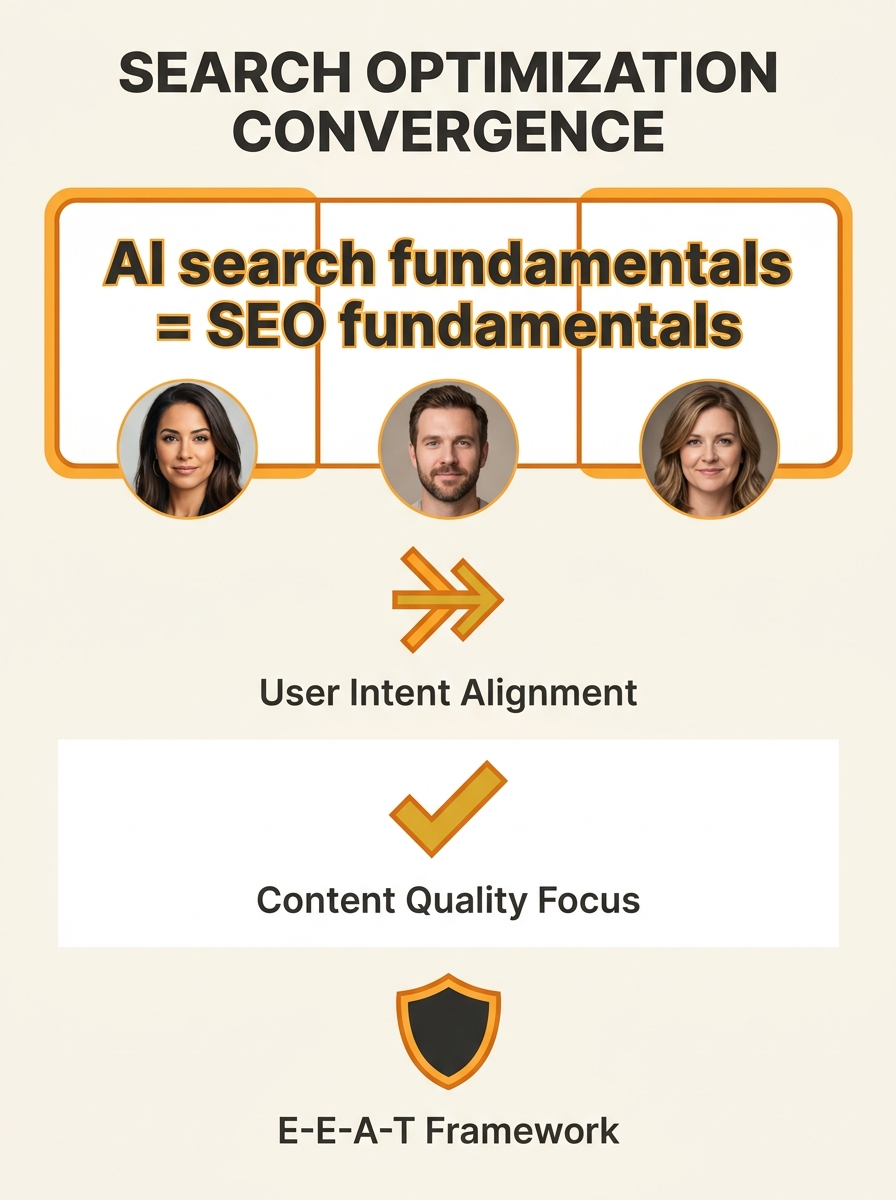
Three search marketing practitioners published converging statements within days of each other in early August 2026 arguing that the industry debate over naming AI search optimization misses a simpler point: traditional SEO fundamentals already prepare websites for AI search platforms, according to posts on No Hacks and related podcasts. Technical SEO consultant Jono Alderson told the No Hacks podcast that “SEO vs. GEO is the wrong question,” while strategist Mordy Oberstein said “SEO isn’t dead, strategy is dead” in conversation with Brent Csutoras.
TL;DR: Three practitioners say the SEO industry’s debate over whether to call AI search work “GEO” or “AEO” distracts from the reality that traditional optimization fundamentals already train websites for AI platforms.
Practitioners Converge on Fundamentals Argument
Alderson, who appeared on the No Hacks podcast in late July, argued that AI search does not constitute a new discipline requiring separate training, according to the August 7 post. Ross Hudgens warned marketers against branding themselves as “SEO/GEO writers” in statements published the same week.
The three practitioners reached the same conclusion from different starting points, the post noted. When independent voices converge on a shared position within a narrow time window, it typically signals that an industry conversation has become more about positioning than substance.
The core argument centers on a decade of Google guidance that already emphasized entity clarity, site health, and off-site presence consistency—fundamentals that AI language models reward through the same mechanisms that benefited traditional search rankings, according to the analysis.
Off-Site Entity Consistency Gains Importance
One element has shifted in emphasis: off-site entity optimization now matters more than it did under purely algorithmic ranking systems, according to the post. Language models assemble their understanding of a brand from every readable source, not from homepage content alone.
Whether that shift feels new depends entirely on what an organization’s SEO marketing prioritized in the first place, the analysis stated. Businesses that focused on content volume or temporary ranking tactics face a larger adjustment than those that maintained entity consistency and off-site presence as core practices.
The naming debate—whether to call the work GEO (Generative Engine Optimization), AEO (AI Engine Optimization), or something else—occupies energy that could address the underlying question of whether fundamentals were in place to begin with, the post argued.
Testing What Models Already Know
The practical recommendation shifts focus from category prompts to entity interrogation, according to the post. Most businesses test AI visibility by typing category searches such as “best CRM for small teams” and checking whether their brand appears. That approach reveals one ranking on one phrasing.
A more useful test involves prompting the language model directly about the brand and observing which sources it cites to construct its answer, the post stated. That interrogation produces a map of the exact pages and off-site profiles shaping the model’s understanding—information that can guide SEO consultation priorities.
The same machine that reads a website to answer a user question will increasingly act on that information and execute transactions, according to the analysis. Ensuring language models hold an accurate account of a business creates groundwork for agent-driven commerce beyond search visibility alone.
The post connects to broader patterns in how AI search engines depend on traditional SEO infrastructure and why topical authority now outweighs isolated keyword targeting.
Why This Matters Now
Australian SMEs evaluating whether to invest in separate “AI search optimization” services face a strategic choice: pursue new acronyms or audit whether their existing SEO addressed fundamentals in the first place. The practitioner convergence suggests the latter determines outcomes more than the former.
The timing matters because businesses that skipped entity consistency work now face catch-up investment at the same moment language models are becoming primary search interfaces. Organizations that maintained off-site presence hygiene and structural clarity already have the foundation AI platforms reward—no rebranding required.
For marketing managers assessing agency proposals or internal priorities, the convergence offers a filter: recommendations focused on naming the discipline or chasing new tactics signal shallow adaptation, while recommendations focused on entity accuracy, off-site consistency, and testing what models already believe signal understanding of what actually changed and what didn’t.