

AI search platforms now synthesize recommendations on behalf of users rather than presenting ranked lists of options, according to Kris Jones, founder of digital agency LSEO, in a podcast episode published August 3, 2026 by Search Engine Journal. Jones, who built and sold affiliate network Pepper Jam before launching LSEO, said the shift moves buyers closer to purchase decisions without encountering businesses excluded from AI-generated answers.
TL;DR: AI search engines now compare options and recommend solutions directly to users, making third-party brand mentions the primary determinant of whether a business appears in synthesized answers.
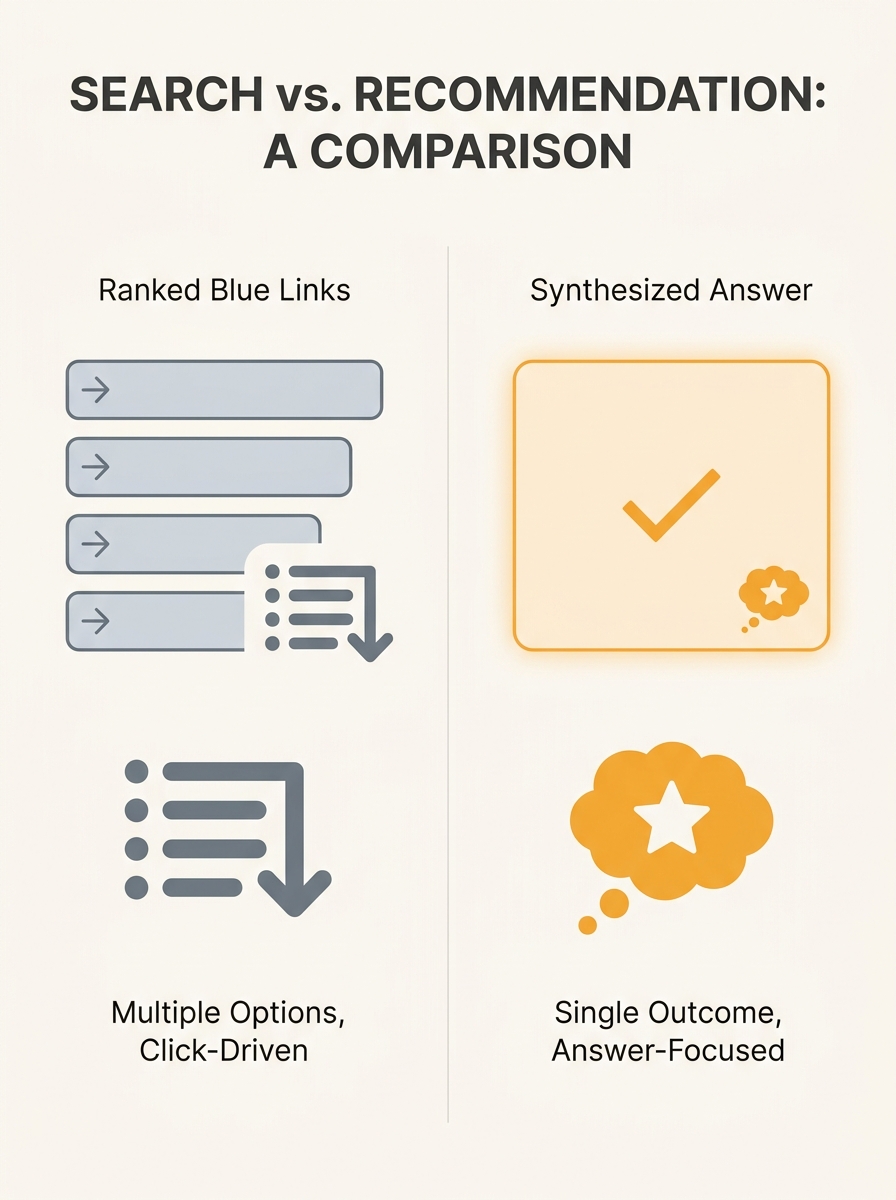
Jones identified “synthesis” as the single factor determining which brands AI systems recommend. Traditional search engines delivered ranked results and left comparison work to users, he said, while AI platforms evaluate sources, weigh options, and present conclusions. “Traditional search basically worked to provide you with options to answer your question. You’re required to do the synthesis,” Jones said in the episode. “Whereas with AI, AI changed the game by doing the synthesis.”
The change repositions the buyer journey. Users receiving AI-generated recommendations arrive at businesses already advised, according to Jones. Businesses excluded from the synthesis step lose visibility entirely rather than appearing lower in rankings.
Third-Party Brand Signals Determine Inclusion
AI recommendation systems draw primarily from brand signals published on third-party websites rather than from company-controlled content, Jones said. The raw material for AI-generated answers sits on domains businesses do not own, including news coverage, industry publications, review platforms, and comparison articles.
Jones estimated that 70 to 80 percent of AI search optimization relies on fundamental SEO practices, with the remainder covering third-party brand-building work. He advised marketers against dismissing existing search programs. “Do not fire your SEO company,” Jones said, characterizing AI optimization as an additional layer rather than a replacement for traditional search work.
The finding aligns with prior analysis showing AI search engines still depend on traditional SEO infrastructure to surface and evaluate content. Jones argued that Google’s multi-year emphasis on structured markup, featured snippets, and authoritative content trained the models now powering AI recommendations.
Industry Awards and Comparison Coverage Carry Weight
Jones identified third-party awards and recognitions as immediately accessible sources of brand signals. Many marketers dismiss industry awards as pay-to-play programs with predictable winners, he said, but those winning businesses appear consistently in AI recommendations. “Those are the companies that are showing up in the AI recommendations,” Jones said when asked about award programs.
Comparison articles published by established industry publications function similarly, Jones said. When an authoritative site in a category publishes a roundup of top platforms or service providers, AI models treat the piece as a credible source for later synthesis. Jones distinguished independent third-party coverage from self-published “best of” content, calling the latter spam.
The emphasis on third-party sources parallels research showing software companies’ own comparison pages drive 69 percent of Google AI recommendations to competitors when those pages mention rival products.
Brand Messaging Consistency Replaces NAP Discipline
The accuracy and consistency of brand information across third-party mentions now matters as much as name-address-phone (NAP) consistency mattered in early local SEO, according to Jones. AI systems answering customer questions directly pull pricing, product descriptions, and service details from multiple sources, raising the cost of outdated information remaining online.
Jones provided an example of an adult education chain whose Google AI Overviews displayed tuition figures pulled from a decade-old Reddit thread. The AI-generated pricing was approximately 30 percent below current rates. Prospective students called confused or annoyed about apparent price increases that had not occurred, Jones said. The issue required publishing accurate current information across enough credible sources that AI models found multiple corroborating data points instead of relying on stale forum posts.
The pattern extends beyond pricing. Jones said businesses need to audit what third-party sites say about product capabilities, service areas, and brand positioning, then address inconsistencies through earned media rather than by attempting to control external content directly.
What Happens Next
Australian businesses evaluating AI search strategies face a resource allocation question. Jones’s 70-to-80-percent estimate suggests most existing search budgets remain relevant, with the incremental work concentrated in earned media and third-party relationship building. The shift does not require abandoning current programs.
The immediate tactic available to most businesses is applying for every credible industry award and pursuing inclusion in authoritative comparison coverage. Jones’s recommendation contradicts common marketing instincts that dismiss these programs as low-value, but the data he cited connects them directly to AI recommendation outcomes.
Measurement remains difficult. Jones advised checking multiple AI platforms beyond ChatGPT and Google, noting that click rates from conversational search tools baseline lower than traditional search traffic. The goal is recommendation share rather than click volume, a metric current AI search measurement tools do not yet track systematically.